Capgemini and Efma publish an annual report on Retail Banking that highlights points of view of banking customers and banking executives from around the world on FinTech.
Capgemini, one of the world’s foremost providers of consulting, technology and outsourcing services, and Efma, specialized in delivering information via publications and conferences, have recently published an annual report on Retail Banking, based on the results of a global survey of 16,000 retail banking customers in 32 countries, and interviews with banking executives from around the world.
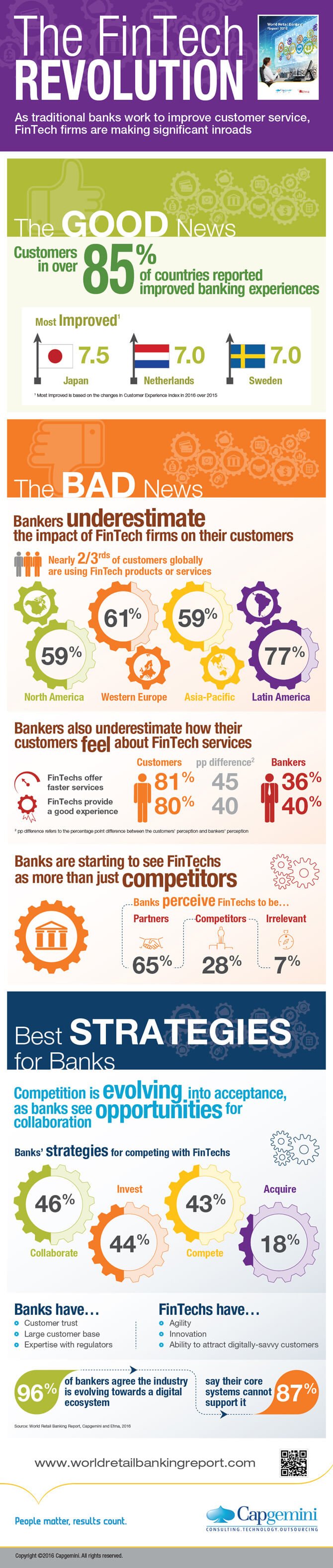
The report found that people using FinTech products or services are more likely to refer their Fintech provider (55%) to a friend than their primary bank (38%). FinTech providers are viewed as easy to use and provide a good user experience in contrast to their incumbent banking counterparts (check the video below). 82% of customers said that a primary value proposition of FinTech products is that they are easy to use, 81% said faster service, and 80% said good customer experiences. Banks have largely focused resources on compliance and cost cutting instead of user experience which explains the discrepancy in customers’ willingness to refer.
46% of banks plan to collaborate with FinTech providers, but only 13% believe their core systems can handle the technical demands of partnerships. Many financial institutions believe partnering with FinTech providers is the best way to avoid disruption. However, implementing new technologies proves difficult due to the incompatibility of banks’ legacy systems and Fintech new digital models.
“The inability of banks to innovate leaves the door wide open for fintech providers to attract new customers,” said Anirban Bose, Head of Global banking and Financial services, Capgemini. “There is opportunity for banks to begin working collaboratively with these companies, but they must formulate a rapid response plan to do so before the swiftly evolving bank environment outpaces their window for change.”
According to the report, Turkey (83%), Portugal (81%), Argentina (80%), Mexico (78%) and India (77%) have the highest fintech adoption rates. The global average across regions was 63% (for the fulle details check the infographic below).
67% of customers in North America have complete trust and confidence in their bank — the highest of any region. While only 51% of Western European customers feel the same, having the least trust of any region. Customers in Western Europe are also least likely to trust FinTech providers, suggesting a general distrust of financial services providers.
The survey defined FinTech as “the use of digital technologies for making the traditional financial products/services more efficient. This includes both, digital technologies that are provided either as completely new and standalone services to consumers or those which support/enable the traditional banking and financial services.