
The crypto market slides amid growing uncertainty. Let’s explore the key trends and events on Nov. 12.
At the current moment, Ethereum (ETH) is priced at $3,550, down roughly 0.78% over the past 24 hours. Over the last week, the cryptocurrency has fluctuated between $3,216 and $3,633. This marks a 13% decline over the past month.

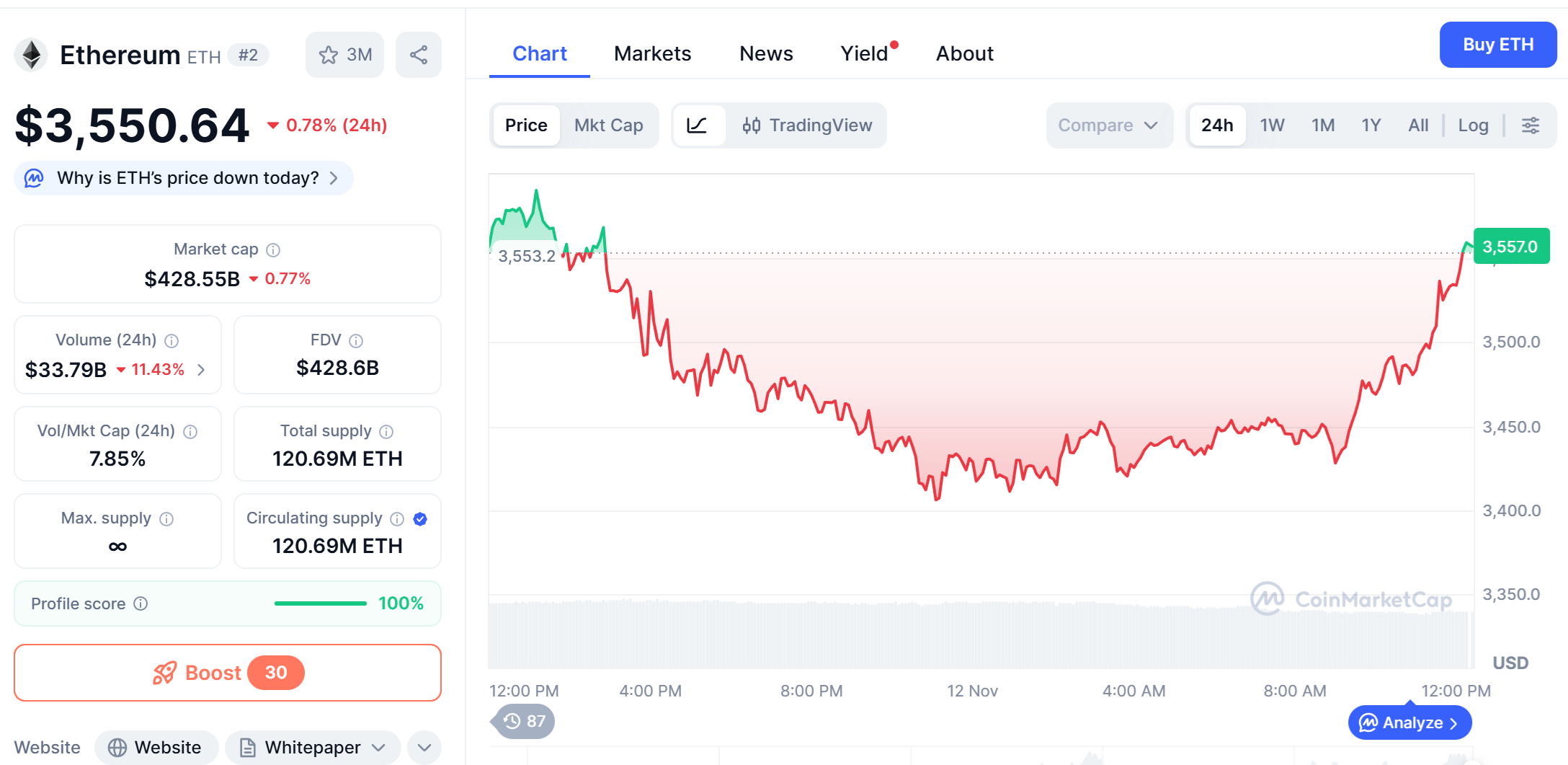
Trading activity has eased. Ethereum’s 24-hour trading volume fell by almost 12%. CoinGlass data shows derivatives volume dropping 7.5% to $74.95 billion, while open interest decreased 3.4% to $38.74 billion. The figures point to a cooling market as traders take fewer new positions following recent volatility.
Coinbase Business has officially launched in Singapore.
This new enterprise platform by Coinbase was introduced in June 2025, and Singapore would be the first market outside the US where Coinbase Business will be available.
The platform was designed for startups and small businesses. It enables users to send and receive payments in Coinbase-backed stablecoin USDC, manage digital assets, and automate financial workflows.
BitMEX co-founder Arthur Hayes urged Zcash holders to move their assets off centralized exchanges (CEXs).

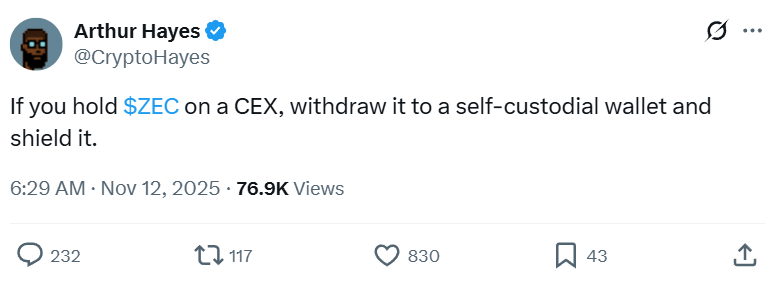
His comments coincided with volatile price movements for ZEC. The token jumped to $723 on Nov. 8, dropped to $504 on Nov. 9, surged again to $677 on Nov. 10, and then fell sharply. Currently, ZEC is trading around $479.
Binance is showing signs of a potential market-wide rally.
Over the past 24 hours, the platform recorded net inflows of $377 million in USDT and $650 million in USDC. In the past seven days, Binance has seen more than $3 billion in combined USDT and USDC inflows.
Historically, stablecoin inflows into centralized exchanges like Binance often precede Bitcoin and altcoin accumulation.
Want to learn more? Read our recent report.
Sonic Labs is unveiling an updated tokenomics model that features a revised fee monetization structure designed to foster a deflationary ecosystem for its native token.
The redesigned framework offers tiered rewards for builders, ranging from 15% to 90% depending on network usage. Validators will receive a fixed 10% allocation. The remaining tokens will be burned, and all transaction fees on the Sonic blockchain will continue to be paid in S tokens.
With incentives for both builders and validators, Sonic aims to stimulate ecosystem growth. At the same time, the token-burning mechanism is expected to reinforce its deflationary economic model.