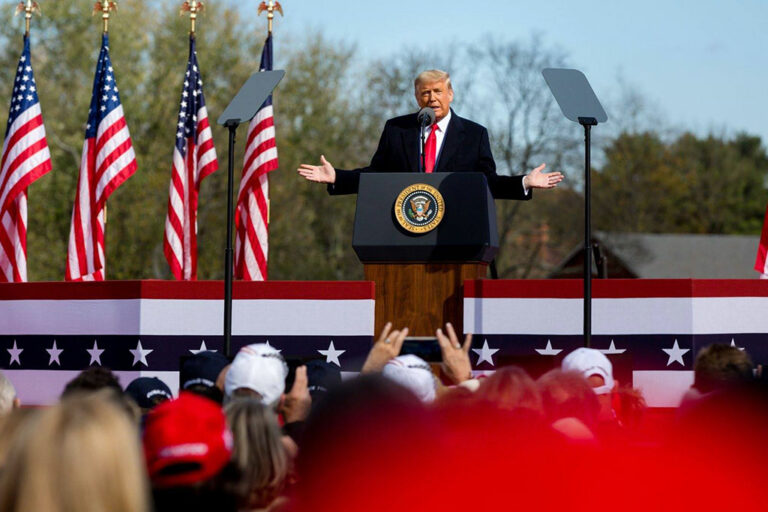
The US Federal Reserve has been exploring the feasibility of a CBDC. This, however, is not a sign that a digital dollar is on the horizon.
Former United States President Donald Trump has stated that he will not allow the creation of a central bank digital currency (CBDC). Trump, who is seeking the Republican presidential nomination said this during a campaign speech in Portsmouth, New Hampshire on Wednesday. He explained that a digital US dollar would give the federal government “absolute control” over citizens’ money.
“Tonight, I am also making another promise to protect Americans from government tyranny,” Trump said. “As your president, I will never allow the creation of a Central Bank Digital Currency. Such a currency would give the federal government, our federal government, absolute control over your money… They could take your money and you wouldn’t even know it was gone.”
Trump added that the creation of a CBDC would be a threat to freedom and that he would stop it from coming to America.
JUST IN: 🇺🇸 Former President Donald Trump says he "will never allow the creation of a central bank digital currency" if elected in 2024. pic.twitter.com/1HyLAPCARJ
— Watcher.Guru (@WatcherGuru) January 18, 2024
The US Federal Reserve has been exploring the feasibility of a CBDC. This, however, is not a sign that a digital dollar is on the horizon. Fed Governor Michelle Bowman commented in October that she has yet to see a compelling argument that a CBDC could solve problems around financial inclusion and frictions within the payment system better than alternatives.
The digital dollar – along with other digital assets such as cryptocurrencies – has been a major talking point for politicians in recent months. Last year, Florida Governor and another contender for the Republican Party nomination, Ron DeSantis vowed to ban CBDCs if elected president. Prior to the launch of his presidential bid in July, DeSantis signed a bill into law in Florida that restricts the use of CBDCs in the state, asserting that they are a threat to financial freedom.
Another Republican aspirant Vivek Ramaswamy, who withdrew from the race on Monday after only managing to secure 8% of the vote in the Iowa Republican caucus, has previously called for a crypto-focused policy framework.
Former United States Securities and Exchange Commission enforcer John Reed Stark commented on the recent attention in crypto from politicians in a post on social media platform X. He opined that crypto “could hold the key to the 2024 presidential election.”
“Every presidential contender should immediately appoint an internal Crypto Czar to serve as the crypto-focal point and crypto-spokesperson for that candidate,” he wrote.
While calling crypto a “mammoth Ponzi scheme”, Stark acknowledged that the “crypto community are extraordinarily passionate and represent a growing and powerful political constituency.”
“Crypto ownership is most akin to an ethos, a lifestyle, a culture, and a worldview, which could […] transform crypto enthusiasts into one-issue voters who could move the election needle dramatically. The stark reality is that above all else, people have always voted with their wallets – and going forward will do so even moreso if their wallets are digital,” added he.
next