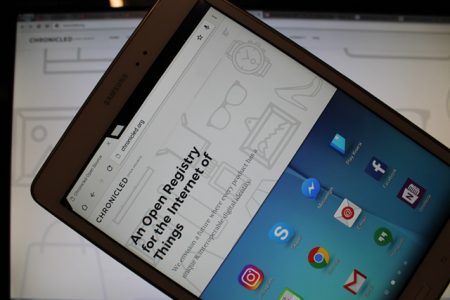
The San Francisco-based blockchain startup announced yesterday that it released an open source tool for registering connected items, including wearables and smart home objects.
Chronicled has announced the launch of a public registry for IoT devices, built on the ethereum blockchain technology. The new registry was designed to store the identities of physical objects, embedded with near-field communication and bluetooth low energy microchips.
The project is expected to increase interoperability among internet connected devices and expand the consumer IoT. Moreover, the registry will make it easier for companies to monetize IoT deployments.
“Chip companies, physical IP creators, and brands can now register and verify their BLE and NFC chips on a public blockchain,” said Ryan Orr, Chronicled CEO, in a press release. “These tamperproof chips can be ordered today and are already being deployed in consumer goods.”
The company has already deployed about 10,000 NFC and BLE chips. Initially, the chips were used in wearables, mainly sneakers, security items and smart home devices, but the startup is planning to deploy them in other consumer products.
The IoT industry is growing at a fast pace now. We’ve observed a number of new projects lately, including Intel’s atom-powered Joule module and Onion’s Omega 2 mini computer.
A recent report by Gartner says smart home devices is among the technologies that will dominate in the near future. Mike J. Walker, research director at Gartner, noted the companies should drive innovation and continue working on new emerging technologies.
According to Daniel Cooley, Senior Vice President of IoT Products at Silicon Labs, lack of interoperability remains the main factor slowing down the growth of the consumer IoT market. “By putting IoT chip registrations into private databases, today every brand is creating the equivalent of its own private cellular phone network or its own private email system that is not interoperable with any other network,” he said.
“We are excited that our Bluetooth low energy chip customers now have the opportunity to register and verify their chips on a public blockchain. This interoperable back end is a valuable building block and positive step for the entire IoT ecosystem including app developers, brands and consumers alike.”
As Chronicled’s CTO Maurizio Greco noted, the open source tools will allow developers to “associate chips with physical products and build apps with smartphone scan and authentication functionalities.”
Meantime, Ethereum creator, Vitalik Buteri, commented: “Consumer IoT has always been one of the areas of blockchain adoption that I have been most bullish about, and I am excited to see Chronicled’s efforts in pushing IoT authentication use cases a step further.”
The new project will enable brands and businesses to better communicate with their clients. The retailer, for instance, could offer a reward for customers using certain products in real time. Besides, the registry can be used to provide counterfeit protection and verify authenticity.
Chronicled has open sourced the registry under the Apache license. The startup is now collaborating with other IoT startups, such as Silicon Labs, SmartTrac, Blue Bite, Ambisafe, Identiv, Origin Labs, and Cellotape.
next