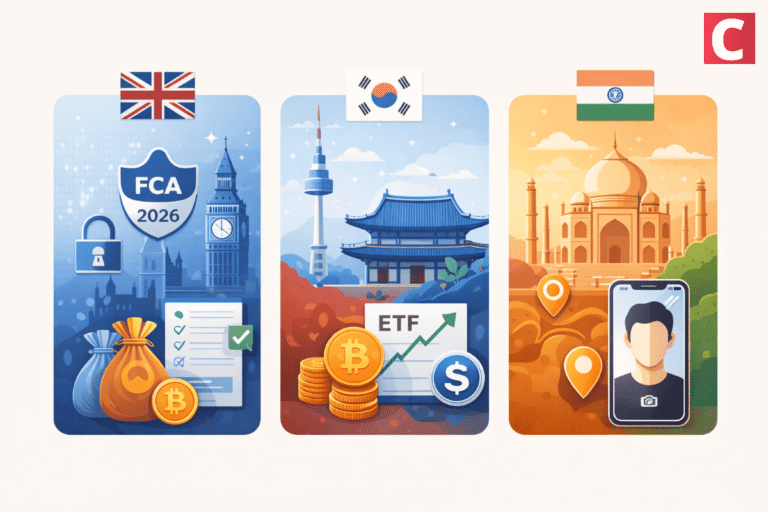
As the world enters 2026, crypto regulations are shifting, with South Korea and India bringing new rules.
As 2026 starts, policymakers around the world are shifting their stance on the cryptocurrency industry. Governments are no longer debating whether crypto should be regulated, but how far control should go.
In the UK, senior lawmakers are calling for a full ban on crypto donations to political parties. According to a Jan. 11 report by The Guardian, chairs from seven parliamentary committees warned that crypto donations make enforcement of political finance rules harder.
Lawmakers argue that even with blockchain records, identifying the true source of funds remains difficult, especially when donations move through wallets or overseas platforms.
The move comes as the UK moves closer to implementing a comprehensive crypto regulation. Parliament passed a law in December recognizing digital assets as property. The government plans to regulate crypto like other financial products by 2027.
The Financial Conduct Authority is also working on rules covering stablecoins, exchanges, lending, and staking, with rollout expected later this year.
South Korea Reopens Crypto to Corporations
Meanwhile, South Korea’s Financial Services Commission is reportedly preparing new guidelines that would allow corporations to invest in cryptocurrencies for the first time since 2017.
According to a local exclusive report, listed companies and professional investors would be allowed to allocate up to 5% of their equity capital to crypto. Investments would be limited to the top 20 cryptocurrencies by market cap and restricted to five regulated exchanges.
The inclusion of US dollar stablecoins like USDT USDT $1.00 24h volatility: 0.0% Market cap: $183.55 B Vol. 24h: $72.74 B is still under review. A senior FSC official said final guidelines could be released as early as January or February.
The shift, which reverses a nine-year ban imposed over money laundering concerns, could unlock large capital flows. Local estimates suggest firms like Naver, with $18.4 billion in equity, could invest major sums into crypto.
The policy shift may also accelerate plans for a national stablecoin and spot Bitcoin BTC $67 424 24h volatility: 0.9% Market cap: $1.35 T Vol. 24h: $44.68 B ETFs. Last week, South Korea already announced its goal to run 25% of treasury transactions through a CBDC by 2030.
India Tightens Surveillance on Crypto Users
In South Asia, India’s Financial Intelligence Unit announced last week new rules requiring crypto exchanges to conduct stricter identity checks. Users must now verify accounts using a live selfie with blinking, along with recorded GPS location, IP address, date, and time.
The rules ban platforms from supporting ICOs and from using mixers or tumblers that hide transaction trails. All exchanges must register with the FIU, report suspicious activity, and store user data for five years.
India keeps a cautious stance on cryptocurrencies and treats them as virtual digital assets.
next