Tether’s USDT growth has slowed sharply, signaling caution for the crypto market as liquidity cools.
The demand for Tether’s USDT stablecoin has slowed down significantly in January 2026.
Market experts believe that these concerns exist for the crypto market as the stalling USDT growth could put the brakes on future Bitcoin BTC $68 277 24h volatility: 0.8% Market cap: $1.36 T Vol. 24h: $44.77 B price rally.
Tether USDT’s Circulating Supply Drops Sharply, Which Could Impact the Crypto Market
CryptoQuant data shows that Tether’s circulating supply is experiencing a sharp slowdown, signaling slower growth in stablecoin liquidity.
Historically, such slowdowns in USDT issuance can influence overall crypto market momentum.
The 60-day average of USDT market cap changes indicates that Tether’s expansion has declined significantly since late November 2025.
During this period, growth dropped from $15 billion to $3.3 billion. The slowdown could be temporary, however, as market experts still believe that stablecoin payments flow would reach $56 trillion by 2030.
Comparing this to Bitcoin’s price action reveals a familiar pattern from previous cycles.
Rapid increases in USDT market capitalization often coincided with Bitcoin rallies, showing higher liquidity entering the market.
When that liquidity growth slowed, Bitcoin usually entered a consolidation phase and, in some cases, moved into a downtrend.
So far, the 60-day market cap change metric has not yet turned negative. However, CryptoQuant noted that the 60-day market cap change metric has not yet turned negative.

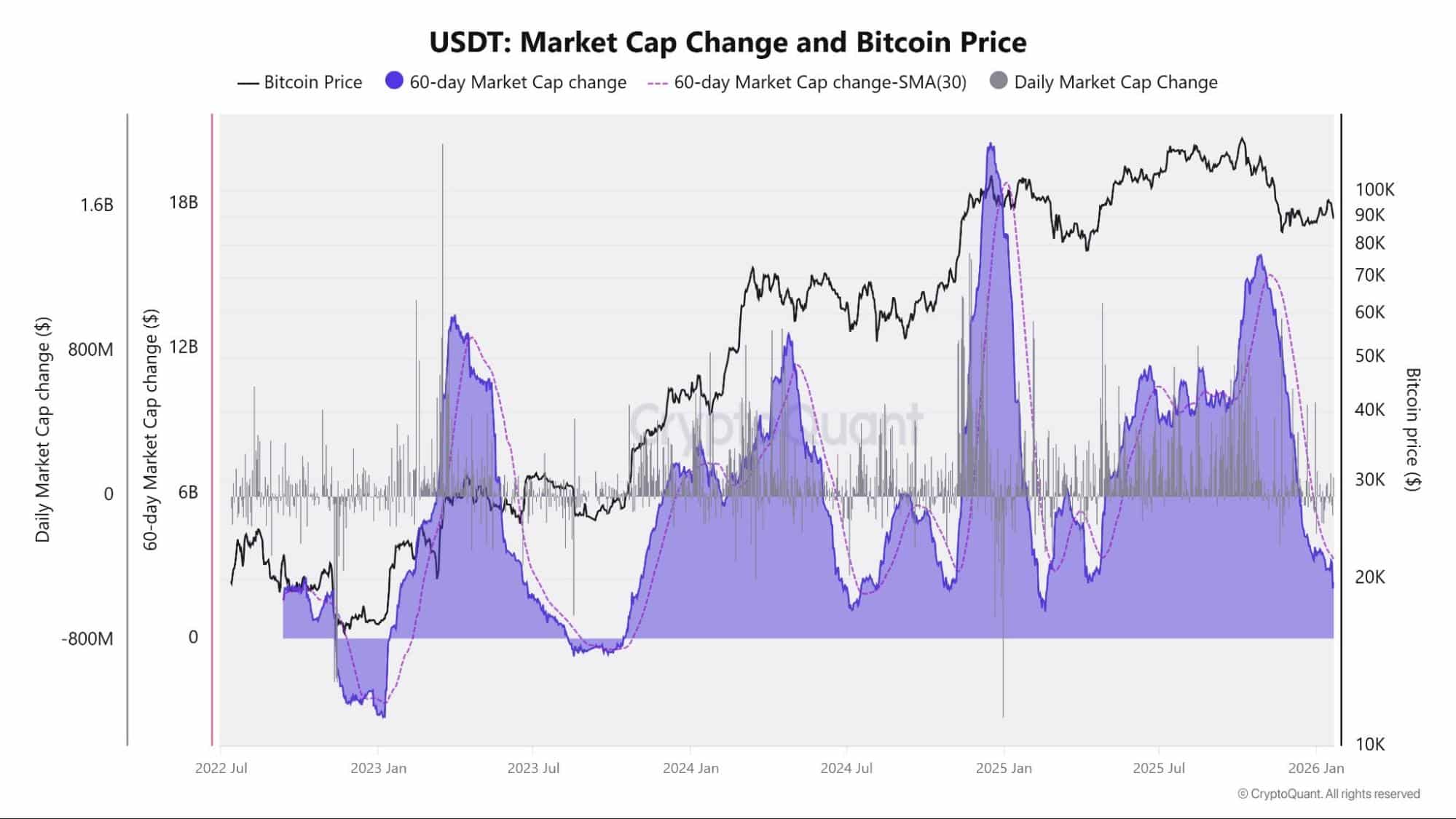
Market Cap Change and Bitcoin Price. | Source: CryptoQuant
One notable development is the decline in USDT market capitalization on Ethereum ETH $2 016 24h volatility: 2.5% Market cap: $242.18 B Vol. 24h: $22.30 B over the past month.
During the same period, USDT has traded consistently below $1. CryptoQuant noted this isn’t a depegging event, but the combination of falling supply and sub-$1 pricing points to capital outflows.
This indicates that stablecoin holders are choosing to exit rather than deploy their crypto into new positions.
CryptoQuant also highlighted Tether Treasury’s recent burn of 3 billion USDT, the first since May last year, marking the largest USDT burn in the past three years.
USDT Burn Signals Caution as Stablecoin Outflows Rise
Some market participants see the burn as a cautious signal from large holders amid rising macro uncertainty and geopolitical risks.
USDT is removed from circulation when investors redeem the stablecoin for US dollars, prompting Tether to burn the corresponding amount.
If outflows accelerate, the stablecoin market’s two-month plateau near $308 billion in total capitalization could break and move into a corrective phase.
Such a shift could increase the risk of a broader downturn in crypto.
However, Tether has an unusual buyer: Iran’s central bank, which bought $507 million in USDT to bypass US sanctions and help stabilize the rial.
next