Ethereum co-founder Vitalik Buterin has raised red flags over Sam Altman’s Worldcoin project, arguing that its one-person-one-ID model threatens the core pseudonymity of crypto culture.
Ethereum co-founder Vitalik Buterin has sounded a cautionary note on Sam Altman’s digital identity project, World, warning that its one-human-one-ID model could break down a key pillar of internet and crypto culture: pseudonymity.
World, formerly known as Worldcoin, has recently surged in adoption, claiming over 13 million verified “unique humans” via its controversial Orb-based iris-scanning technology.
Created by Tools for Humanity — co-founded by OpenAI’s Sam Altman and CEO Alex Blania — the project distributes a crypto token called WLD to users in exchange for biometric verification.
Buterin acknowledges the technical merits of the system, which uses zero-knowledge (ZK) proofs to preserve privacy. Still, he believes the broader implications could be troubling.
Someone seems to be launching a smear campaign against Worldcoin. I’m not trying to endorse them, but this kind of behaviour is exactly why the ecosystem struggles move forward.
Vitalik recently published a post highlighting the importance of pluralistic identity systems. He… pic.twitter.com/Vwnmw9Y6jJ
— Kim ⚡️ (@0xKimberly) June 28, 2025
The Trade-Off Between Security and Privacy
In a post released Saturday, Buterin praised the potential of ZK-wrapped ID systems to combat the growing problem of bots and sybil attacks, especially in an AI-dominated internet era.
World promises to create a safer, more human internet by allowing users to distinguish real people from AI-generated profiles.
However, Buterin warns that World’s rigid implementation risks wiping out pseudonymity. If every verified user is limited to a single ID, even if ZK-wrapped, it may force all online activity to fall under a single, publicly known persona.
In the digital asset space, multiple wallets, usernames, and pseudonyms form the norm, offering privacy and protection in an age of surveillance and geopolitical risk.
He argues instead for a pluralistic identity model, where no single issuer or structure dominates the landscape. Buterin believes that a diverse ecosystem of weak and strong IDs would better balance user freedom, privacy, and trust.
Market Sentiment: Where Does WLD Stand Now?
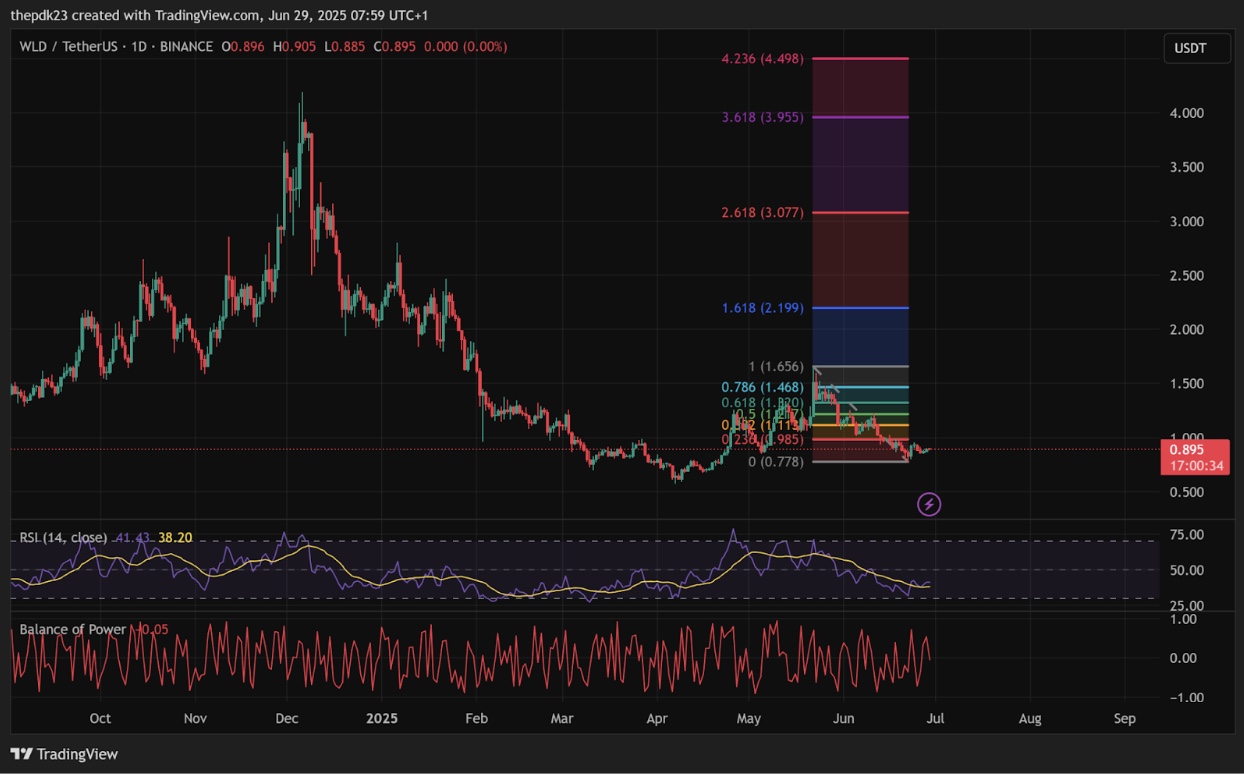
Buterin’s comments arrive as WLD’s price action is attempting to stabilize after a steep decline. The daily chart reveals a bearish structure, but also potential signs of an early accumulation phase.
The recent high at $1.656 and low at $0.778 define the current Fib zone. Price has retraced to the 0.786 level ($1.468) and failed to hold. It’s now hovering around $0.895 — below key support levels, such as 0.618 ($1.280) and 0.5 ($1.217), suggesting short-term bearishness.
If sentiment reverses, reclaiming $1.12 (0.382 Fib) could open a path back to $1.468 and eventually toward higher Fib extensions of 1.618 Fib extension at $2.199, 2.618 Fib extension at $3.077, and 4.236 Fib extension at $4.498.

WLD | Source: TradingView
Meanwhile, the RSI (Relative Strength Index) sits at 41.43 with the signal line at 38.20 — both below the neutral 50 mark, indicating that sellers remain in charge. The BoP reading at -0.05 further confirms that sellers are in charge.
World’s Next Moves: Expansion Amid Scrutiny
Despite criticism, World is pressing ahead. It recently launched in the US and is rolling out a Visa debit card linked to the WLD ecosystem. It also partnered with Tinder in Japan for a pilot program that uses World ID to help users verify they’re interacting with real people on dating platforms.
next