
Celestia, Virtuals, and Optimism were among 2025’s worst-performing tokens. We unpack their steep drops, and what triggered the declines.
The late-year sell-off turned many high-beta tokens red, including BTC $68 889 24h volatility: 3.5% Market cap: $1.38 T Vol. 24h: $41.20 B and ETH $2 051 24h volatility: 5.1% Market cap: $247.59 B Vol. 24h: $19.13 B . Looking at data from aggregators like CoinMarketCap or Coingecko, we see that most of the poor performers have lost around 80% this year. This includes PEPE $0.000004 24h volatility: 4.2% Market cap: $1.62 B Vol. 24h: $281.24 M , once a meme-coin leader that has since lost 79% of its value, along with other high-profile altcoins.

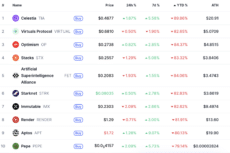
10 worst-performing altcoins in 2025 | Source: CoinMarketCap
In this article, we will take a close look at Celestia (TIA), Optimism (OP), and Artificial Superintelligence Alliance (FET/ASI). Below is a review of how far each altcoin fell in 2025, what drove the moves, and how the market responded.
Celestia (TIA): -90%
TIA $0.34 24h volatility: 7.3% Market cap: $300.72 M Vol. 24h: $55.25 M , a proof-of-stake L1 blockchain optimized for app creation, lost almost 90% year-to-date. According to CMC, it fell from about $5.5 at the start of 2025 to $0.46 near year-end.
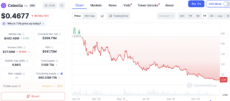
Celestia (TIA) price in 2025 | Source: CoinMarketCap
Mostly, the drop was due to the unlock and overhang dynamics. Celestia’s vesting and 2024–26 unlock cadence kept selling pressure steady in 2025. By summer, TIA was mainly viewed as a textbook post-airdrop unwind. CoinDesk analysts tied its continuing emissions to thin liquidity.
Moreover, in August, Celestia Foundation disclosed it bought back 43.45 million TIA from Polychain (around $62.5 million at the time). The move was meant to steady the token supply, but instead spotlighted investor selling. The post on X quickly provoked a reaction from the crypto community.
“This is a new level of grift tbh. Translation: We will now take $TIA tokens from one investor who was dumping and give it to another investor who will dump later on,” wrote user nicknamed Mirza.
The Celestia Foundation has worked with Polychain Capital to assign Polychain’s entire remaining TIA holdings to new investors.
This month, the Foundation purchased 43,451,616.09 TIA from Polychain Capital for $62.5m. Polychain will shortly be undelegating their entire staked…
— Celestia (@celestia) July 24, 2025
Another major problem was weak fee capture and utilization optics. Independent on-chain analyses repeatedly highlighted very low data utilization and fee revenue (circa $60/day earlier in 2025). This reinforced a valuation vs. usage gap. According to Chain Catcher, the network could generate about $5.2 million in annual fee revenue if used correctly.
Optimism (OP): -84%
OP $0.19 24h volatility: 5.8% Market cap: $405.97 M Vol. 24h: $43.32 M , a popular layer-2 blockchain on top of Ethereum, lost 84.5% year-to-date. It fell from $2.06 at the start of 2025 to $0.27 in late December, per CMC.
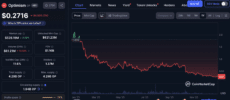
Optimism (OP) price in 2025 | Source: CoinMarketCap
As with Celestia, persistent unlocks worked poorly for Optimism. OP faced recurring token unlocks throughout the year: late-May, late-April, and a scheduled Dec. 31 tranche of around $8.6 million. Each of those repeatedly added token supply during weak demand.
According to Tokenomist, large cliff unlocks (single unlocks exceeding $5 million) scheduled over the next 7 days include HYPE, SUI, EIGEN, KMNO, OP, ENA, ZORA, and SVL. Large linear unlocks (daily unlocks exceeding $1 million) over the same period include RAIN, SOL, TRUMP, WLD,… pic.twitter.com/ZBllI1K6lq
— Wu Blockchain (@WuBlockchain) December 29, 2025
L2 competition was a significant headwind, too. Even as Optimism shipped fault-proofs and progressed on the Stage 1 decentralization path in 2024 and 2025, trading still reflected L2 sector fatigue and rotating liquidity. By September, media coverage framed OP as one of the L2 laggards. The slide deepened into Q4.
Artificial Superintelligence Alliance (FET): -84%
ASI Alliance is a collaboration between three major blockchain-based AI projects: SingularityNET, Fetch.ai, and Ocean Protocol. In 2024, when it was founded, it was on the wave of AI hype. However, in 2025, it lost around 84% of its value, from $1.6 to about $0.2.
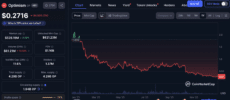
Optimism (OP) price in 2025 | Source: CoinMarketCap
The first problems started in 2024. The multi-token ASI merger (FET, AGIX, OCEAN) did not go smoothly, creating operational noise. Several exchanges supported auto-conversions while Coinbase declined to facilitate migrations, adding uncertainty around flows.
In October 2025, Ocean Protocol exited the ASI Alliance, prompting governance disputes, legal threats, and a drop in the FET price around the time. The ASI board temporarily suspended the conversion bridge while seeking legal advice.
Alignment is vital in any evolving partnership. Transitions are natural.
Ocean Protocol’s exit from the Alliance does not impact the core technology stack – momentum and development remains undiminished within the founding teams. The ASI Alliance remains fully aligned in its… https://t.co/q6FJCWhwax
— Artificial Superintelligence Alliance (@ASI_Alliance) October 9, 2025
In addition, late-2025 risk-off spilled over into AI tokens. According to the latest Coingecko report, AI is not the most profitable crypto narrative anymore. In fact, the crypto AI coins have lost around 50% in price in 2025. What was the most profitable narrative, you may ask? Well, we’re back to the real-world assets (RWA): around +180% in gains.
The Bigger Altcoins Backdrop
Late-2025 macro and cross-market stress (tariff shocks, tight liquidity, tech-led risk aversion) broadly hit crypto, compounding token-specific supply overhangs. End-of-year reviews documented the wholesale risk-off turn and sharp liquidations across digital assets.
However, if you’re interested in more optimistic forecasts, read our summary of crypto moguls’ predictions for 2026.
next