
Bitcoin Reclaims $72K on US-Iran Ceasefire Deal
Bitcoin price is trading near $71,700, up +4% over the past 24 hours after briefly touching $72,753 intraday, its highest print in 20 days – as the US and Iran agreed to a two-week suspension of military hostilities.
The move erased weeks of geopolitical discount baked into price, but the analytical question is whether a temporary ceasefire, not a resolution, is sufficient to sustain a break above the psychological $72,000 threshold that has capped the market since mid-March.
US President Donald Trump announced via Truth Social on Tuesday that he would suspend military action against Iran for two weeks, hours before a deadline he had set for Tehran to reopen the Strait of Hormuz or face strikes on key infrastructure. Iran’s Supreme National Security Council accepted the ceasefire, though it explicitly stated the pause did not constitute an end to the broader conflict – a distinction markets will be forced to reprice if hostilities resume around April 22.
🚨 President Donald J. Trump makes a statement on Iran: pic.twitter.com/9mqTayL0Q3
— The White House (@WhiteHouse) April 7, 2026
Cross-Asset Transmission: Oil Corrects, Equities Bid, BTC Follows Risk-On Flow
The macro transmission mechanism here is straightforward: eased Hormuz disruption risk pulled Brent crude back toward $94 per barrel from elevated levels, relieving inflation expectations and reducing the risk-off pressure that had effectively capped Bitcoin price below $70,000 for nearly two weeks.
S&P 500 and Dow futures moved higher in tandem, confirming this was a broad risk-on bid rather than a crypto-specific or safe-haven move.

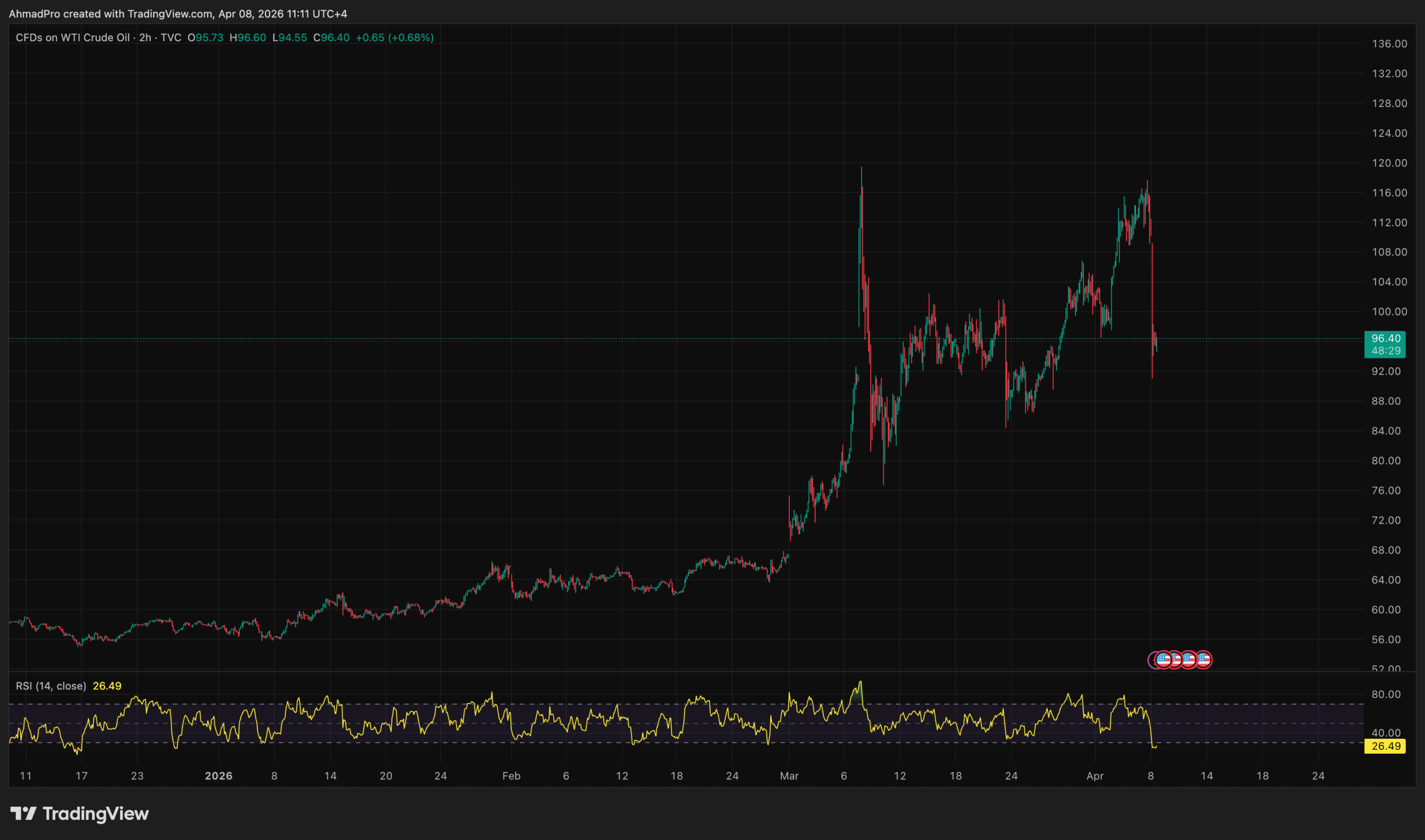
Source: Tradingview
As Bitcoin’s correlation with macro risk assets has deepened through the Iran conflict, the ceasefire announcement functioned as a simultaneous trigger across asset classes. Riya Sehgal of Delta Exchange noted that the rally’s durability remains uncertain, characterizing Bitcoin as trading as “a high-beta macro asset, sensitive to liquidity, rate expectations, and geopolitical stability.”
The CoinSwitch Markets Desk projected a move toward $75,000 if momentum holds, while flagging $68,000 as near-term support. Analysts broadly described the move as a classic short squeeze layered on a geopolitical relief trade – approximately $400 million in short positions were liquidated in the eight hours following Trump’s announcement, with an additional $270 million unwound in the surrounding 24-hour window.
The broader crypto market cap reached $2.52 trillion at the peak. Ethereum, Solana, XRP, and Dogecoin all posted gains alongside BTC, consistent with a broad risk-appetite recovery rather than Bitcoin-specific accumulation.
DISCOVER: Meme coin supercycle: Top performers this week
Can Bitcoin Price Hold $72,000 After the Ceasefire Rally?
The technical setup entering Tuesday’s session had Bitcoin price range-bound between $66,000 and $70,200 for most of Q1 2026, with the Strait of Hormuz disruptions serving as a persistent ceiling on risk appetite.
The $70,000 level had functioned as a line in the sand for nearly two weeks before the ceasefire announcement cleared it. The Crypto Fear & Greed Index posted an extreme fear reading of 11 on Tuesday, suggesting the market was heavily underpositioned heading into the rally, which partly explains the scale of short liquidations.
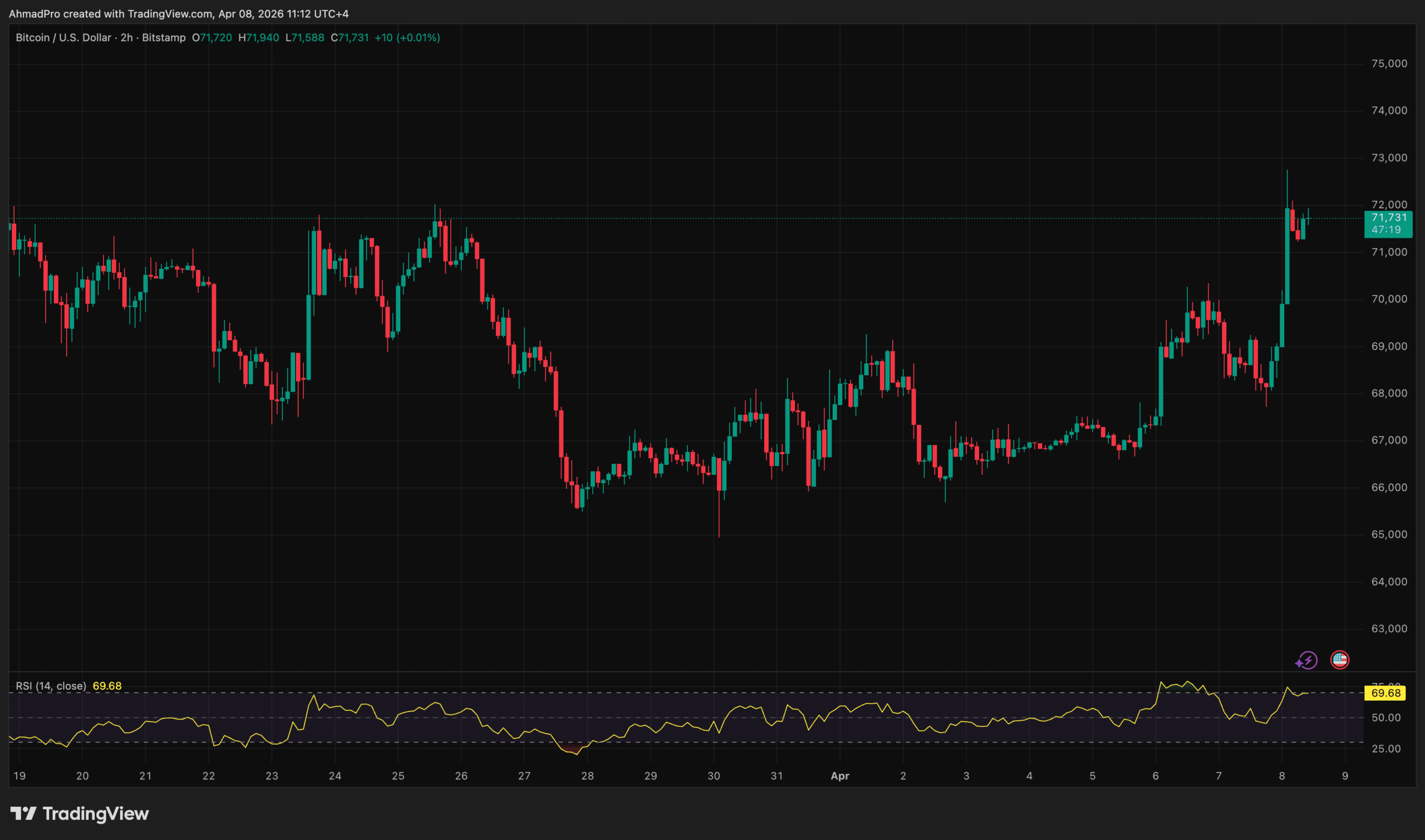
Source: BTCUSD / Tradingview
Bull case: Iran’s compliance with Hormuz reopening holds through the two-week window, oil stabilizes below $95, and ETF inflows sustain above $400 million per week. Under this scenario, BTC consolidates above $72,000 and targets $75,000, where the next material resistance cluster sits. The invalidation level for this thesis is close to $70,200.
Bear case: Hostilities resume before the two-week window closes, or Iran’s compliance with Hormuz passage proves partial. BTC retraces to $68,269 – the intraday low recorded during Tuesday’s volatile session – with deeper support near $66,000 if risk-off conditions reassert. The fragility of the ceasefire language, with Iran explicitly stating it does not signal an end to the conflict, keeps this scenario non-trivial.
ETF Flows and the Headline-Driven Rally: Is Institutional Demand Confirming the Move?
Spot Bitcoin ETF inflows reached $471 million on April 6, according to available flow data – a meaningful single-day figure that suggests some institutional participation in the relief rally. However, on-chain data simultaneously flagged large-holder selling pressure during the same window, raising the question of whether ETF inflows represent genuine accumulation or tactical positioning ahead of a potential reversal.

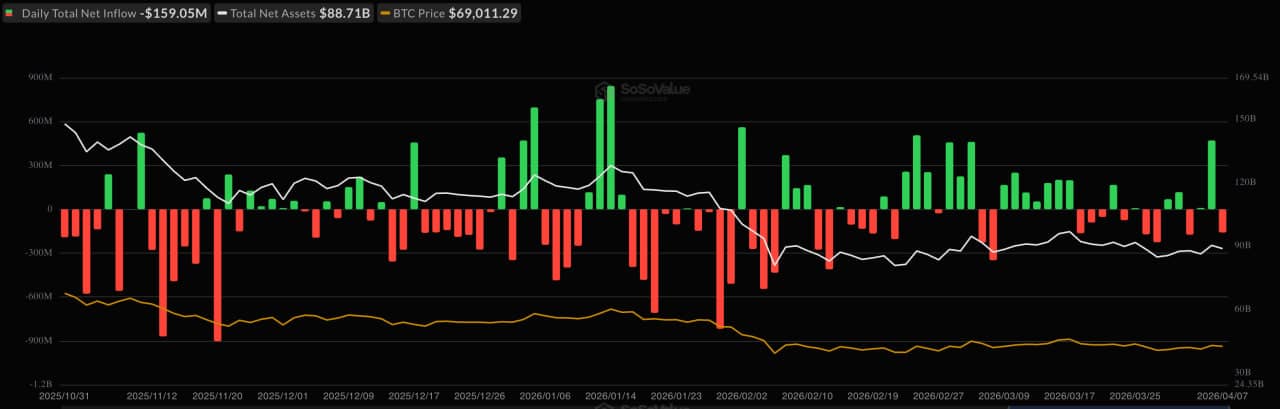
Source: SoSoValue
The distinction matters. A rally driven primarily by short liquidations and headline sentiment – with institutional sellers distributing into strength – carries a different durability profile than one underpinned by net new demand entering the market.
Iran’s ongoing exploration of alternative payment infrastructure amid the conflict adds a longer-term structural dimension to the geopolitical story, but near-term price action will be determined by whether the ceasefire holds and whether ETF flow data through April 10 confirms the bid. Open interest data will be the next signal to watch: if open interest rebuilds alongside price, that suggests fresh longs entering rather than a pure short-squeeze dynamic.
Until the Strait of Hormuz is demonstrably reopened and the two-week ceasefire survives its first stress test, the current Bitcoin move is more accurately characterized as a geopolitical relief trade than a structural trend change.
EXPLORE: Crypto breakout alerts this week
next