
The Ethereum Foundation deposited 4,938 ETH worth $7.86M into Lido Finance, continuing active treasury rotation under its 70,000 ETH staking initiative.
The Ethereum Foundation deposited 4,938 ETH, valued at approximately $7.86 million at the time of the transaction, into Lido Finance, according to on-chain data flagged by the Onchain Lens tracker on June 30, 2026.
Onchain Lens noted the foundation may continue adding to the position, though the EF has not released a statement explaining this specific tranche.This is not simply a treasury management footnote.
Ethereum Foundation has staked 4,938 $ETH ($7.86M) with @LidoFinance and is likely to stake more.https://t.co/2bSoblDs0d pic.twitter.com/hojDQ5Zq8T
— Onchain Lens (@OnchainLens) June 30, 2026
The deposit sits within the EF’s formally announced Treasury Staking Initiative, disclosed on February 24, 2026 via the Ethereum Foundation’s blog, which targets approximately 70,000 ETH staked, with rewards directed back toward protocol development, grants, and operations.
The structural question is no longer whether the EF participates in ETH staking; it is how that participation is distributed between third-party liquid staking protocols and self-operated validators.
Ethereum Foundation Staking Activity: The Lido Deposit in Context
The 4,938 ETH deposit arrives after a period of significant movement in the EF’s Lido position. By late April 2026, the Foundation had approached roughly 69,500 ETH staked across Lido and its own validators, just short of its internal benchmark, before initiating a structured exit from Lido via 271 batched transactions of 811 wstETH each into Lido’s unstETH withdrawal contract, unwinding approximately 21,270 ETH (around $49.6 million).
That withdrawal was interpreted by on-chain analysts as a rebalancing toward self-operated validator infrastructure rather than a retreat from ETH staking altogether.

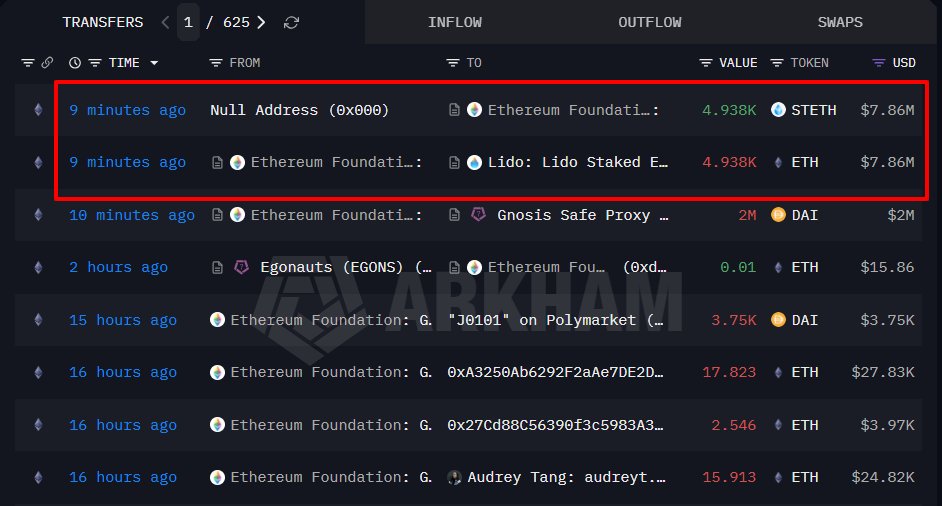
Source: Arkham
The latest deposit therefore represents a continuation of active treasury rotation rather than a directional bet. Lido Finance remains one of the largest liquid staking protocols on Ethereum, controlling roughly 22.8% of all staked ETH and issuing stETH, a liquid receipt token, that holders can deploy elsewhere in the ecosystem while their underlying ETH continues earning staking rewards.
ETH Supply Conditions: Exchange Balances and On-Chain Data
The EF deposit lands against a backdrop of tightening ETH supply. ETH exchange balances have fallen to multi-year lows, per on-chain data aggregated across major tracking platforms, meaning the liquid float available for sale on open markets has contracted materially.
Network-wide, more than 30% of total ETH supply, approximately 36.6 million ETH, was staked as of January 2026, an all-time high driven by institutional treasury staking, corporate holders, and ETF-adjacent demand.
Crypto trader Ted Pillows, citing price structure on X, characterized ETH’s current positioning as a return to a high-demand zone and said the asset “could see a relief rally next month if the price stays above the $1,500 level.”
The $1,500 level functions as the key near-term support cited across trader commentary, though ETH has struggled to build sustained upward momentum despite the supply-side compression.
next