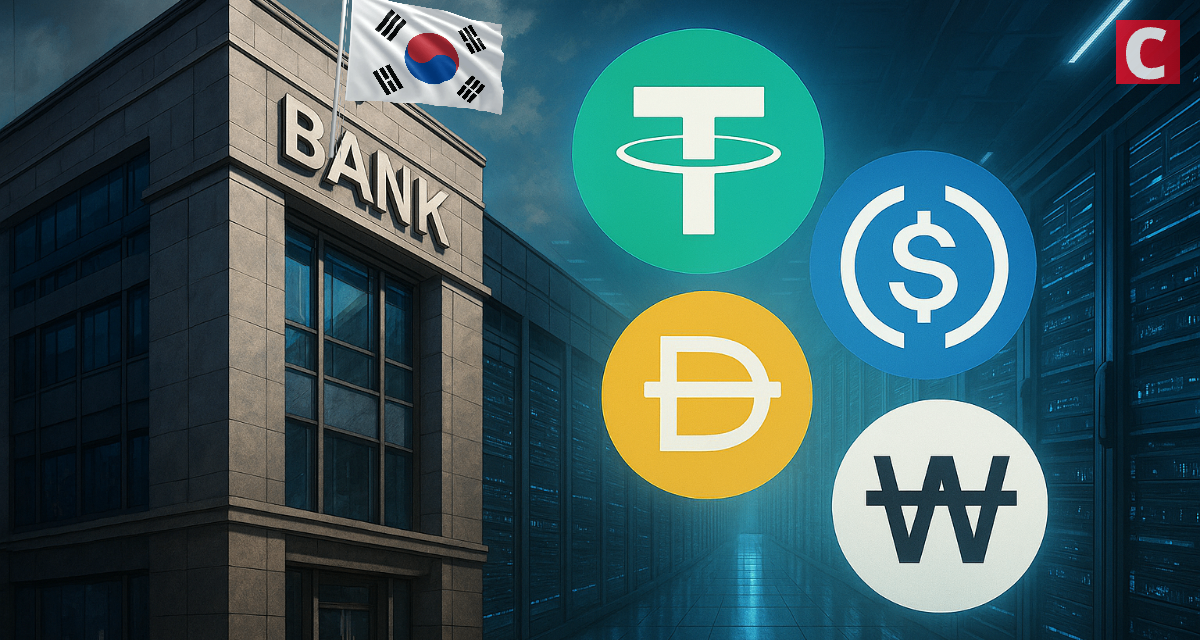
South Korea’s top financial institutions are joining forces with major tech giants to seize early advantage in the growing stablecoin market.
Leading South Korean banks and tech companies made it clear that they seek dominance in the stablecoin space. According to reports from The Korea Times, financial holding groups KB, Shinhan, Hana, and Woori are forming alliances with Naver, Kakao, and Samsung Electronics to accelerate stablecoin development and issuance.
These collaborations come at a time when stablecoin transactions in Korea have already surpassed 60 trillion won ($41.15 billion), despite the absence of formal legalization.
The country’s Financial Services Commission (FSC) is expected to submit a bill to the National Assembly by late 2025, establishing clear regulations for issuing and managing stablecoins.
One industry insider told The Korea Times, “alliances with big tech firms are considered essential, since it would take banks considerable time to develop the necessary technology on their own.”
Banking Meets Big Tech
Each of the four leading financial groups is adopting a different strategy. KB Financial Group, Shinhan Financial Group, and Hana Financial Group have already partnered with Naver.
They are working on joint fintech products while exploring potential collaboration with Dunamu, the operator of Upbit, South Korea’s largest crypto exchange. Interestingly, there are also ongoing merger talks between Naver and Dunamu.
Meanwhile, Woori Bank serves as the exclusive operator of Samsung Wallet Money and Points, directly integrating with the Galaxy ecosystem. Samsung could become one of the few global tech firms capable of both issuing and managing stablecoins at scale.
Other subsidiaries within these groups, including credit card, insurance, and asset management divisions, are also developing stablecoin-related services such as reserve management, remittance integration, and digital asset custody.
According to the earlier reports, Kakao Group’s digital-only subsidiary, KakaoBank, is preparing to enter the stablecoin sector, exploring both issuance and custody solutions. Kakao has also formed a dedicated stablecoin task force.
Stocks Up, Crypto Down
Meanwhile, the KOSPI index recently hit an all-time high above 4,200 points. On the other hand, trading volumes on Korea’s top five crypto exchanges have plummeted more than 80% year-over-year, dropping from KRW 17.1 trillion in late 2024 to just KRW 3.2 trillion by mid-2025.
According to CryptoQuant CEO Ki Young Ju, South Korea’s stock index KOSPI has hit an all-time high, while trading volume on Korean crypto exchanges has dropped to a record low. He agreed with an analyst suggesting that the South Korean president is actively boosting the stock… pic.twitter.com/z032aaTp0V
— Wu Blockchain (@WuBlockchain) November 4, 2025
CryptoQuant CEO Ki Young Ju said that the KOSPI rallied because of policy-driven incentives focused on chasing capital away from overheated sectors like real estate and crypto.
next