
Polymarket’s CLARITY Act market puts odds of 51+ Senate votes at 47%, while support above 60 falls to 32% in a $37,494 contract.
Clarity Act odds took a hit this week. Polymarket traders now assign a 53% probability that more than 50 senators will vote “Yes” on the first Senate final-passage vote for the CLARITY Act, down 8 points, according to the platform’s “How many Senators will vote for the Clarity Act?” market. The odds of clearing 60 votes sit at 32%. Total volume is $39,633, with the market running through December 31, 2026.
This isn’t simply a bet on whether the bill clears the Senate. It’s a read on how big a coalition traders expect, and the gap between 53% and 32% is the story.

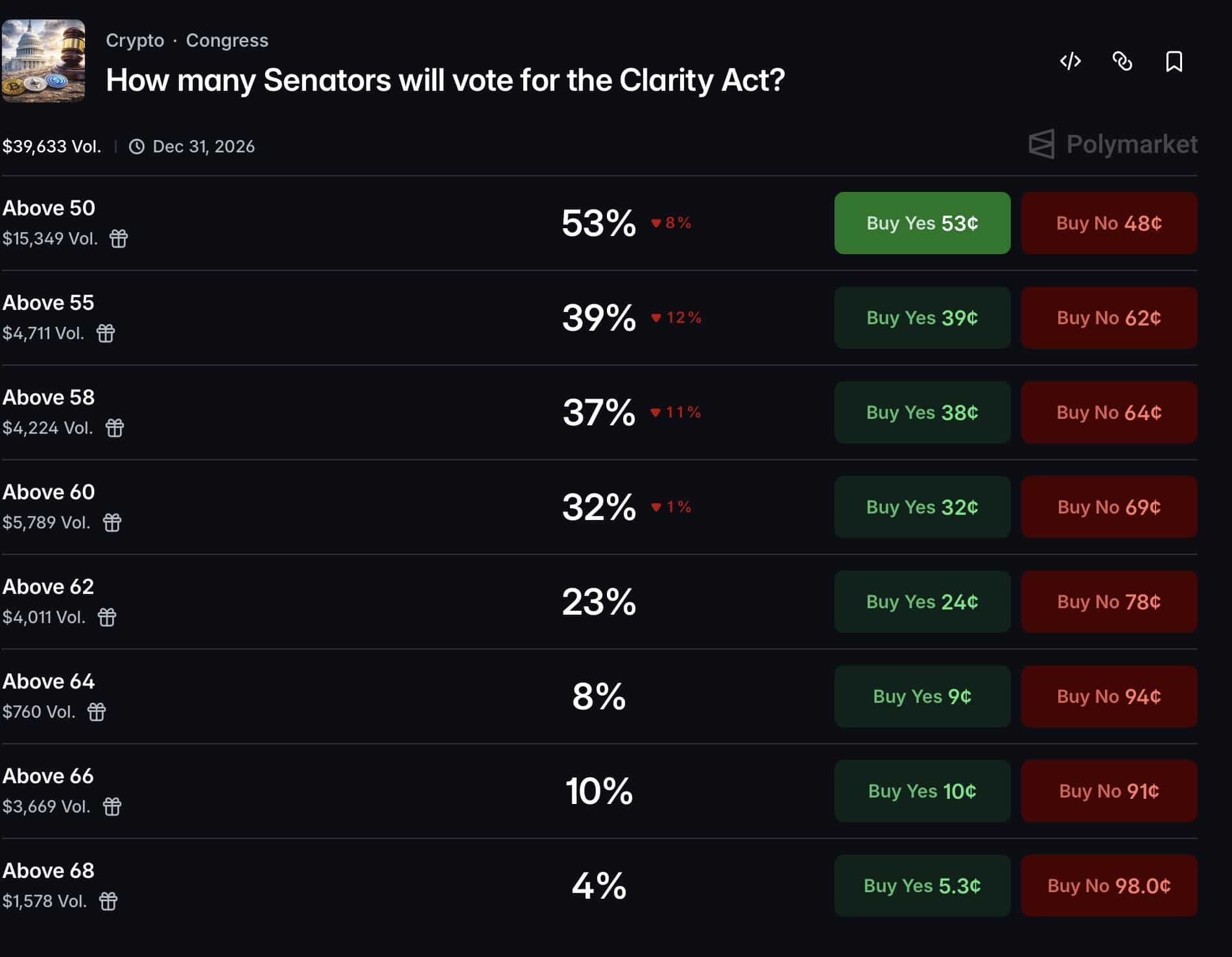
How many Senators will vote for the Clarity Act? Polymarket
Clarity Act Odds Slip: How The 60-Vote Wall Works
The contract’s language is precise: “Above” means strictly greater, so Above 50 requires 51 senators and Above 60 requires 61.
The ladder falls off fast above the majority line. Above 55 prices at 39% and above 58 at 37%, both down more than 10 points: the steepest declines anywhere in the market. Traders aren’t abandoning the bill; they’re trimming expectations for a broad bipartisan coalition. A simple majority and a filibuster-proof one are structurally different asks, and the Clarity Act odds are priced accordingly.
Democrats rejected the final version of the Clarity Act and proposed a counteroffer.
The New York Attorney General is calling on Congress to block the Crypto Clarity Act.
The odds of Clarity becoming law this year have dropped to 20%.
This isn't looking good. pic.twitter.com/Ouam3Cr9T0
— Ted (@TedPillows) September 15, 2026
It is worth being precise about what this contract does and does not measure. Per the market’s own resolution rules, it resolves based on the first Senate vote on final passage of qualifying crypto market-structure legislation occurring before January 1, 2027. This explicitly excludes committee votes, motions to proceed, cloture votes, and amendments.
That distinction matters because the 60-vote cloture threshold that governs whether a bill can even reach a final-passage vote is a separate procedural gate this contract does not directly track.
According to Congress.gov’s legislative tracker, the underlying bill, H.R. 3633, passed the House 294-134 on July 17, 2025, and the Senate Banking Committee reported an amended substitute on June 1, 2026. The background that establishes the bill has advanced, without confirming when or whether a qualifying final-passage vote will occur.
Sign Up With MergeX And Trade Crypto53% Chance of a Senate Majority: Becoming Law Is a Longer Shot
JUST IN: 🇺🇸 Trump administration launches major push to convince Senators to advance the Crypto Clarity Act.
— Watcher.Guru (@WatcherGuru) September 15, 2026
The mechanism functions as follows: the first qualifying final-passage vote controls resolution regardless of whether the bill actually passes on that vote, and not every senator needs to participate for the count to be official.
If the bill instead clears the Senate by voice vote or unanimous consent, the market resolves “Yes” automatically, irrespective of the numerical threshold in the title. If no qualifying vote occurs before January 1, 2027, the market resolves “No” by default, per the stated rules.
We suspect the pricing reflects a market that sees a workable majority coalition as plausible while remaining skeptical that support extends deep enough to constitute an overwhelming bipartisan vote. That reading is narrower than a forecast of enactment: the contract measures a vote count, not a signature, and the stakes extend well beyond this single tally into how SEC and CFTC jurisdiction over digital assets ultimately gets settled.
DISCOVER: Meme coin supercycle: Top performers this week
next