August CPI Drives Fed Hike Prediction Market Odds to 81.3%
Federal Reserve hike odds reached 81.3% after August CPI, while Kalshi and Polymarket recorded $192.6 million in combined volume before the Fed decision.
Fed hike prediction market odds ease off post-CPI peak. Cross-venue probability of a 25-basis-point Federal Reserve rate hike in September peaked near 81% in the 24 hours after the Sept. 11 inflation release and has since eased slightly.
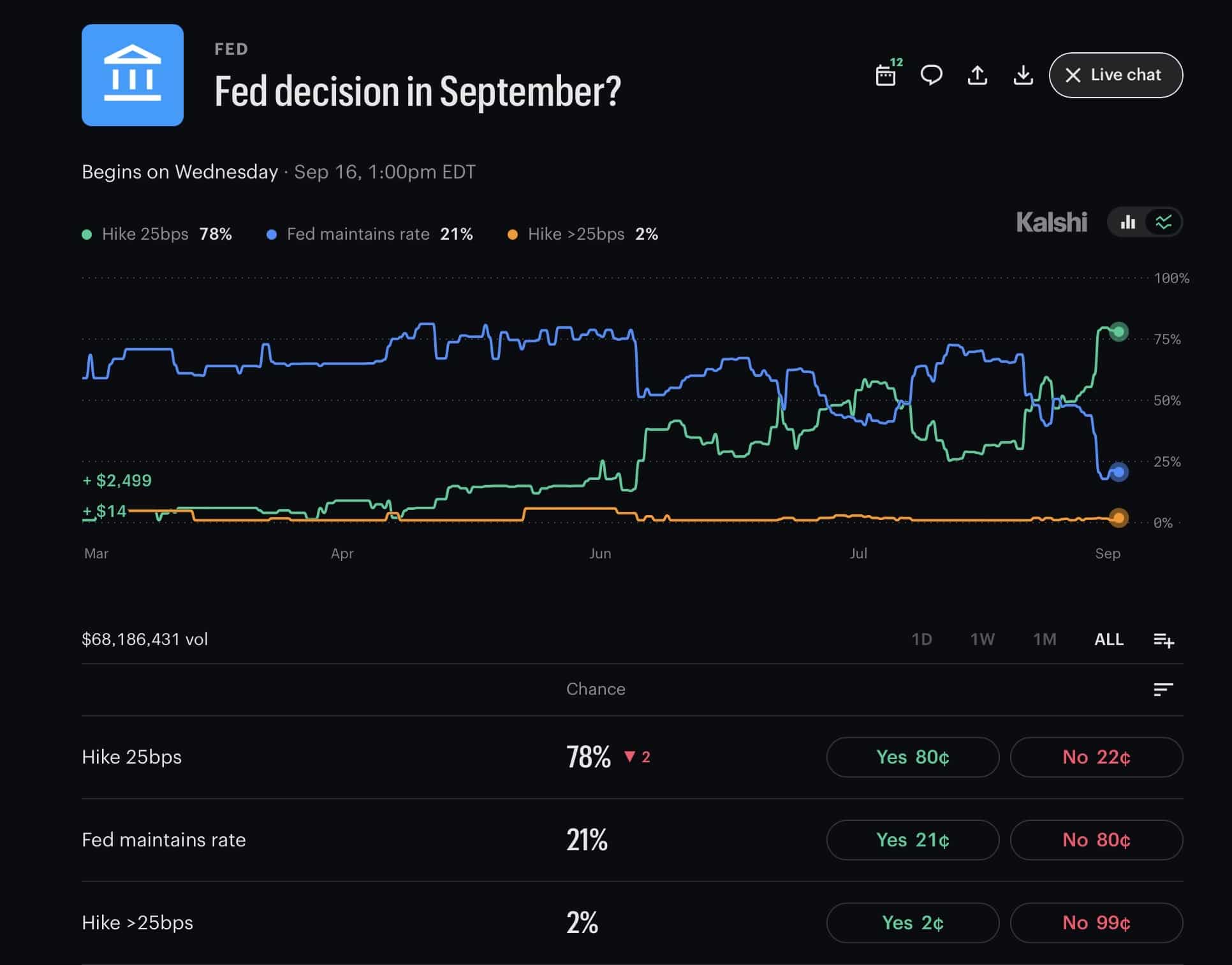
As of Sept. 14, Kalshi’s “Fed decision in September?” market prices a quarter-point hike at 78%, down 2 points on the day, with “Fed maintains rate” at 21% and a larger-than-25bp hike at 2%.
Cumulative volume has continued to build. Polymarket’s global “Fed Decision in September?” market has traded roughly $148.5 million since it launched on May 13, while Kalshi’s Fed decision market shows about $68.2 million. This put the combined volume across the two venues above $215 million, well ahead of the $192.6 million figure reported over the weekend.
The repricing sets up the Federal Open Market Committee’s Sept. 15–16 meeting, which concludes Wednesday with the policy statement and Chair Kevin Warsh’s press conference. It is also a Summary of Economic Projections meeting, so an updated dot plot lands alongside the decision.
The Bureau of Labor Statistics reported that the Consumer Price Index rose 0.4% month over month in August after a 0.1% increase in July. The 12-month headline rate held at 3.4%, unchanged from July rather than rising to it. Both the monthly and annual headline figures matched the Dow Jones consensus.
The surprise was in the core. Core CPI, which excludes food and energy, rose 0.3% for the month against a 0.2% forecast: the tenth of a point that did the repricing. The annual core rate actually eased to 2.4% from 2.5%, its lowest reading since March 2021, and in line with estimates. The hawkish read rests on the monthly core acceleration and the energy picture, not on a broad-based annual deterioration.
Energy carried the headline. Gasoline prices jumped 3.9% in August after falling 2.9% in July and were 27.4% higher than a year earlier; the BLS noted gasoline accounted for more than a third of the monthly all-items increase. The broader energy index rose 2.1% for the month and 16.3% over the year. Fuel oil was up 52% annually.
Shelter rose 0.3% after two straight 0.1% months, with the annual shelter rate easing to 3.0% from 3.2%. Food edged up 0.1%. Airline fares rose 2.7%, communication 2.3%, education 0.8% and used cars and trucks 0.4%. Natural gas (-1.1%) and electricity (-0.2%) fell.
Economists read the print as tilting the committee hawkish. Kathy Bostjancic of Nationwide said the report did not deliver the continued disinflation Warsh had conditioned a hold on, and flagged the risk that higher oil, gasoline and diesel prices spill into other goods and services and into inflation expectations. Nationwide moved to a quarter-point hike call.
The federal funds target range has sat at 3.50%–3.75% for all of 2026. A quarter-point move would lift it to 3.75%–4.00% and would be the Fed’s first hike since July 2023.
The September meeting only became live in late August. Prediction markets gave a fed hike odds roughly a 1-in-4 chance in mid-August; Warsh’s Aug. 28 Jackson Hole keynote, in which he called the 2% PCE objective a fixed target and pointed to 12-month PCE at 3.7% and the six-month rate at 4.1%, flipped the meeting to a coin flip within an afternoon. A strong August payrolls report (162,000 against a consensus near 53,000, with July revised from -23,000 to +21,000) pushed it further. September’s PPI, released Sept. 10, came in at 0.4% for the month and 5.4% annually, a tenth above forecast.
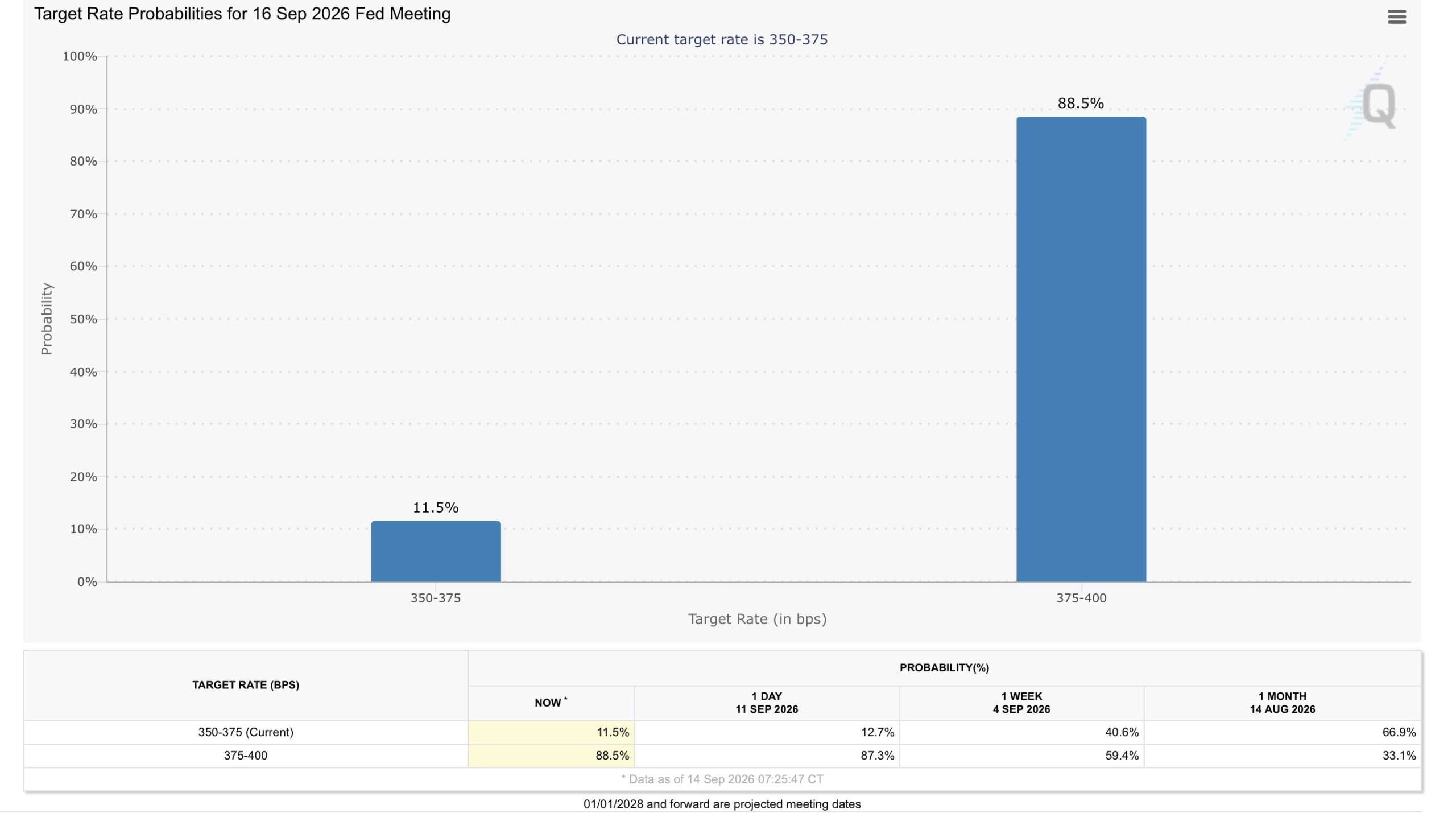
CME FedWatch, the futures-based gauge, has run consistently hotter than the prediction markets through this cycle and sat in the mid-80s after the CPI print. The three venues have priced the same event at meaningfully different numbers all month.
Target Rate Probabilities for 16 Sep 2026 Fed Meeting CMEgroup
Note that PCE for August will not be published until after the meeting, so the committee votes without it.
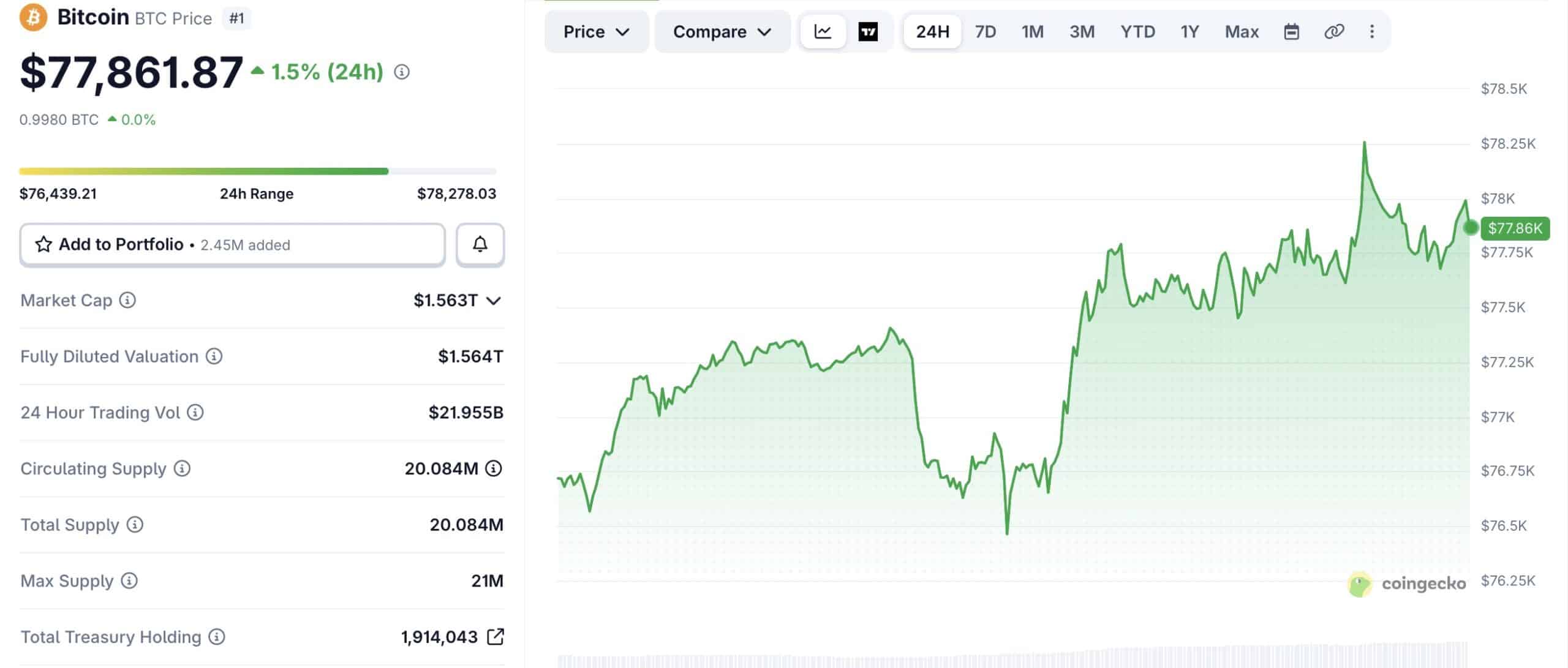
Bitcoin, Ether, DeFi borrowing costs and stablecoin yields are the areas traders are assessing ahead of the FOMC meeting. As analysis rather than confirmed data, higher expected rates typically firm the dollar and short-term Treasury yields, conditions that have historically weighed on liquidity-sensitive assets.
The clearest observed reaction to this repricing has been in bonds, not crypto: the 2-year Treasury yield hit its highest level since late July following Warsh’s Jackson Hole remarks. No comparable measured move in Bitcoin, altcoins, crypto derivatives or liquidations has been documented in the reporting on either the speech or the CPI print.
Prediction markets function here as sentiment and price-discovery tools rather than settled forecasts, and the odds can move again before Wednesday’s decision.
Disclaimer: Coinspeaker is committed to providing unbiased and transparent reporting. This article aims to deliver accurate and timely information but should not be taken as financial or investment advice. Since market conditions can change rapidly, we encourage you to verify information on your own and consult with a professional before making any decisions based on this content.
Daniel Frances is a technical writer and Web3 educator specializing in macroeconomics and DeFi mechanics. A crypto native since 2017, Daniel leverages his background in on-chain analytics to author evidence-based reports and deep-dive guides. He holds certifications from The Blockchain Council, and is dedicated to providing "information gain" that cuts through market hype to find real-world blockchain utility.