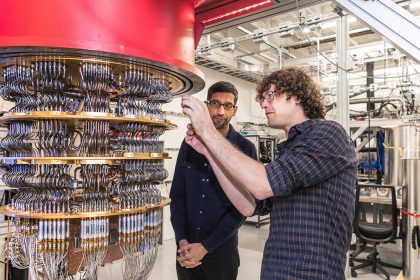
Google says that it has achieved a major breakthrough in quantum computing by processing calculations that are seemingly impossible with the speeds of today’s computers. IBM strongly disputes the statement.
It seems that the guys at Google set to beat everyone else in the game of quantum computing which has already set certain sparks in motion as to the veracity of such claims. According to Google, they have made a breakthrough that enables computers to be able to make calculations that are seemingly impossible with the speeds of today’s computers and are virtually unheard of in terms of technological breakthroughs.
Referred to as “Quantum Supremacy”, this achievement allegedly puts Google “thousands” of years ahead of everyone else in the quantum computing field. This came as a result of over ten years of research which came with the use of Googles’ quantum chip the sycamore chip.
This was revealed in a paper published by Nature Journal where Google revealed that its quantum computer had completed one of the most difficult tasks in the history of computing in just about 3 minutes 20 seconds the paper said.
Based on the speeds of the largest supercomputers, the same calculation will take 10,000 years according to the guys at Google though this has been hotly debated by IBM who has given an alternate explanation to the same scenario. Google said in the published journal:
“ For m = 20, obtaining a million samples on the quantum processor takes 200 seconds, whereas an equal-fidelity classical sampling would take 10,000 years on a million cores, and verifying the fidelity would take millions of years”.
In a recent blog post, IBM disputed the paper’s claims and gave an alternate explanation of its own saying that:
“We argue that an ideal simulation of the same task can be performed on a classical system in 2.5 days and with far greater fidelity. This is, in fact, a conservative, worst-case estimate, and we expect that with additional refinements the classical cost of the simulation can be further reduced….”
Again, as to the veracity of these claims, it is way too early to speculate about who is right or wrong as quantum computing is still in the most rudimentary of phases.
About two decades ago research and development teams in Japan invented what we now call “superconducting cubits” which refer to certain metals that work like the processors we have today but at an exponentially higher rate. This led to increased private interest and even governmental interest in quantum computing as well. From China’s and their $450 million quantum laboratory to Donald Trumps’ plans to build a lab with a $1.2 billion government commitment.
Quantum computing sees computing from a change of state perspective rather than a binary one. This has allowed quantum computing to be one of the next big advances in the use of technology in the twenty-first century. Based off quantum physics which deals with change of state rather than the state of the matter in itself, quantum computing will be able to do things we have never thought of ranging from cracking of encryption to creation of near-impossible encryption protocols and algorithms being able to solve many of the world’s problems albeit at sub-atomic level.
next