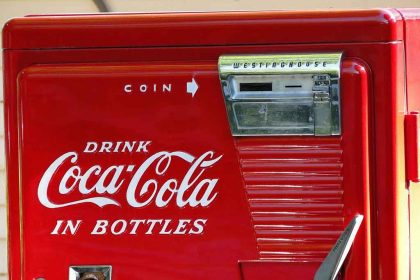
Coca Cola can now be purchased with BTC, due to the power of the Lightning Network and Richardo Reis, the creator of a new crypto-capable vending machine.
The world of cryptocurrency seems not to be a myth any more. With the rapid development of blockchain technology, digital money are becoming more and more real, being already implemented into a wide range of fields. It is not a secret that virtual money can be easily used for purchasing goods and services online, but what about people’s everyday life? Will we ever be able to pay with crypto in traditional shops? The answer to this question is almost ready to turn the world upside down.
According to the recent news, which has already received national media coverage, including such major news publications as Forbes, Bitcoin is about to get a “big boost” to mass adoption. It is due to a Spanish hardware hacker Richardo Reis, a cryptocurrency-advocate and Lightning Network developer, who has recently created a hand built Coca Cola vending machine that accepts Bitcoin payments.
As Richardo Reis wrote in his blog on Medium.com platform, he utilized a Raspberry Pi mini PC to accomplish the task. Raspberry credit card PCs caught the attention of crypto enthusiasts thanks to the development of the Raspiblitz protocol. This protocol transforms the mini PC into a Lightning Network node.
Using BTCPay, an open-source cryptocurrency payment processor, Reis generated a QR code that can be scanned by a smartphone to make an instant payment and complete the sale, so that a user can get his refreshing glass of soda in a couple of minutes.
Normally, Bitcoin transactions take no less than an hour, but Reis used the Lightning Network (LN) to create his BTCPay-powered Coke vending machine. This changes the situation greately, as the LN allows for many benefits in comparison to Bitcoin blockchain.
The LN enables transactions to be processed off of the Bitcoin blockchain, so it doesn’t require six blocks to be verified to complete the task successfully. It allows for micro-transactions with a minimum sum of 0.00000001 BTC to take place, while the blockchain requires a much higher minimum. That is why many in the crypto sphere consider the LN as Bitcoin’s best solution to current congestion issues.
After the LN achieved new milestone threshold with the overall node capacity crossing 100 BTC on September 3, many experts in the field agreed that the remarkable progress of Bitcoin’s scalability solution could help spearhead Bitcoin payments in the mainstream financial market. And now we see Reis’s crypto-capable vending machine as a perfect evidence demonstrating the LN’s power.
However, Richardo Reis isn’t the first one who created a vending machine working on the LN. At the end of September, the Lightning Peach developers from Bitfury introduced the world their new coffee vending machine that accepts Bitcoin payments. The team created the coffee machine to showcase their vending concept. Today, the unit sits in Bitfury’s lobby.
Despite Reis’s crypto-capable vending machine demonstrates some of the LN’s fantastic possibilities, it still remains only a prototype waiting for the commercial roll-out. But if this will finally happen, we will soon see how the adoption of such machines goes to the general public.
next