The CLARITY Act fell short in the Senate, leaving crypto regulation unresolved as agencies and markets absorb the legislative setback ahead of midterms.
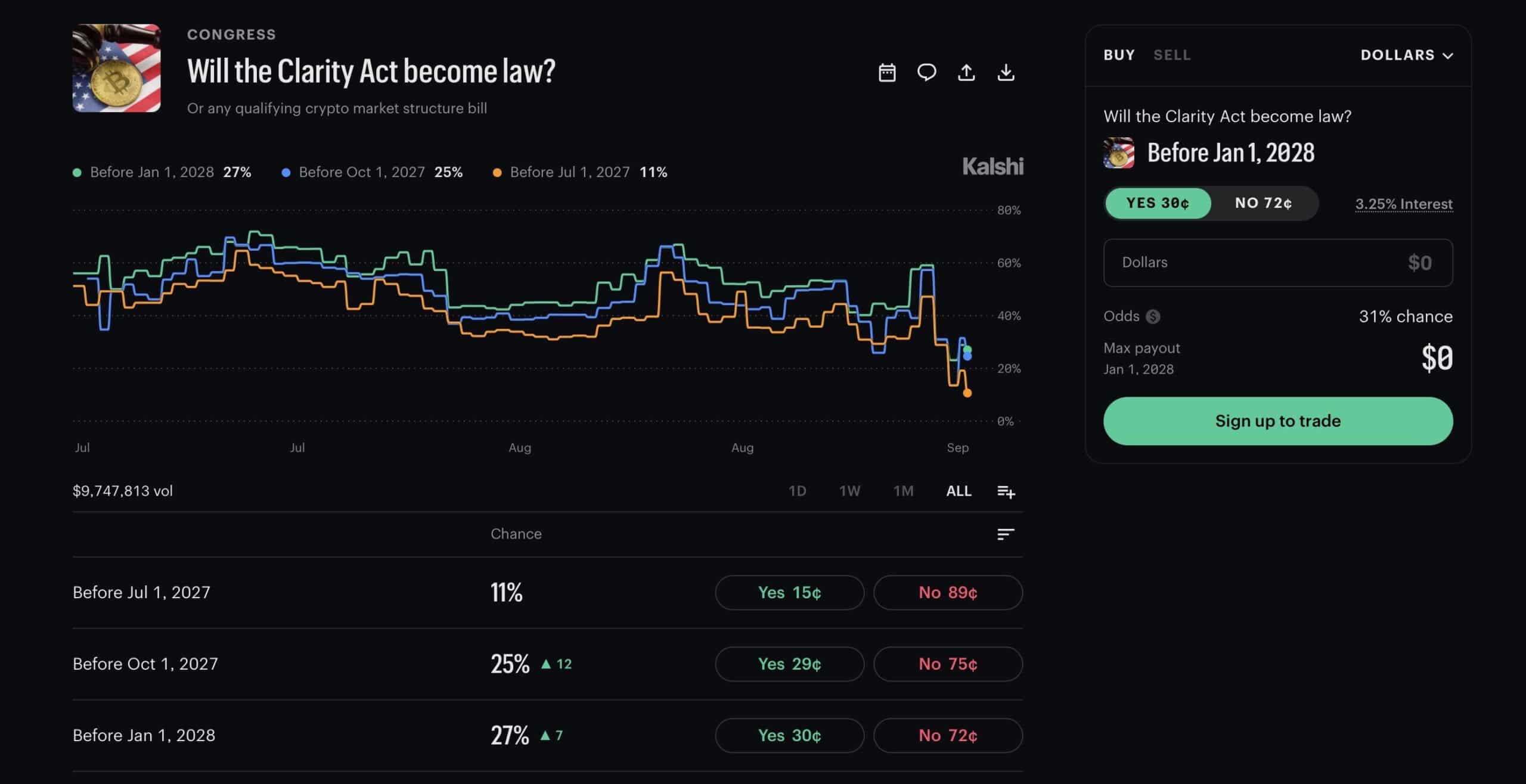
The U.S. Senate failed to advance the CLARITY Act on September 15, 2026. The comprehensive cryptocurrency bill had President Donald Trump’s backing. Prediction market odds now show traders doubt it will become law soon. On Kalshi, the chance of the CLARITY Act, or a similar crypto market structure bill, becoming law before January 1, 2028, stands at 27%.
The cloture motion fell short of the 60 votes needed to proceed. Reuters reported a 50-49 vote in favor, while Congress.gov records a 49-50 margin. Either way, the motion missed the required threshold.
Republican Senators Jerry Moran, Susan Collins, Josh Hawley and Thom Tillis joined Democrats in voting no. The result was a setback for digital-asset firms and Republicans who had backed the bill for months.
Supercharge Your Trading in 2026 With BloFin AI Trading BotsJUST IN: 🇺🇸 Group of Senate Democrats say they are "committed to working in a bipartisan fashion" to pass the CLARITY Act. pic.twitter.com/T6Dipr84yV
— Whale Insider (@WhaleInsider) September 17, 2026
Why Do Prediction Market Odds Still Give the Bill a Chance?

Clarity Act Law – Prediction Market Odds Kalshi
The vote did not kill the bill. Congress is set to leave Washington before the November midterm elections, Reuters reported. That puts the measure on hold rather than ending it.
Tillis switched his vote from yes to no. This procedural move lets him seek reconsideration later. Congress.gov shows he filed a motion to reconsider on September 15. The failed vote was therefore not a final vote on passage.
Prediction market odds reflect this uncertainty. On Kalshi, traders price a 25% chance the bill becomes law before October 1, 2027. That falls to 11% before July 1, 2027. The longest-dated contract traded near 60% in early September before dropping after the vote.
What Would the CLARITY Act Change?
The bill aims to create a regulatory framework for digital assets. It sets out how the SEC and CFTC would oversee the offer and sale of digital commodities. It also covers registration, digital-commodity exchanges, brokers, dealers and rulemaking.
My thanks go to everyone who put so much effort into the CLARITY Act— across the Administration, Congress, investors, and innovators. Our collective conviction that America must continue to lead is indispensable.
I have been unequivocal: with or without legislation, we will act…
— Paul Atkins (@SECPaulSAtkins) September 16, 2026
Senate Republicans released revised text the Sunday before the vote, Reuters reported. The changes aimed to ease concerns from banks and some Democrats but did not win enough support. The crypto industry had spent hundreds of millions of dollars campaigning for the bill.
The House has already passed the measure. Congress.gov lists Tillis’s reconsideration motion as its latest Senate action. For more, see CoinSpeaker’s coverage of the Senate vote.
CLARITY Act News: The SEC and CFTC Fill the Gap


Coinbase CEO
Coinbase CEO Brian Armstrong called the outcome disappointing in a social media post. He said the SEC and CFTC can use existing powers to set clearer rules. Reuters reported the agencies are positioned to fill the gap.
However, experts cited by Reuters said only Congress can create a lasting framework. Agency rules could change with the political climate or face court challenges.
Markets reacted quickly. Bitcoin fell more than 5% as the vote headed for failure, its biggest daily drop since June. Shares of Coinbase and Circle each fell as much as 10%.
Market Intelligence: Crypto Analyst Predicts Best New Crypto to Hodl
next