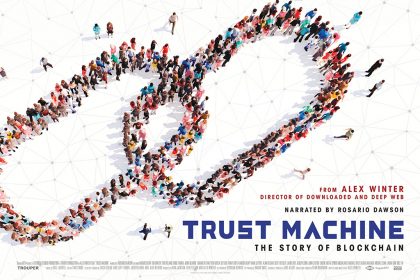
After his documentary “Panama Papers” that exposed illegal offshore activities made by global companies, director Alex Winter presented another movie masterpiece – “Trust Machine”, which was first released on October 26 in New York.
The feature-length documentary “Trust Machine” is indeed an excellent attempt to present the intricacies of blockchain and cryptocurrency to the masses. It explains how, over the years, the fintech industry has managed to touch different levels of human sentiments and emotions, covering everything that goes around in the blockchain and the cryptocurrency space.
One of the problems that crypto-community fears of is hacking. As the actress Rosario Dawson narrates in the movie:
“The wide spread proliferations of open-source technologies like cryptocurrency and blockchain – was exactly what hackers had envisioned from beginning.”
This is the example that Winter used to show how governments and institutions are fighting no matter what, to keep their power.
The documentary also describes the famous Lauri Love case. Back in 2013, this British activist was charged with hacking data from United States Government computers including the United States Army, Missile Defense Agency, and NASA. Now in the movie, he claims that “the blockchain technology is going to scare the sh*t out of some very powerful people.”
As always there are two sides of the (crypto)coin. One is that the blockchain technology helps the people who are still disconnected from the internet world. Recent studies shows that two billion people in the world do not have access to financial services, that one in three children born is not documented and as of 2015 that there are more than 95 million people who are stateless or war refugees.
One of the blockchain platforms BanQu is helping Somalian people in Kenyan refugee camp to create their economic identity using biometrics that is then uploaded to a secure ledger. Those shared information are making BanQu users get credit or enter a contract.
However, the opposite side argues that Blockchain technology was meant to be the private one. The question is: If the people buying things in the supermarket have to go through the eye scan, how private this is?
Nevertheless the government power, biometry or refugee crisis, Blockchain, claims Winter, can be so much more.
Nowadays we are witnessing major problems concerning the media sector and regarding unauthorized downloading of the movies and/or music. In the movie, songwriter Imogen Heap explains that the blockchain technology could help fix the problems Napster caused, letting fans support artists directly with micropayments.
Fortunately or not, it seems that blockchain is here to stay. Maybe not as the Bitcoin, or Dash, but maybe simple as a technology that will help people empower themselves in the future.
If you are interested to watch the movie, the next schedule is on November 16th in Los Angeles at the Laemmle Monica.
next