
Ethereum ICO Whale Moves $23M ETH After 10-Year Dormancy
A wallet linked to Ethereum’s 2014 ICO moved approximately $23 million in ETH last week after roughly a decade of inactivity, with blockchain monitoring service flagging the transfer from the dormant address and tracing proceeds through a multisig wallet, which has since deposited a cumulative 12,001 ETH, equivalent to approximately $24.62 million, to OKX over the past 60 days.
The wallet originally accumulated around 38,800 ETH during the 2014 ICO at an average acquisition cost of roughly $0.31 per token via Poloniex, implying a cost basis near $12,000 total – a figure that places unrealized gains in the tens of millions and, by extension, places real distribution risk on the table.
An #Ethereum ICO participant "0xCD59" transferred all 10,000 $ETH($22.88M) to a new wallet after being dormant for 10.8 years.
He invested only $3,100 in the ICO and received 10,000 $ETH — now worth $22.88M, a 7,381x return!https://t.co/HioUzA13Lu pic.twitter.com/5gBezsDQC2
— Lookonchain (@lookonchain) April 28, 2026
Dormant whale reactivations are among the more closely watched on-chain signals in the Ethereum market precisely because they conflate three structurally distinct possibilities – outright distribution, custodial migration, and renewed accumulation – and the data available at the point of detection rarely resolves which is occurring.
The distinction matters: sell-side distribution from a wallet carrying a near-zero cost basis represents uninhibited exit pressure, while a custody reshuffle is market-neutral. That ambiguity is the tension driving analyst attention to this address right now.
DISCOVER: Next Crypto to Explode in 2026
Ethereum ICO Whale Reactivation: What a $23 Million Move After Ten Years Actually Represents
The mechanism functions as follows: when an ICO-era wallet that has not transacted in approximately ten years initiates an outbound transfer, on-chain surveillance tools flag the address against historical activity logs and cross-reference destination wallets against known exchange deposit addresses.

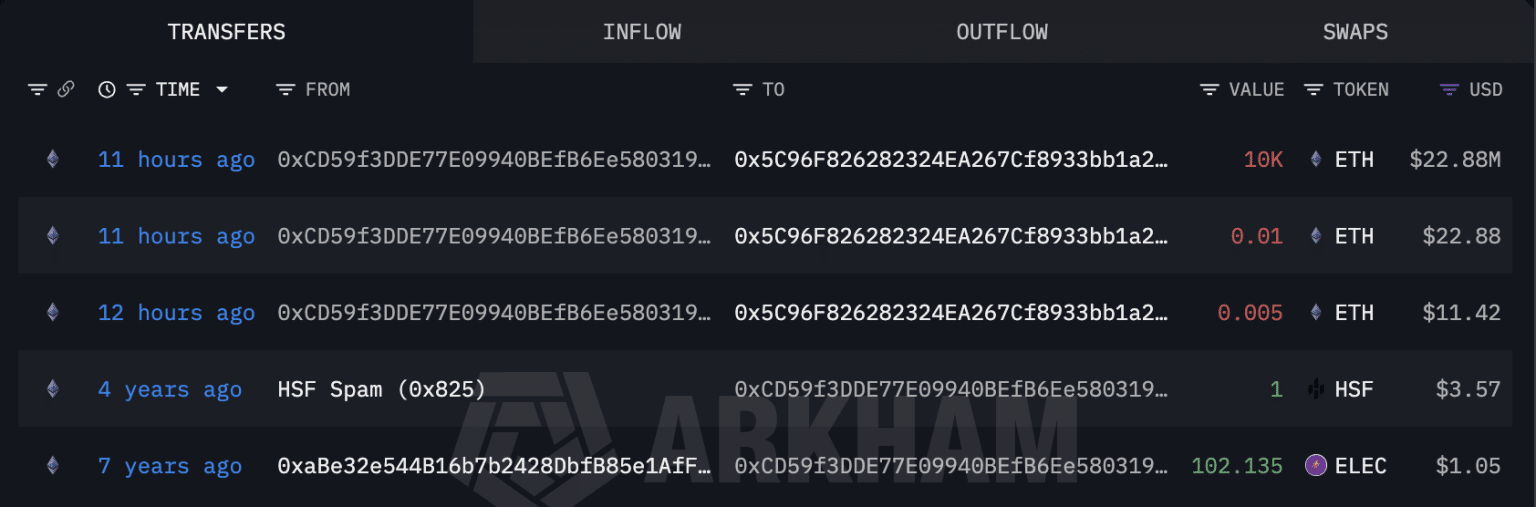
Source: Arkham
The ICO-era context is not incidental here. An acquirer who paid approximately $0.31 per ETH faces effectively no cost-basis pressure at any price above single digits, meaning the decision to sell or hold is driven entirely by portfolio strategy and macro outlook, not by a need to recover capital. That asymmetry is precisely why ICO-era whale reactivations carry structural weight beyond their nominal dollar size.
EXPLORE: Best Meme Coins to Buy in 2026
next