
Bitmine Stock Offering: Is an ETH Treasury Play Next?
Ethereum News: Bitmine Immersion Technologies filed with the US Securities and Exchange Commission on Wednesday to launch a Series A Perpetual Preferred Stock offering, 3 million shares at $100 per share, targeting roughly $300 million in gross proceeds, and the market’s immediate read was not operational financing.
It was ETH accumulation. Shares of the company (BMNR) closed up approximately 5.8% on Thursday even as Ethereum itself slid 1.7% over 24 hours to trade near $1,650, extending a weekly decline of close to 17%.
The analytical question is not whether Bitmine needs capital; it is whether this preferred-stock structure represents routine corporate financing or the next deliberate expansion of what has already become the world’s largest Ethereum treasury vehicle.
Ethereum News: Bitmine Stock Offering, What the SEC Filing Actually Establishes
The mechanism functions as follows: Bitmine is offering 3 million shares of Series A Perpetual Preferred Stock at $100 per share, carrying a cumulative 9.5% annual dividend paid weekly in cash when declared by the board. Should the company fail to pay any weekly dividend, the rate compounds by 0.05% per missed week, capped at a maximum 15% annual rate until the obligation is satisfied in full.
The stock is expected to list on the New York Stock Exchange under the ticker BMNP, with trading commencing approximately 30 days after first issuance.
On intended use, the company’s Wednesday press release was deliberately broad: proceeds “may include the acquisition of additional ETH and other digital assets; the expansion of the Company’s staking and validator infrastructure, including through MAVAN; working capital; strategic investments aligned with the Ethereum ecosystem and broader digital asset adoption; and/or repurchases of the Company’s common stock.”

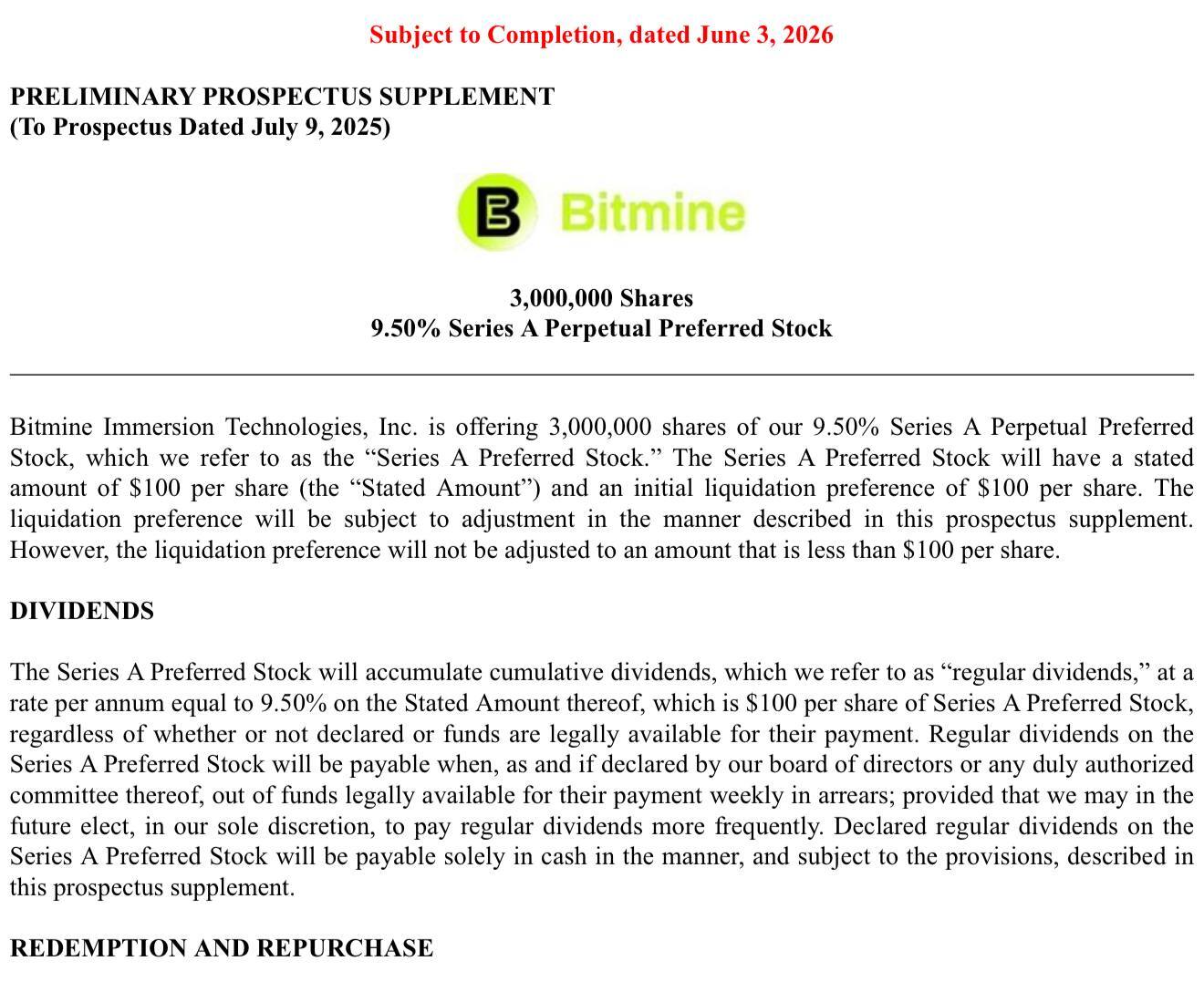
Source: Cointelegraph
That language does not guarantee ETH purchases; it authorizes them as one of several permitted uses alongside operational and infrastructure spending.
This offering does not arrive in a vacuum. Bitmine previously raised capital through a registered direct common-stock sale in September 2025, with proceeds earmarked primarily for ETH accumulation, a transaction Chairman Thomas Lee characterized as “materially accretive” because it increased ETH holdings per share.
By January 2026, the company had disclosed holdings of approximately 4,143,502 ETH alongside 192 BTC, a $25 million stake in Eightco Holdings, and roughly $915 million in cash, total crypto-plus-cash holdings of approximately $14.2 billion. Of that ETH, some 659,219 tokens were already staked through the company’s MAVAN validator infrastructure, generating the ongoing yield that market participants believe underpins the economics of this preferred structure.
EXPLORE: Next Crypto to Explode in Q2
The MicroStrategy Playbook and Where the ETH Treasury Model Diverges
The structural parallel to Strategy’s perpetual preferred stock, STRC, which carries an 11.5% dividend, is explicit enough that market participants have been drawing it since the filing dropped.
The MicroStrategy playbook, refined across multiple capital raises, established that a publicly listed company can systematically issue equity and debt instruments to accumulate a digital asset at scale, with the asset’s appreciation providing the long-run return that justifies the dilution. Bitmine is following that architecture almost step-for-step in its ETH accumulation program.
Two interpretations are available. The first is the literal reading: the preferred offering funds a mix of staking infrastructure expansion, general working capital, and opportunistic ETH purchases, with no single use dominating.
The second is the market’s structural reading: the offering is the next capital raise in a deliberate, multi-year program to compound Ethereum holdings per share, with the 9.5% dividend obligation backstopped by staking yield rather than asset sales.
As the market dropped:
Strategy is down $11.07B on $BTC;
Bitmine is down $9.58B on $ETH;
SharpLink is down $1.59B on $ETH;
Metaplanet is down $1.38B on $BTC;
Forward Industries is down $1.13B on $SOL; pic.twitter.com/bX2ButqyGG— Lookonchain (@lookonchain) June 5, 2026
Evidence supports the second interpretation more than the first. Bitmine’s prior capital raises were each framed around ETH-per-share accretion. The company has stated a goal of controlling 5% of the global ETH supply. Thomas Lee’s keynote at the Proof of Talk conference in France explicitly described ETH digital asset treasuries using staking yields to fund ecosystem grants, a governance and yield framework, not a mining operations pitch.
The structural distinction from Strategy matters here. When Strategy disclosed it had sold 32 BTC, its first BTC sale since 2022, to fund dividend payments on its preferred instruments, Bitcoin briefly fell below $62,000 as risk-off sentiment rippled through the broader market.
The episode surfaced the tension at the heart of a pure-holding model: dividend obligations in cash require either asset sales or external capital inflows. Bitmine’s staked ETH, generating yield natively, offers at least a partial mechanical answer to that problem, though at current staking rates and current ETH prices, whether that yield covers a 9.5% annualized dividend on $300 million of preferred at scale remains an open arithmetic question.
DISCOVER: Best Meme Coins to Buy in 2026
next