
 Fact-Checked by:
 24 mins
 Managing crypto token permissions is essential for DeFi wallet security. Every approval you grant persists until revoked, and unli...
10 Best Crypto Affiliate Programs in 2026 with Highest Payouts
The best crypto affiliate program in 2026 is MEXC, according to our team’s deep sector research. It outperforms competitors with its 70% revenue share and reliable tracking system.
Assessment, based on our methodology, shows that strong alternatives include Bybit, which offers up to 50% commissions with regional bonuses, and Margex, which provides a flat 40% revenue share paid in BTC.
To identify the best crypto affiliate programs, we applied a transparent methodology. Our analysts compared base and maximum revenue shares, payout frequency, and other relevant factors.
Affiliate programs are already a large and expanding market. According to DemandSage estimates, the sector for the best crypto affiliate programs is valued at around $17 billion in 2025, with projections indicating it may reach $27.78 billion by 2027.
Top 10 Highest Paying Crypto Affiliate Programs List
Below, we list the best crypto affiliate programs for crypto investors based on a combination of factors, including conversion rates, offers, and cost per action (CPA) or recurring revenue potential.
- MEXC – Up to 70% revenue share; 10% sub-affiliate
- Margex – 40% of your referrals’ trading fees
- OKX – Up to 50% commission, paid in USDT (tiered)
- Binance – Revamped program: up to 50% commission
- BloFin – Up to 50% on trading fees; lifetime commissions settled every 6 hours in USDT
- KCEX – Up to 100% commission for top tiers; futures leverage up to 100x
- Bybit – Up to 50% commission across Spot, Futures, and Options (program cap 50%)
- CoinEx – Affiliates Earn 40%, 45%, or 50% With 1,400 Supported Coins
- WEEX – Commissions up to 50%; futures leverage up to 200x
- Bitunix – Up to 50% commission via Affiliate Program
Reviewing the 10 Best Crypto Affiliate Programs in 2026
Finding the most profitable crypto affiliate programs depends on finding the right matches for your traffic and followers. For example, a more sophisticated audience may convert well with full-service exchanges that offer spot, futures, and options trading. Examples include OKX, Binance, or Bybit. Altcoin traders might convert well with platforms that offer a broad selection, such as MEXC or KCEX.
Let’s review each of the top crypto exchange affiliate programs and their marketing tools to learn more about the opportunities and features of each platform.
1. MEXC – Tiered Commissions with Sub-Affiliate Support
MEXC lists nearly 3,000 spot assets and adds margin, futures, and staking, breadth that can translate into more trading touchpoints from referred traffic across market cycles.

MEXC offers the highest referral commissions. Source: MEXC
The program uses a tiered structure that scales with performance; holding the MX token unlocks the highest tier. It’s built for audiences of active traders rather than casual beginners.
Pros
- Monthly bonuses available
- Liberal acceptance guidelines
- Competitive starting commissions
- Strong fit for KOLs, influencers, and crypto content publishers
Cons
- Not available in the US
- Advanced interface can challenge beginners
- Region-based variability can complicate planning
| Max Commission | Up to 70% (with MX token) |
| Recurring Payouts | Yes – Up to 1,080 days |
| Subaffiliate Support | Yes – 10% |
| Payout Method | Daily in USDT |
| KYC Required | No (for most users) |
| Supported Products | Spot, margin, futures, staking |
2. Margex – All Affiliates Earn a Flat 40% Commission
Launched in 2019 by former traders, Margex keeps the partner experience straightforward with a single-rate model and a trader-first interface. The platform’s focus on derivatives and a built-in copy-trading marketplace can help affiliates attract audiences that value streamlined execution and signal-based strategies.
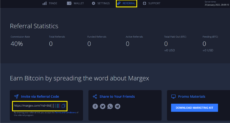
Each user can quickly find their Margex referral link in their personal account. Source: Margex
Fee dynamics also work in affiliates’ favor: a $100,000 notional position can generate about $15.80 in maker fees or roughly $48 in taker fees across open and close, illustrating how notional size can translate into consistent commissions.
Pros
- No KYC for affiliates (limits apply)
- Broad eligibility
- BTC-denominated payouts
- Up to 100x leverage available
Cons
- Comparatively limited asset selection
- No sub-affiliate support
- Lower maximum commission versus tiered rivals
- 30-day referral cookie
| Max Commission | Flat 40% |
| Recurring Payouts | Yes |
| Subaffiliate Support | No |
| Payout Method | BTC |
| KYC Required | No (limits apply) |
| Supported Products | Perpetual futures, margin, copy trading |
3. OKX – Lifetime Commissions up to 50%
OKX is a full-stack venue with over 350 spot pairs, as well as derivatives, including futures, perpetuals, and options. Automation tools, such as trading bots and copy trading, can help keep referred users active across various market conditions.
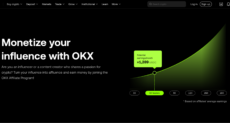
OKX reports a potential average monthly income of 1,289 USDC from 60 traders. Source: OKX
The program starts at 30% of trading fees and can scale to 50% on lifetime activity. A mix of spot and leveraged products typically lifts notional volumes versus spot-only platforms, which can translate into steadier commission flows.
Pros
- New-user bonuses
- Subaffiliate revenue share
- Real-time reporting and 24/7 help desk
- High earners can reach ~20,000 USDT per month
Cons
- Not available in all major markets
- Complex UI
- Strict KYC
| Max Commission | Up to 50% |
| Recurring Payouts | Yes – Lifetime |
| Subaffiliate Support | Yes |
| Payout Method | N/A |
| KYC Required | Yes |
| Supported Products | Spot, futures, perpetuals, options, copy trading, bots |
4. Binance – Variable Commission, up to 40% with Bonuses
Binance operates on a global scale, providing partners with a large potential audience and steady trade activity from referred users. The program is geared toward creators and communities that can drive measurable traffic and sustained engagement.

The Binance Affiliate Bonus increases as the fees paid by referrals grow. Source: Binance
Referral Pro terms start at 20% on spot and 10% on futures, with the ability to reach 40% on both categories based on volume and quality. Subaffiliate sharing is available (up to 10%), and typical acceptance criteria include a social following of 5,000+ or communities of 500+ members.
Pros
- Unparalleled liquidity
- Hourly payouts
- Bonuses paid monthly
- Strong brand recognition aids conversions
Cons
- KYC requirements
- Lower base commissions
- Futures earnings limited to 12 months
| Max Commission | Up to 40% (with bonuses) |
| Recurring Payouts | Yes |
| Subaffiliate Support | Yes – up to 10% |
| Payout Method | N/A |
| KYC Required | Yes |
| Supported Products | Spot, margin, perpetuals, options, copy trading, earn |
5. BloFin – Tiered Revenue Model with Lifetime Commissions
BloFin focuses on derivatives and spot with a unified trading account that streamlines capital across products, reducing friction for referred users. The partner flow is straightforward for growth: daily payouts are deposited directly into the spot account, and earnings accrue as long as referrals continue to trade.
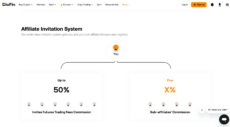
BloFin offers affiliate partners a flexible, increasing revenue share. Source: BloFin
The commission model starts at 30% and moves to 40%, 45%, or 50% based on monthly performance reviews. Terms emphasize longevity (lifetime commissions) and operational ease rather than complex tier mechanics.
Pros
- Wide selection of futures pairs
- 150x leverage available
- No KYC needed (up to 20,000 USDT daily)
- Extensive subaffiliate support
- Demo copy trading
Cons
- Limited trading tools
- No direct fiat deposits
- Lower liquidity
| Max Commission | Up to 50% |
| Recurring Payouts | Yes – Lifetime |
| Subaffiliate Support | Yes – configurable revenue split |
| Payout Method | Daily to BloFin spot account |
| KYC Required | Threshold-based (limits apply) |
| Supported Products | Spot and derivatives; unified account |
6. KCEX – Global Altcoin Access, Commissions up to 50%
KCEX pairs spot and derivatives with broad bot compatibility, giving affiliates an angle into automated trading flows without extra setup. The platform reports over 100 million USDT paid to about 15,000 partners, signaling an established track record for fee sharing.

KCEX reports that more than 15,000 partners have joined its crypto affiliate program. Source: KCEX
Payouts are USDT-denominated and credited to the trading account. Basic use does not require KYC, but bonus claims often do, which can influence conversion paths for incentive-driven campaigns.
Pros
- Wide selection of altcoins
- 100x futures trading
- Available in 150 countries
- Low trading fees
Cons
- Customer service complaints
- Spotty bonus claims
- No direct fiat deposits
| Max Commission | Up to 50% |
| Recurring Payouts | N/A |
| Subaffiliate Support | N/A |
| Payout Method | USDT to trading account |
| KYC Required | No, for basic use; required for many signup bonuses |
| Supported Products | Spot, margin, perpetual futures |
7. Bybit – Earn up to 50% on Spot, Futures, and Options Trading Fees
Bybit, founded in 2018, targets active traders with a broad derivatives stack and automation features that can keep referred users engaged across market conditions. A large catalog helps discovery beyond the most crowded pairs, while copy trading and bots add hands-off strategies for followers.
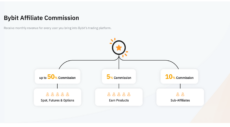
Spot, futures, and options account for up to 50% of commissions in the Bybit crypto affiliate program. Source: Bybit
Affiliates can earn up to 50% on spot and futures fees, 5% on earn products, and 10% from subaffiliates. Approvals for qualified partners are typically fast (about 24 hours), and the program reports a network of more than 100,000 affiliates worldwide.
Pros
- Vast selection of trading tools
- Daily payouts
- Top-tier marketing support
- Expiry futures trading (rare)
Cons
- Not available in some major markets
- Can be complex for new traders
- Commission paid in volatile assets
| Max Commission | Up to 50% (spot and futures) |
| Recurring Payouts | N/A |
| Subaffiliate Support | Yes, 10% |
| Payout Method | N/A |
| KYC Required | N/A |
| Supported Products | Spot, futures, options, copy trading, bots, earn (lending, staking, DeFi) |
8. CoinEx – Tiered Commissions up to 50%
CoinEx targets altcoin enthusiasts with a broad listing set (nearly 1,400 coins) and tools for hands-on or automated strategies, including futures with leverage up to 100x, copy trading, and grid bots. The breadth helps discovery beyond large-cap pairs while keeping active users engaged.

The CoinEx crypto affiliate program promises an average of 1,200 USD in monthly rewards. Source: CoinEx
The affiliate track consists of three Ambassador tiers, each with an increasing revenue share based on monthly performance: Silver (40%), Gold (45%), and Diamond (50%). These tiers are tied to specific volume and referral thresholds. The program also provides enablement resources to help partners scale.
Pros
- Training and enablement for Ambassadors
- Clear three-tier structure with performance thresholds
- Active ecosystem for strategy automation (copy/grid)
Cons
- 2-year earnings cap on referred Ambassadors
- 5% cap on referred Ambassadors
| Max Commission | Up to 50% |
| Recurring Payouts | N/A |
| Subaffiliate Support | Yes (Ambassador referrals) |
| Payout Method | N/A |
| KYC Required | N/A |
| Supported Products | Spot, futures (up to 100x), copy trading, grid bots |
9. WEEX – 200x Leverage, Commissions up to 50%
WEEX leans into high-velocity trading with a polished interface, frequent signup bonuses, and a demo account that helps new users test strategies before going live. Top affiliates reportedly clear 50,000+ USDT monthly, supported by a deep futures lineup and education that shortens the path from onboarding to active trading.
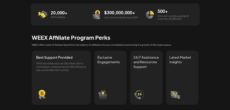
WEEX stated that it has paid out over $300 million through its crypto affiliate program. Source: WEEX
Leverage rises to 200x on select pairs, and WEEX Futures Pro adds tooling for advanced order flow. The platform also supports copy trading and bot strategies via an optimized API, providing affiliates with multiple engagement options beyond manual trading.
Pros
- Nearly 800 coins
- Large selection of futures pairs
- Multi-tier subaffiliate program
Cons
- Contested MSB license claims (US)
- Limited fiat on-ramps
| Max Commission | Up to 50% |
| Recurring Payouts | N/A |
| Subaffiliate Support | Yes – multi-tier |
| Payout Method | N/A |
| KYC Required | Withdrawals up to 500,000 USDT daily without KYC; 50,000 USDT per transaction limit |
| Supported Products | Spot, futures, copy trading, bots (API) |
10. Bitunix – Commissions Up to 50%
Bitunix combines a broad spot roster (400+ coins) with nearly 400 perpetual pairs, plus dual-investment, copy trading, bot-friendly API access, and a multi-window terminal that can display up to 16 panes on one screen. Generous signup incentives for qualified traders shorten the path from onboarding to live activity.

Bitunix invites media pioneers and bloggers to join its crypto affiliate program. Source: Bitunix
The program targets derivatives-first audiences and emphasizes tooling over hand-holding. On-chain proof of reserves and an insurance fund aim to bolster trust around high-leverage markets without forcing users into a single trading style or workflow.
Pros
- Up to 125x leverage
- Wide derivatives selection
- Optional KYC
Cons
- Contested licenses (UK, US)
- No third-party PoR audits
- Less suitable for new traders
| Max Commission | Up to 50% |
| Recurring Payouts | Yes – Daily |
| Subaffiliate Support | No |
| Payout Method | Daily USDT to spot account |
| KYC Required | Optional for basic features; higher limits with KYC |
| Supported Products | Spot (440+), perpetual futures (~400), copy trading, dual-investment, API |
Compare the Highest Paying Crypto Affiliate Programs in 2025
| Platform | Max Commission | Recurring? | Sub-affiliates | Payout Type |
| MEXC | Up to 70% | Yes (1,080 days) | Yes (10%) | USDT daily |
| Margex | 40% (flat) | Yes | No | BTC daily |
| OKX | Up to 50% | Yes (hourly) | Yes | USDT hourly |
| Binance | Up to 50% | Yes (no time limit for top performers) | Not stated | USDC hourly (Referral Pro) |
| BloFin | Up to 50% | Yes (lifetime) | Yes | USDT every 6 hours |
| KCEX | Up to 100% (top tiers) | Yes (daily payouts) | Not stated | USDT daily |
| Bybit | Up to 50% | Yes (daily) | Yes (10%) | Daily (asset varies) |
| CoinEx | Up to 50% (Ambassador) | Yes (daily) | Yes (Ambassador program) | USDT daily |
| WEEX | Up to 50% | Yes (daily) | Not stated | USDT daily |
| Bitunix | Up to 50% | Yes (daily) | Not stated | USDT daily |
How We Picked and Ranked These Crypto Affiliate Programs – Our Methodology
We want to be transparent with you, which is why we disclose our methodology. Here, we explain the principles we use to select the best crypto affiliate programs and the research methods behind our work. We review dozens of dashboards and trackers, triple-check every figure, and update this article regularly. All of this is so you can rely on fresh, accurate data and make an informed decision.
Commission structure & caps (30%)
We compare base and maximum revenue share, CPA plus rev-share mixes, sub-affiliate percentages, and any volume or tier triggers that meaningfully change payouts.
Recurring payouts & payout speed (20%)
Our analysts carefully reviewed each platform’s payout frequency, since many participants in the best crypto affiliate programs want the ability to receive earnings daily or at least weekly, rather than once per month.
We also identified which programs offer lifetime payouts and which limit affiliate commissions to a specific time period. The team found that some users are also interested in the payout currency, and we now have clear answers on that as well.
Conversion performance (20%)
We evaluate cookie windows, onboarding friction, funnel quality, and disclosed EPC or retention proxies. The goal is reliable, repeatable conversions, not headline rates.
Affiliate tools & support (15%)
We review dashboards, link builders, postback and API support, creative assets, tracking depth, and partner manager responsiveness for practical campaign management.
Compliance & reach (10%)
We assess KYC tiers, supported regions, language and localization, fiat on-ramps, and product availability that can affect approval rates and user activation.
Trust & safeguards (5%)
We consider brand reputation, proof-of-reserves disclosures, incident history, and security communications that influence long-term partner risk.
We weight scores to reflect real payout potential and operational reliability. Use this framework to match offers to your audience, then A/B test two or three programs and monitor EPC, retention, and true recurring revenue over time.
Crypto Affiliate Programs Basics
Affiliate programs provide a way to earn commissions for referring new customers. In the crypto space, exchange affiliate programs offer one of the more lucrative ways to earn because commissions are often based on a percentage of trading fees generated by referred customers. This structure allows recurring revenue rather than a one-time payout for a product conversion, for example.
In the following sections, we’ll detail how these programs typically work, including payout frequency and potential profitability.
How Do Crypto Affiliate Programs Work?
Crypto affiliate programs use a special referral link to track clickthroughs and conversions. If someone uses your affiliate link to sign up for the exchange and meets other requirements, you can earn commission based on that user’s future trading fees. Most of the programs in this space provide lifetime earnings, meaning you’ll continue earning as long as that user generates trading fees on the platform. However, some programs limit this based on a time period or may offer time-limited promotions.
Commissions are typically paid to your spot trading account on the platform, often daily, but possibly weekly or monthly, depending on the program. Expect payment in USDT in most cases, which is a popular stablecoin token pegged to the US dollar.
Are Crypto Affiliate Programs Profitable?
Crypto affiliate programs can be extremely profitable, generating six-figure incomes or higher for top performers. However, the niche comes with some unique challenges as well. For example, you’ll likely find limited opportunities in using pay-per-click (PPC) ads to drive traffic. Major platforms like Google Ads place strict limitations on crypto-related ads.
Conversion rates also play a strong role in your earning potential. Even with strong traffic on your site and a large follower base on social media, it’s essential to match offers to your audience. In a later section, we’ll discuss how to choose the best crypto affiliate marketing program for your traffic. In many cases, this may mean you need more than one, perhaps varying offers based on promotions or a specific piece of content.
Lastly, volume matters. A referral who meets the conversion requirements and only buys $100 worth of Bitcoin likely won’t generate much commission. By contrast, someone who trades $500,000 monthly and stays with the platform for a long time continues to generate significant commission revenue on most programs.
Many programs also allow sub-affiliates, meaning you can earn a percentage of the commission earned by affiliates you refer. In some cases, you can share a percentage of your commission with sub-affiliates, although program structures vary.
How Profitable Is Crypto Affiliate Marketing?
As you might expect, crypto affiliate marketers often play their cards close to the vest regarding earnings and conversions. Exact earnings and conversion rates aren’t widely publicized for a number of reasons, including security.
However, crypto affiliate marketing platforms offer this information in a more general sense. For example, Weex shares that the average earnings for an affiliate with 150 referrals are $6,971 monthly. Affiliates on the same platform with 180 referrals earn more than $9600 monthly.
The popular Margex platform pays out nearly $350,000 in USDT monthly in many cases, using a fixed commission rate of 40% of trading fees.
Platforms that offer leverage trading provide a better income opportunity in many cases because the trading fees add up faster. For example, Binance charges a 0.1% trading fee for spot trades. By contrast, USDT futures commissions are 0.02% (maker) or 0.05% (taker). This seems like spot trades pay more. However, trades are much larger with leverage.
- Spot: A $1,000 spot trade generates $1 in trading fees.
- Futures: A $1,000 futures trade with 50 leverage is really a $50,000 trade. Even using a lower-cost limit order, this trade generates $10 in trading fees.
As a top performer on Binance, you can earn 40% of trading fees, which is $0.40 for spot compared to $4.00 for the futures trade in this example. Affiliates earning tens of thousands of dollars monthly often use subaffiliates and focus on high-leverage exchanges to scale to larger commissions.
While crypto exchange affiliate programs offer outstanding income opportunities, choosing the right program for your traffic is crucial to maximizing conversion rates, reaching top commission tiers, and earning bonuses.
How to Choose the Best Crypto Affiliate Program for Your Audience
Finding the most profitable crypto affiliate programs hinges on several considerations, including how well the offer or platform fits your traffic and even the reputation of the exchange. Let’s explore some of the key factors that can affect your choice.
Cryptocurrency Selection & Tools
A large selection can be a benefit in many cases. However, if your content is focused on Bitcoin, a strong Bitcoin affiliate program with a platform that has a good reputation in the community may perform better than a platform focused on high-leverage altcoin trading.
Try to match the programs you promote to the expected audience. Allcoin audiences might convert better with a platform that offers a wide selection. Active traders may be looking for a platform that offers derivatives and advanced tools.
Commission Rate
Many of the best crypto affiliate programs offer up to 50% commission on spot or futures trading. However, these often start at a much lower tier, such as 30%. Some may also have a minimum number of new referrals monthly to maintain higher commission rates.
Weigh how much time and effort you can commit to a single program. Building around the milestones required for higher commission tiers may not be viable for content creators without a large staff. A fixed commission might be a better fit.
Conversion Rate
Conversion rates for affiliate programs vary greatly depending on the offer and how well it aligns with the traffic. Generally speaking, affiliate conversion rates range from 0.5% to 1%, but you may see numbers well outside of this range through careful targeting and optimization. We’ll discuss A/B testing in a later section, but consider using competing offers on similar types of content to see which performs better with your audience.
Marketing Support
Well-known exchanges often sell themselves. When partnering with some of the smaller exchanges, marketing support in the form of banners that highlight the benefits of the program can help make your content more authoritative. Some platforms also offer coaching and detailed tracking to help you understand how to optimize your presentation.
Exchange Reputation
Affiliate marketing means putting your reputation on the line with the products and services you highlight. Oftentimes, you’re working with smaller exchanges or less-known trading platforms. Do your own research before sending your visitors or followers to a platform. Their funds may be at risk, as well as any accrued earnings you hold on the platform.
Cookie Duration
Research the cookie duration before investing time in content for a specific platform. Many exchanges offer lifetime payouts for whichever affiliate gets the conversion, but cookie durations may play a role. Crypto affiliate programs trend toward longer cookie durations of six months or longer, although products like hardware wallets or services like crypto tax platforms may have shorter cookie durations.
Payout Method and Frequency
In most cases, cryptocurrency affiliate programs payout commissions in USDT, a stablecoin token pegged to the US dollar. However, even among the top crypto affiliate programs, payout frequency can vary.
Longer durations could introduce risk, as these funds are typically deposited into your spot trading account on the exchange. A considerable amount of commissions can accrue over a week or a month, and these funds may not be available if the platform freezes withdrawals or if you lose access to your account for any reason.
Daily payouts are safer, allowing you to withdraw your funds more often. By some estimates, as much as 60% of all crypto exchanges have ceased operations since the collapse of the Mt. Gox exchange.
Supported Regions
Crypto exchanges have a spotty record with government regulators. Following a series of high-profile run-ins with regulators, many have ceased offering trading to users in the US or other highly-regulated markets. Binance’s run-ins with the US DOJ highlight the challenge and risks.
Regional availability can affect both conversion rates and your ability to maintain an account to collect commissions. VPNs and other workarounds might not be enough to keep your account active if you’re in a restricted area.
Consider A/B Testing
Several crypto exchange affiliate programs could be a fit for your audience, so you don’t have to choose just one. By joining more than one affiliate program, you can compare Program A against Program B to see which performs better and measure click-through rates to determine which is a better match for your traffic.
Conclusion – Are Crypto Affiliate Programs Worth It?
Do you need the most profitable crypto affiliate program? Choose MEXC, because our research shows that this platform outperforms competitors across most key metrics.
Is MEXC not the right fit for you for any reason? Then consider strong alternatives: Bybit and OKX offer referral commissions of up to 50%, Margex offers 40% and CoinEx ranges from 40% to 50%.
Does your audience actively use leverage? KCEX and WEEX are built specifically for that type of referral user and affiliate, where leverage directly boosts total fee volume.
Our research shows that to achieve maximum profitability, you need to carefully match each program to your traffic and test several options. It’s not enough to simply share a link and ask users to sign up; you must provide value and context so your audience has a real reason to trade actively on the platform you recommend.
FAQ
Which is the highest-paying affiliate program?
How much do crypto affiliates make?
Is crypto good for affiliate marketing?
How much does Binance affiliate pay?
Can you make $100 a day with crypto affiliate marketing?
What is the best crypto affiliate program for beginners?
References
- Top Crypto Exchanges by Volume (Messari)
- Spot Trading Fee Rates (Binance)
- Marketing Conversion Rates (OptiMonk)
- Binance Pleads Guilty to Federal Charges (Justice.Gov)
- When Crypto Exchanges Collapse (Science Direct)
Coinspeaker in Numbers
250K+
Monthly Users
80+
Articles & Guides
5000+
Research Hours
23
Authors
guides
How to Revoke Crypto Token Permissions in 2026?
March 13th, 2026
How to Keep Your Crypto Safe in 2026: Guide For Traders
March 6th, 2026
LiquidChain (LIQUID) Price Prediction 2026, 2027, and 2030
February 4th, 2026
Crypto theft is more common than most traders think, and it rarely takes a sophisticated hack. A forgotten token approval, a poorl...
LiquidChain is a Layer 3 blockchain project that wants to unify the liquidity of Bitcoin, Ethereum, and Solana into a single execu...
Otar Topuria
Crypto Editor, 41 postsI’m a crypto writer and analyst at Coinspeaker with over three years of experience covering fintech and the rapidly evolving cryptocurrency landscape. My work focuses on market movements, investment trends, and the narratives driving them, helping readers what is happening in the markets and why. In addition to Coinspeaker, my insights and analyses have been featured in other leading crypto and fintech publications, where I’ve built a reputation as a thoughtful and reliable voice in the industry.
My mission is to demystify the crypto markets and help readers navigate the noise, highlighting the stories and trends that truly matter. Before specializing in crypto, I worked in the IT sector, writing technical content on software development, digital innovation, and emerging technologies. That made me something of an expert in breaking down complex systems and explaining them in a clear, accessible way, skills I now find very useful when it comes to unpacking the intricate world of blockchain and digital assets.
I hold a Master’s degree in Comparative Literature, which sharpened my ability to analyze patterns, draw connections across disciplines, and communicate nuanced ideas. I’m particularly passionate about early-stage project discovery and crypto trading, areas where innovation meets opportunity. I enjoy exploring how new protocols, tokens, and DeFi projects aim to disrupt traditional systems, while also evaluating their potential risks and rewards. By combining market analysis with forward-looking research, I strive to provide readers with content that is both informative and actionable.