
 12 mins
 Developers and businesses looking to integrate trading, swapping, or fiat on-ramps into their applications rely on crypto exchange...
Developers and businesses looking to integrate trading, swapping, or fiat on-ramps into their applications rely on crypto exchange APIs – after all, building a crypto exchange from scratch is a massive resource.
API communication layers connect external platforms directly to the liquidity and execution of established exchanges, and as the world becomes more accepting of blockchain, demand for reliable infrastructure is climbing, allowing more platforms to embed crypto features natively.
We explore the crypto exchange APIs available in 2026, focusing on fees, rate limits, supported assets, and verifiable security audits.
Key Takeaways for Crypto Exchange APIs
- Binance offers the deepest liquidity and highest rate limits, making it the default choice for high-frequency trading.
- OKX provides aggressive fee structures for derivatives and a robust WebSocket feed for real-time data.
- ChangeNOW stands out for non-custodial swaps, supporting over 1,500 assets with SOC 2 Type II and ISO 27001 certifications.
- CEX.io caters to institutional clients with its FIX API and strong fiat on-ramp support.
- KuCoin delivers Level 3 order book data and access to over 700 altcoins.
Top Crypto Exchange API Providers List for March 2026
- Binance: Best for high-frequency trading and deep liquidity.
- OKX: Best for derivatives and institutional volume.
- ChangeNOW: Best for non-custodial, multi-asset swaps.
- CEX.io: Best for FIX API integration and fiat ramps.
- KuCoin: Best for altcoin diversity and Level 3 data.
5 Best Crypto Exchange API Providers Reviewed
1. Binance
Binance arguably dominates the crypto API market through sheer volume, with developers using its RESTful API for standard requests and WebSocket Streams for real-time market data. Institutional traders can also access a FIX API, which is the legacy standard for high-speed financial data transfer. The platform supports over 350 cryptocurrencies.
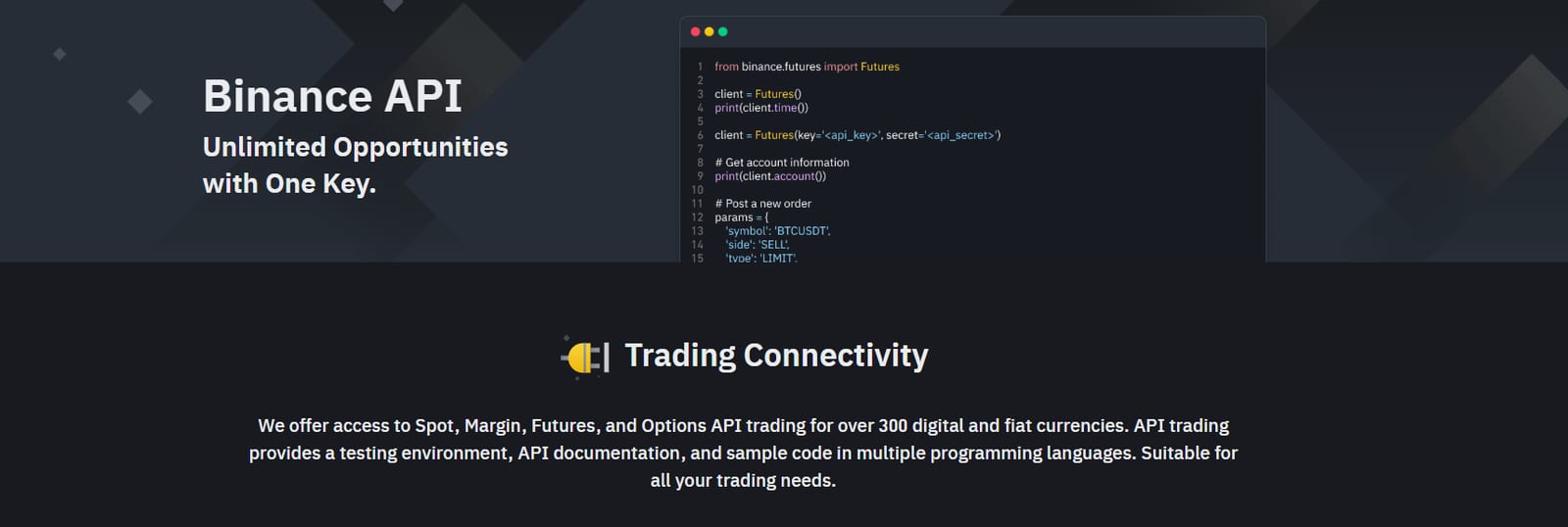
Fees sit at 0.10% for both makers and takers on the spot market, although paying with BNB cuts this by 25%. Rate limits are generous, allowing up to 6,000 requests per minute for the spot API, while the futures API allows 2,400 requests per minute. Binance uses a weight-based rate limit system, meaning heavier requests consume more of the limit. Pulling historical K-line data, which supports 500 to 1,000 entries per request, will drain the rate limit faster than a simple price ping.
Binance relies on self-published zk-SNARK Proof of Reserves to demonstrate solvency.
| Supported Coins | 350+ |
| Fees (Maker/Taker) | 0.10% / 0.10% (Spot) |
| API Rate Limit | 6,000 requests per minute (Spot) |
| Audits | Self-published zk-SNARK Proof of Reserves (Mazars withdrew in 2022) |
| Order Types | Limit, Market, Stop-Limit, Trailing Stop |
2. OKX
OKX is one for the advanced traders and institutional developers. The API covers spot, margin, and futures trading, using REST for account management and historical data, and WebSocket connections for real-time information. It also supports over 350 coins.
Spot trading fees start at 0.08% for makers and 0.10% for takers. Futures fees drop to 0.02% for makers and 0.05% for takers. The public API rate limit is capped at 20 requests per two seconds. Private endpoints allow 6 requests per two seconds. Developers are permitted up to 100 WebSocket connections per API key.
| Supported Coins | 350+ |
| Fees (Maker/Taker) | 0.08% / 0.10% (Spot) |
| API Rate Limit | 20 requests per 2 seconds (Public) |
| Audits | Self-published zk-STARK Proof of Reserves (Mazars withdrew in 2022) |
| Order Types | Limit, Market, Stop, OCO |
3. ChangeNOW
ChangeNOW (or ChangeNOW For Business) takes a different approach from traditional order-book exchanges, operating as a non-custodial infrastructure layer that aggregates liquidity from both centralized and decentralized sources, making it easy to offer crypto swaps and on/off-ramp flows.
For businesses, this removes the need to manage custody, wallets, or execution logic internally – companies can even offer white-label crypto wallets powered by ChangeNOW.
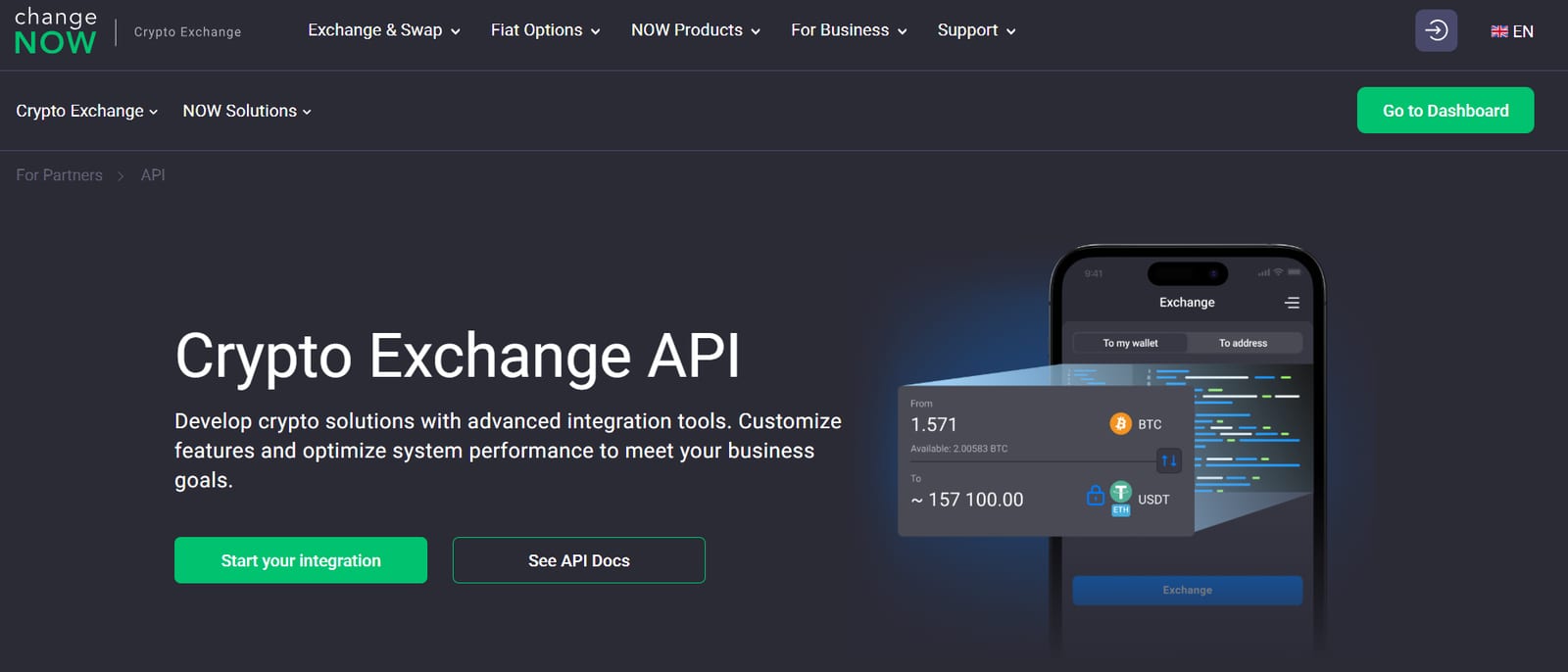
ChangeNOW’s API supports over 1,500 assets across 110+ networks, with all tokens inter-exchangeable through cross-chain swaps. Integration is straightforward, with support for both fixed-rate and floating-rate execution (across more than two million supported pairs), allowing developers to control price certainty versus market exposure depending on the use case. This makes it suitable for companies that want to integrate wallets, payment gateways, and other embedded cryptocurrency exchange features.
The API delivers an average response time of around 350 milliseconds and maintains a 99.99% availability rate and, once integrated, ChangeNOW handles market data, routing, liquidity sourcing, and transaction processing, reducing ongoing infrastructure overhead for partners.
From a security standpoint, ChangeNOW holds SOC 2 Type II and ISO 27001:2022 certifications, providing independently verified assurances around data handling and operational controls.
| Supported Coins | 1,500+ |
| Fees | Spread-based; partners earn from 0.4% |
| API Response Time | 350 ms average |
| Audits | SOC 2 Type II, ISO 27001:2022 |
| Order Types | Standard and Fixed-Rate Swaps |
4. CEX.io
CEX.io caters to developers needing traditional financial infrastructure and, alongside standard REST and WebSocket APIs, it offers a FIX API, which is the standard for institutional trading.
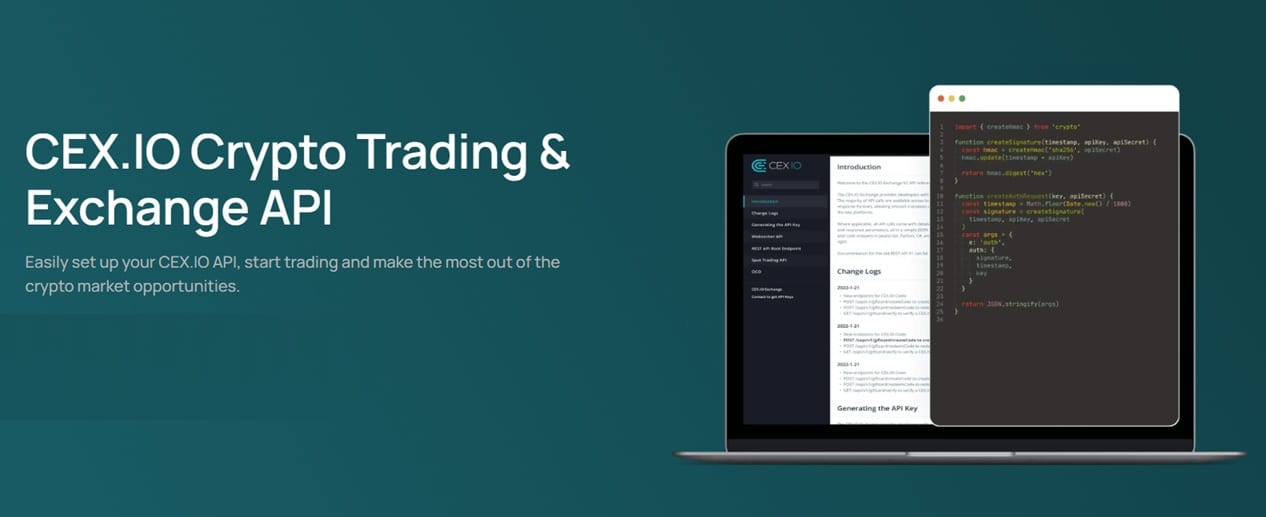
The exchange supports over 160 cryptocurrencies. Spot trading fees are higher than competitors, starting at 0.15% for makers and 0.25% for takers. The API rate limit is restrictive, allowing 600 requests every 10 minutes.
CEX.io maintains PCI DSS compliance for data security. Specific third-party Proof of Reserves audits are undisclosed.
| Supported Coins | 160+ |
| Fees (Maker/Taker) | 0.15% / 0.25% (Spot) |
| API Rate Limit | 600 requests per 10 minutes |
| Audits | PCI DSS Compliance (PoR undisclosed) |
| Order Types | Limit, Market, Stop |
5. KuCoin
KuCoin is the go-to API for developers building altcoin-focused applications, as it supports over 700 cryptocurrencies and provides Level 3 data, giving developers access to the full order book for granular market analysis.
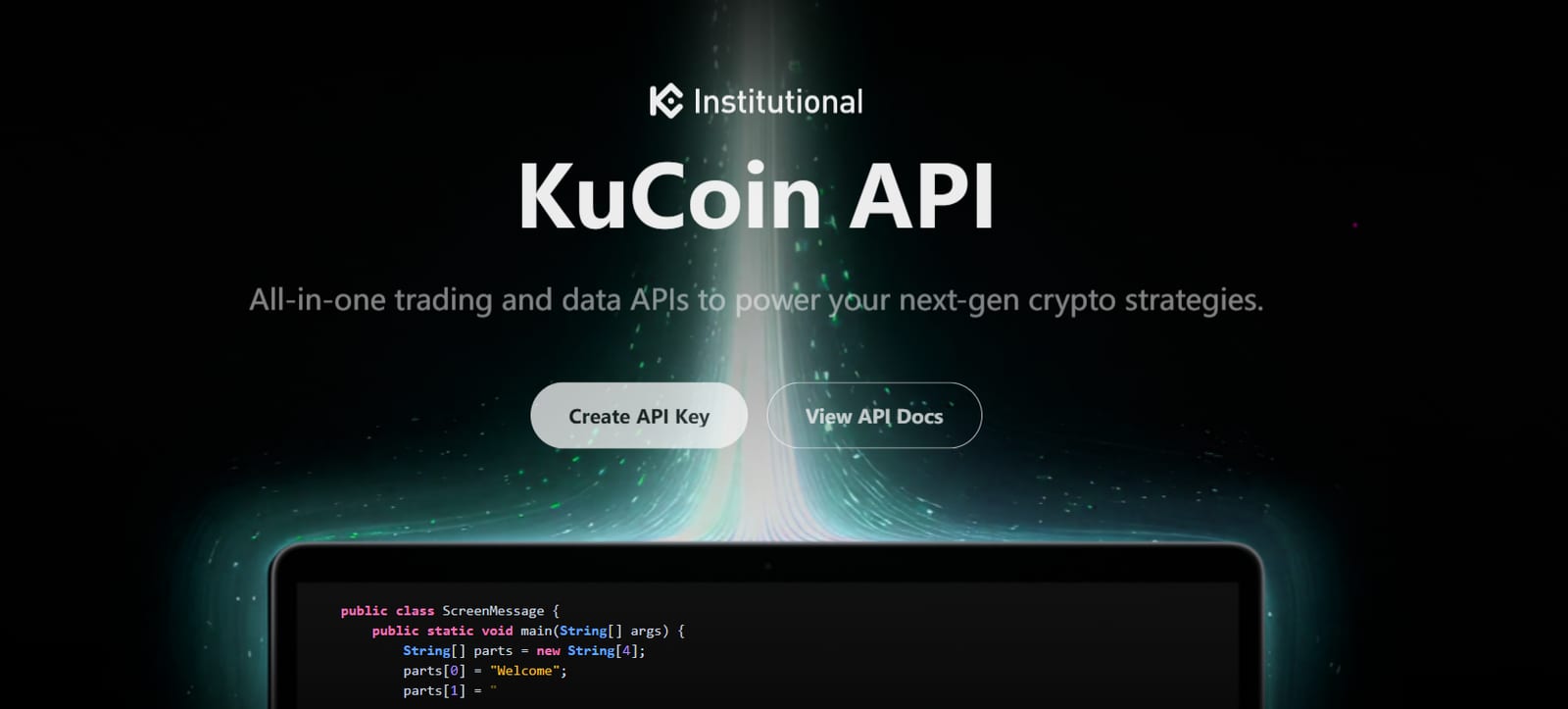
Spot fees are a flat 0.10% for makers and takers, with a 20% discount available when paying in KCS. The general API rate limit is 1,000 requests per 30 seconds.
KuCoin achieved SOC 2 Type II and ISO 27001:2022 certifications between 2023 and 2024. Its previous Proof of Reserves audits were handled by Mazars before the firm halted crypto engagements in 2022.
| Supported Coins | 700+ |
| Fees (Maker/Taker) | 0.10% / 0.10% (Spot) |
| API Rate Limit | 1,000 requests per 30 seconds |
| Audits | SOC 2 Type II, ISO 27001:2022 |
| Order Types | Limit, Market, Stop |
What Are Crypto APIs?
Crypto Application Programming Interfaces act as digital translators, allowing external software to interact directly with an exchange’s internal systems. Developers use them to pull live market data, historical data, execute trades, manage account balances, and process fiat payments without forcing users to leave their native application.
Exchange APIs handle the actual buying and selling of assets. Market data APIs stream live prices and order book depth. Wallet APIs manage the creation of deposit addresses and the broadcasting of withdrawal transactions. Payment APIs allow merchants to accept crypto at checkout, automatically converting it to fiat or stablecoins.
Understanding REST, WebSocket, and FIX APIs
Developers interacting with crypto exchanges typically encounter three types of API protocols. REST APIs are the most common. They require the client application to send a specific request to the server every time it needs information. If a trading bot needs to know the price of Bitcoin, it asks the REST API. If it needs the price a second later, it asks again. This is highly inefficient for high-frequency trading but perfectly adequate for executing occasional trades or checking account balances.
WebSocket APIs solve the inefficiency of REST by opening a persistent, two-way connection between the client and the server. Instead of the client constantly asking for updates, the server pushes new data to the client the moment it becomes available. This is mandatory for live order book updates and real-time price feeds.
FIX APIs represent the legacy standard of traditional finance. The Financial Information eXchange protocol was built for institutional trading long before the crypto market existed. Exchanges like Binance and CEX.io offer FIX APIs specifically to attract hedge funds and institutional market makers who already have infrastructure built around the FIX protocol.
How Does a Crypto Trading API Provider Work?
An application sends a request to a specific API endpoint. The exchange server then verifies the API key and its permissions. Once authenticated, the server processes the request (whether that is fetching the current price of Bitcoin or executing a market buy order) and returns the data in a standardized format.
This communication happens in milliseconds. The speed of execution depends heavily on the physical distance between the developer’s servers and the exchange’s matching engine. Institutional traders often pay for colocation, placing their servers in the same data center as the exchange to shave microseconds off their API response times.
Crypto Exchange API Providers vs. Standard Exchanges
Standard exchanges usually make users interact with a graphical interface. APIs bypass the interface entirely. This allows for automated trading, split-second execution, and the ability to aggregate liquidity from multiple exchanges simultaneously.
Liquidity is accessed directly through the order book rather than a retail matching engine. Prices remain the same, but execution speed drops from seconds to milliseconds. Scale is the most obvious difference. A human trader might execute ten trades a day. An API can execute ten trades a second.
Benefits of Using Crypto APIs
Automation is the primary draw. APIs run trading systems and trading bots, manage portfolio rebalancing, and process payments around the clock. They provide raw historical data for backtesting strategies. By removing manual input, they eliminate human error in trade execution.
Non-custodial APIs also allow businesses to offer crypto services without taking on the regulatory burden of holding user funds. A gaming platform can integrate a swap API to let users buy in-game tokens without the platform ever touching the underlying crypto.
Understanding API Rate Limits
Every crypto exchange imposes rate limits to prevent server overload and malicious DDoS attacks. A rate limit dictates how many requests a developer can send to the API within a specific timeframe. If a bot exceeds this limit, the exchange will temporarily ban the IP address or suspend the API key.
Binance uses a complex weight-based system. Instead of simply counting the number of requests, Binance assigns a “weight” to each endpoint. A simple ping to check the server status might cost one weight. Requesting the entire historical order book for Bitcoin might cost fifty weight. Developers must carefully manage their request weight to avoid hitting the 6,000 per minute ceiling.
CEX.io takes a much stricter approach, hard-capping users at 600 requests every 10 minutes. This effectively limits developers to one request per second, making it unsuitable for high-frequency arbitrage but perfectly fine for a retail-facing portfolio tracker.
The Importance of Security Audits in Crypto APIs
Today, exchanges like Binance and OKX rely on self-published cryptographic proofs using zk-SNARKs and zk-STARKs. While mathematically sound, these self-published reports lack the independent oversight of a traditional financial audit.
For non-custodial platforms and infrastructure providers, operational security audits are more relevant. SOC 2 Type II and ISO 27001 certifications prove that a company follows strict, independently verified protocols for data protection and system security. ChangeNOW and KuCoin hold these certifications, providing a verifiable layer of trust.
Are Crypto APIs Safe?
Security depends entirely on implementation and the provider’s infrastructure. API keys act as passwords and should be restricted using IP whitelisting. Permissions must be strictly defined. A key used only for pulling market data should never have withdrawal rights enabled.
The underlying exchanges must also maintain rigorous security standards. SOC 2 Type II and ISO 27001 certifications prove that an exchange follows strict data protection protocols. Proof of Reserves, while flawed, offers a baseline level of transparency regarding an exchange’s solvency.
How to Get Started With a Crypto API Provider
First, register an account with the chosen exchange and complete any required identity verification. Centralized platforms will not issue API keys to unverified accounts.
Head to the API management section to generate a new API key and secret. The secret key is only displayed once. If it is lost, the developer must delete the API key and generate a new one.
Define the key’s permissions immediately. By default, most exchanges enable read-only access. If the application needs to execute trades, enable trading permissions. Never enable withdrawal permissions unless the application specifically requires it, and even then, restrict withdrawals to a pre-approved whitelist of wallet addresses.
Restrict access to specific IP addresses. If a hacker steals an API key, they cannot use it unless they also control the whitelisted IP address.
Most major exchanges offer a testnet environment. Developers should always run their code in the testnet using virtual assets before deploying live capital. This prevents costly bugs, like a loop that accidentally buys and sells the same asset a thousand times in a minute, draining the account through trading fees.
Conclusion
Integrating a crypto exchange API is the most efficient way to build trading and payment features into an application.
Binance and OKX offer the liquidity needed for heavy trading volume, while ChangeNOW provides a massive asset list and non-custodial security for businesses wanting a hands-off approach.
The right choice often depends on whether the priority is low fees, altcoin diversity, or regulatory compliance.
FAQs
What is the best crypto exchange API for developers?
Are crypto APIs free to use?
What is the difference between REST and WebSocket APIs?
Do I need to complete KYC to use a crypto API?
Coinspeaker in Numbers
250K+
Monthly Users
80+
Articles & Guides
5000+
Research Hours
23
Authors
guides
5 Best Crypto Exchange APIs to Use in Your Business 2026
March 24th, 2026
How to Revoke Crypto Token Permissions in 2026?
March 13th, 2026
How to Keep Your Crypto Safe in 2026: Guide For Traders
March 6th, 2026
Managing crypto token permissions is essential for DeFi wallet security. Every approval you grant persists until revoked, and unli...
Crypto theft is more common than most traders think, and it rarely takes a sophisticated hack. A forgotten token approval, a poorl...
Daniel Francis
, 86 postsDaniel Frances is a technical writer and Web3 educator specializing in macroeconomics and DeFi mechanics. A crypto native since 2017, Daniel leverages his background in on-chain analytics to author evidence-based reports and deep-dive guides. He holds certifications from The Blockchain Council, and is dedicated to providing "information gain" that cuts through market hype to find real-world blockchain utility.