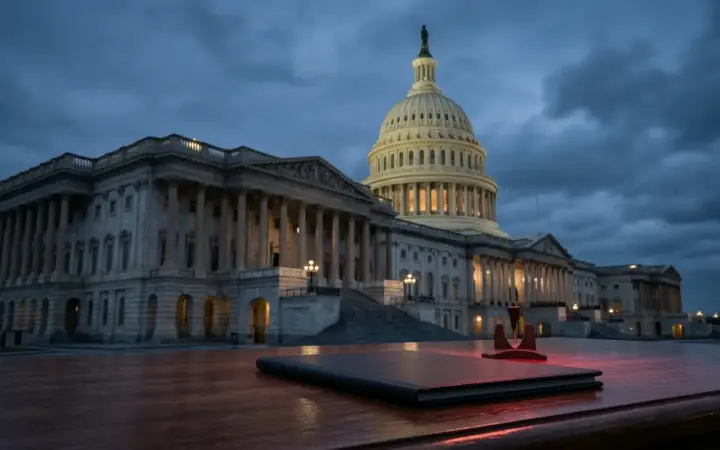
In CLARITY Act news today, the Digital Asset Market Clarity Act remains a bill, not a law. Although the House passed it 294-134 in July 2025, the Senate had not held a floor vote or filed a cloture motion before setting the measure aside ahead of the August recess.
The Senate left Washington without voting on the crypto market-structure bill, narrowing the time available for action before the midterm elections.
Senate Majority Leader John Thune said the measure would go to the floor in September. Lawmakers are due back for a brief, roughly three-week session before leaving to campaign, leaving the bill to compete with other legislative priorities. The Senate’s next steps will show whether negotiators can resolve the dispute that has held up the legislation.
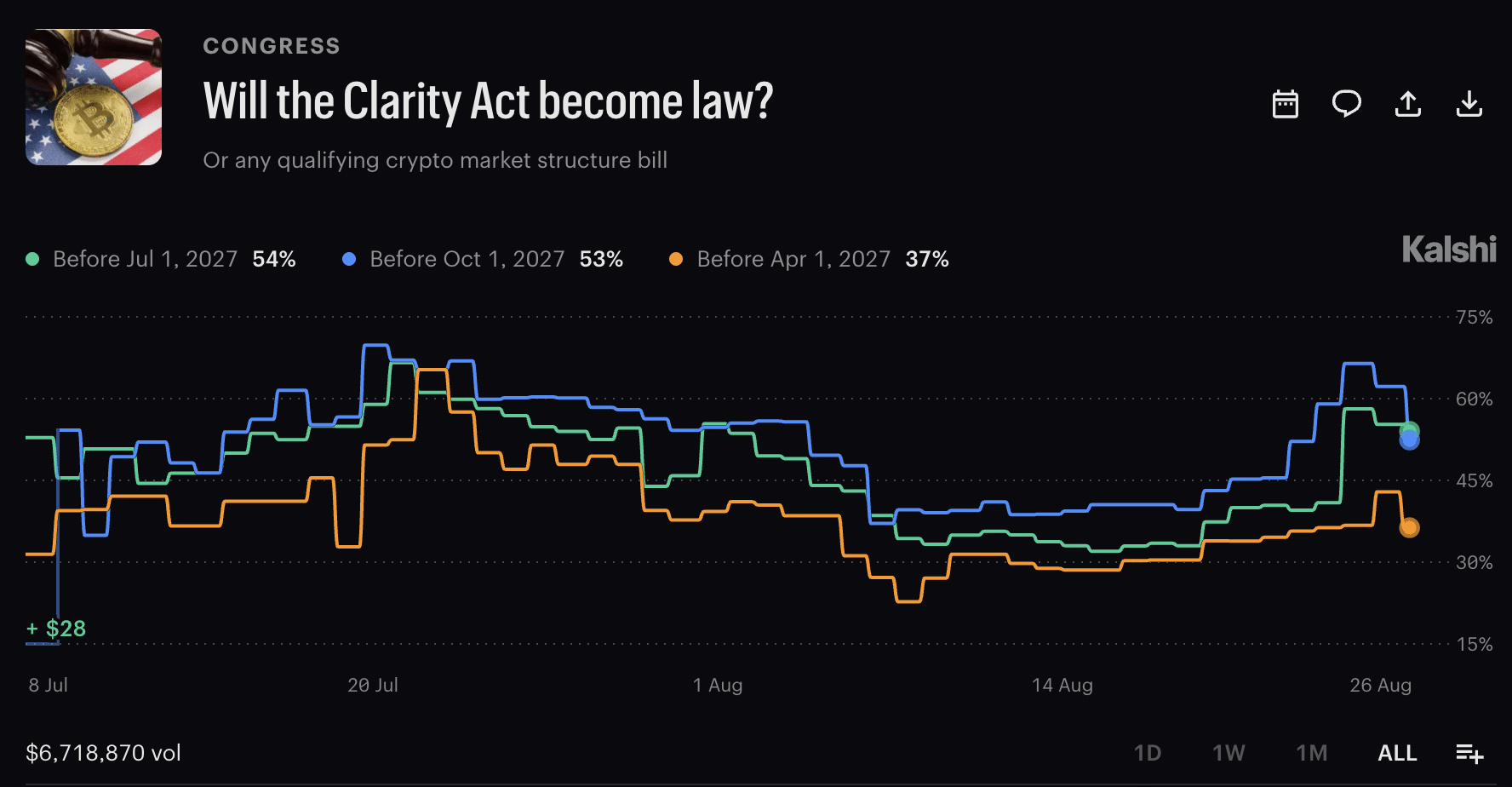
Now, prediction markets such as Kalshi are pricing in an 8% chance of the bill passing in September, down from 10% just yesterday. 54% of the $6.7M in volume in this market believe the bill will be passed by July 1, 2027.
CLARITY Act News: From House Passage to a Shelved Senate Bill
The House approved the CLARITY Act with substantial bipartisan support. The Senate Banking Committee later advanced its version, with two Democrats voting in favor, and the bill became eligible for floor consideration in June 2026. It remained on the Senate Legislative Calendar through the first half of the year before being shelved in late July.
The framework would establish statutory categories distinguishing digital commodities from securities and divide jurisdiction between the Commodity Futures Trading Commission and the Securities and Exchange Commission.
It would place primary oversight of spot trading in digital commodities with the CFTC while leaving the SEC responsible for digital assets classified as securities.
The bill would also create registration categories for digital commodity exchanges, brokers, dealers, and custodians. Those regimes would require agency rulemaking to define standards for registration, capital, custody, and conduct.
Other provisions include a self-certification process for networks that meet statutory maturity criteria, protections for non-custodial software developers from money-transmitter treatment, and federal preemption of conflicting state rules governing covered assets and intermediaries.
The CLARITY Act news bill needs 60 votes to overcome a filibuster. Negotiations have centered on an ethics provision concerning federal officials who issue or sponsor digital assets while in office.
Republicans released updated language on July 22 that would prohibit federal officials, including the president, from issuing or sponsoring digital assets while in office. The proposal would be enforced solely by the Justice Department, carry penalties of up to $250,000 per day, and sunset on January 20, 2029.
Democrats rejected the text, objecting to an enforcement structure centered exclusively on the Justice Department. They have sought an independent enforcement role for state attorneys general, a role that was barred under the released proposal. Both Democrats who voted the bill out of committee opposed that version.
Sen. Cynthia Lummis has continued to work on the crypto bill. The broader negotiation remains focused on whether an agreement can be reached on the ethics provision before the Senate takes up the measure.
A Narrow September Opportunity for the CLARITY Act
In other CLARITY Act news, the Senate’s September session offers a limited window for the CLARITY Act. Floor time will compete with appropriations deadlines and other business, while any version passed by the Senate would also require House concurrence.
Ian Katz, managing partner at Capital Alpha, told The Hill that the bill’s prospects weaken as the September window approaches because there are few legislative days and other issues competing for attention. Katz said the legislation was not yet dead but did not look promising.
A possible year-end route has also been discussed. The trade press has reported that lobbyists have floated attaching the bill, or portions of it, to must-pass legislation such as appropriations or the defense authorization measure. No senator has confirmed that strategy, and it would not resolve the underlying disagreement over votes and enforcement.
Disclaimer: Coinspeaker is committed to providing unbiased and transparent reporting. This article aims to deliver accurate and timely information but should not be taken as financial or investment advice. Since market conditions can change rapidly, we encourage you to verify information on your own and consult with a professional before making any decisions based on this content.
Daniel Frances is a technical writer and Web3 educator specializing in macroeconomics and DeFi mechanics. A crypto native since 2017, Daniel leverages his background in on-chain analytics to author evidence-based reports and deep-dive guides. He holds certifications from The Blockchain Council, and is dedicated to providing "information gain" that cuts through market hype to find real-world blockchain utility.