
 Fact-Checked by:
 14 mins
 AI cryptocurrencies combine blockchain with artificial intelligence to power decentralized machine learning networks, GPU computin...
LivLive Price Prediction – LIVE Price Potential in 2026-2030
We’ve spent weeks analyzing LivLive’s whitepaper, presale data, and community sentiment to come up with our honest take on where LIVE could go in the next five years.
LivLive is a new presale project that wants to build an AR platform where you earn crypto for real-world activities like walks, check-ins, and reviews. And it’s all verified through a wristband you wear.
It combines wearable hardware, AR quests, and blockchain rewards into what they call “the gamified layer for reality”.
Here’s a quick look at our prediction for the next couple of years:
- End of 2025 – The presale runs through 10 stages, so LIVE will likely still trade at presale prices through most of the year. I expect somewhere between $0.02 and $0.06, with an average around $0.035.
- End of 2026 – If the team delivers the TGE and secures exchange listings as promised, LIVE could reach $0.52 on the high end. The $0.25 launch price serves as the baseline, and initial momentum could push it well beyond that. My average target sits at $0.30.
- End of 2030 – With sustained development and real user adoption, LIVE might hit $0.88 under optimal conditions. Given the size of the attention economy and the problems LivLive aims to solve, I think these targets are achievable if the team executes. My average estimate lands at $0.42.
| Year | Potential Low | Average Price | Potential High |
| 2025 | $0.02 | $0.035 | $0.06 |
| 2026 | $0.15 | $0.30 | $0.52 |
| 2030 | $0.06 | $0.42 | $0.88 |
LivLive’s Price History
LivLive set up a 10-stage presale structure that rewards early participants with lower entry prices. Stage 1 kicked off at $0.02 per token, and the price climbs as each stage sells out until it reaches $0.20 in Stage 10. Pretty standard presale mechanics, but if you look at the numbers closely, there’s an interesting story behind them.
So, the presale has pulled in $2,191,205 from 367 holders so far, but the thing is that the private sale already closed with $2 million, which means the public presale has only added around $191,000 since launch. Some people might look at that and worry. I see it differently.
Stage 1 sits at about 48.69% complete right now, and the public presale only opened recently. That pace tells me there’s genuine retail interest here, not just a handful of whales inflating the numbers to make the numbers attractive. Real people are buying in, and they’re doing it consistently.
The tokenomics don’t raise any red flags either. LivLive allocated 25% of its 5 billion supply to the presale and another 40% for mining rewards. Presale tokens vest over 12 months, mining tokens over 48 months. Basically, all of this means that the team really thought about protecting buyers from the usual post-launch dump.
LivLive (LIVE) Price Prediction
Let me walk through my detailed predictions for 2025, 2026, and 2030.
LivLive Price Prediction 2025
By the end of 2025, LivLive will probably still sit in its presale phase. I expect the token to trade between $0.02 and $0.06, with my average target at $0.035.
The first year really tests whether LivLive can build momentum during the presale. The project has converted around $191,000 in public presale contributions so far, and at the current pace, I could see Stage 1 close within the next few weeks if interest picks up.
The $2.5 million giveaway should help drive attention. I’ve seen giveaways flop before, but this one has real structure. You need to buy a Token and an NFT Pack and complete social tasks to qualify, which should create genuine engagement.
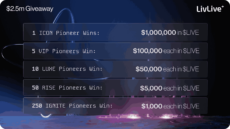
LivLive+ giveaway prize structure. Source: LivLive+
The referral program also looks solid. 10% commissions to senders and 5% to redeemers give people a real incentive to spread the word.
If the community grows organically through referrals, the presale could accelerate faster than my conservative estimates.
LivLive Price Prediction 2026
For 2026, I predict LIVE could trade between $0.15 and $0.52, with an average of $0.30. This assumes the team delivers the TGE and secures exchange listings as outlined in the roadmap.
The project stated a $0.25 launch price, which already represents a 12.5x jump from the Stage 1 presale price. But I’m not sure if the price will stop there.
If the exchange listings generate real volume and the platform launches with active users, LIVE could push well beyond that initial target. We’ve seen it happen with projects that have far less going for them.
What gives me confidence is that the AR concept isn’t some untested experiment. Pokémon GO proved that location-based gameplay can attract massive audiences when executed properly.
At its peak, over 200 million monthly players spent 75 minutes a day chasing virtual creatures around their neighborhoods. That’s more daily engagement than most social media apps manage to pull off.
The closed-loop economy is what really separates LivLive from Pokémon GO and the move-to-earn projects that came before it. Businesses need to buy LIVE to sponsor quests and reach local users, players earn from those activities and spend tokens on upgrades and features, and the whole system circulates value.
The 20% marketing allocation also tells me the team understands how this game works. The best tokenomics in the world mean nothing if nobody knows the project exists.
Sustained campaigns throughout 2026 could build real momentum, and with actual utility waiting on the other side, that attention has a chance to convert into lasting adoption.
LivLive Price Prediction 2030
Looking out to 2030 feels almost reckless in crypto, but here’s my take anyway. LIVE could trade between $0.06 and $0.88, with my average target at $0.42.
Most tokens from 2020 have completely disappeared, and the survivors all share something in common. They solved real problems for real users. LivLive has a shot because it combines hardware integration with a two-sided economy where businesses and players both need the token to participate. And that truly is rare.
The bigger picture favors this model, too. Global ad spend exceeds $1 trillion annually, and most of it gets wasted on bot traffic and fake clicks.
LivLive offers businesses GPS-verified engagement with real users who physically showed up. Marketing departments will pay for that kind of proof once they understand what’s possible.
LIVE Price Prediction Summary
Here’s my complete LivLive price forecast:
| Year | Potential Low | Average Price | Potential High |
| 2025 | $0.02 | $0.035 | $0.06 |
| 2026 | $0.15 | $0.30 | $0.52 |
| 2030 | $0.06 | $0.42 | $0.88 |
What Is LivLive?

LivLive+ promotional banner. Source: LivLive+
LivLive wants to pay you to show up at places, and not in some abstract Web3 way where you stake tokens and watch numbers go up, but literally paying you to walk around your city, visit businesses, and leave reviews. The team calls it “the gamified layer for reality”, and for once, that kind of tagline truly matches what the project does.
The concept sounds like Pokemon GO meets Web3, and honestly, that comparison alone got my attention.

LivLive+ app with the league leaderboard. Source: LivLive
The whole system runs through a wearable wristband that tracks your real-world actions. GPS confirmation, environmental scans, timestamps.
When you complete a quest or check into a location, the wristband verifies you were actually there and records it on-chain. This solves the problem that killed most move-to-earn projects before LivLive – people spoofing their location from the couch while claiming they walked 10,000 steps.
The presale has raised over $2.1 million from 367 holders, with $2 million of that from private investors. The team announced a $0.25 launch price and plans for exchange listings within 12 to 18 months.
A Closer Look at LivLive’s Tokenomics
The LIVE token has a 5 billion total supply, with most of it flowing toward presale buyers and mining rewards.
- Total Supply: 5,000,000,000 LIVE
- Network: Base (secured by Ethereum)
- Current Price: $0.02 (Stage 1)
- Presale Raised: $2,191,205
- Current Holders: 367
Here’s how they distributed their tokens:
- Presale: 25% (1.25 billion tokens) for early investors with 12-month vesting
- Mining: 40% (2 billion tokens) for rewards over 48-month vesting period
- Treasury: 10% (500 million tokens) for growth initiatives with 6-month cliff and 24-month vesting
- Liquidity: 10% (500 million tokens) for exchange pools, 100% unlocked at TGE
- Competition and Growth: 5% (250 million tokens) with 25% unlocked at TGE and 12-month vesting
- Team and Advisors: 5% (250 million tokens) with 6-month cliff and 24-month vesting
- Private Sale: 5% (250 million tokens) with 12-month cliff and 12-month vesting
What I like about these tokenomics is the heavy allocation toward mining rewards. That 40% for mining means active users who engage with the platform get rewarded substantially over time.
Factors That Will Determine LivLive’s Price Performance
Here’s what could affect $LIVE’s price over the coming years (both positively, and otherwise):
Platform Launch and User Adoption
The AR platform is the whole value proposition here. If people don’t download the app, wear the wristband, and actually complete quests, nothing else matters.
Pokémon GO already proved this model can work at a massive scale, and LivLive takes that same formula but pays you to play. That’s a meaningful difference. Chasing virtual creatures for fun kept people engaged for months. But chasing real tokens with real value? I think that could hold attention even longer.
Wristband Hardware Delivery
Hardware changes the story completely with the tiered wristband system costing $250 to $10,000, which could generate upfront revenue.
The hardware also creates user commitment in a way that free apps never can. Someone who spent $500 on a Rise wristband isn’t going to abandon the platform after two weeks. They’ll keep completing quests to justify their purchase.
The risk is obvious, though. Manufacturing is hard, and shipping globally is harder. One supply chain delay or quality control issue and the whole timeline slips.
I’ve seen hardware startups with bigger teams and deeper pockets stumble on logistics. LivLive needs to execute flawlessly here, or the presale momentum could die waiting for wristbands that never arrive.
Business Adoption
Players earning tokens means nothing if there’s no demand on the other side. Businesses need to actually buy LIVE to sponsor quests, and that purchase pressure is what gives the token real value beyond speculation.
The sell to businesses makes sense on paper. A restaurant owner currently pays for Instagram ads that might reach their target audience, might get real clicks, might convert to actual customers. Three “mights” in a row.
LivLive offers something concrete instead. Sponsor a quest, get verified foot traffic from users who physically walked into your location. That’s not an impression or a click, but a person standing at the counter.
The question is whether local businesses will actually adopt a crypto-based marketing tool. Most shop owners don’t have MetaMask installed and don’t want to learn. LivLive needs to make the onboarding dead simple or build some kind of fiat-to-quest pipeline that abstracts the crypto away entirely.
The whitepaper doesn’t go deep on this, and I think it’s the biggest execution question the team faces.
How to Buy LivLive
Buying LIVE during the presale is straightforward if you’ve purchased any presale token before.
- Head to livlive.com and click Connect Wallet.
- Select MetaMask, Trust Wallet, Phantom, or whatever you use.
- Pick your payment method (ETH, USDT, BNB, SOL, or credit card).
- Enter a custom amount or choose one of the Token and NFT Pack tiers.
- Approve the transaction and you’re done.
The pack tiers run from $250 for Ignite up to $10,000 for Icon. Each one includes your token allocation, bonus mining tokens, a physical wristband, and a shot at the $2.5 million giveaway vault.
Higher tiers also come with stronger mining multipliers, which means more LIVE earned per action once the platform goes live.
You can also just buy tokens without a pack if you want smaller exposure. Enter whatever amount you’re comfortable with and skip the hardware. Just know that token-only purchases don’t include the wristband or the full bonus structure.
You’ll need the wristband eventually to actually use the platform, so factor that into your decision.
Pro tip: Scam sites tend to pop up around any presale that gets popular, so double-check you’re on the correct site before you connect anything. Bookmark it after your first visit, and you won’t have to worry about landing on some copycat domain later.
How LivLive Compares to Other Presale Price Predictions
LivLive isn’t the only presale worth watching right now. If you’re weighing your options, here’s how a few other projects compare on paper.
Bitcoin Hyper (HYPER)
Bitcoin Hyper has raised over $28.5 million for its Bitcoin Layer 2 solution. The project wants to bring fast, low-cost transactions to Bitcoin through the Solana Virtual Machine protocol.

Bitcoin Hyper promotional banner. Source: Bitcoin Hyper
That’s serious money for a presale, and the on-chain data shows consistent daily inflows.
Bitcoin Hyper price prediction for 2025:
| Potential Low | Average Price | Potential High |
| $0.15 | $0.08 | $0.20 |
Maxi Doge (MAXI)
Maxi Doge leans into the degen trader aesthetic with a jacked Shiba Inu mascot and no pretense about what it is. Pure meme coin energy, 50 presale stages, and a community that embraces high-risk plays.

Maxi Doge promotional banner. Source: Maxi Doge
The project has pulled in over $4.29 million so far, which tells you there’s appetite for this kind of project even in a bearish meme market. Coinsult and SolidProof both audited the contracts, and the tokenomics look clean.
Maxi Doge price prediction for 2025:
| Potential Low | Average Price | Potential High |
| $0.0002745 | $0.002001 | $0.003294 |
PepeNode (PEPENODE)
PepeNode offers a mine-to-earn meme coin ecosystem where users buy virtual mining nodes. Players upgrade facilities with PEPENODE tokens to earn rewards without expensive hardware requirements.

PepeNode promotional banner. Source: PepeNode
The presale has hit $2.3 million so far. Price predictions suggest PEPENODE could reach $0.003294 by late 2025 if the gamified mechanics attract long-term users.
PepeNode price prediction for 2025:
| Potential Low | Average Price | Potential High |
| $0.0002745 | $0.002001 | $0.003294 |
Final Thoughts
LivLive combines things you don’t often see in the same presale. Hardware that ships to your door, an AR platform with proven mechanics, business demand that creates real buy pressure, and tokenomics that don’t scream “dump incoming”.
Most projects have maybe one of these. LivLive built all four into the same ecosystem.
I believe that we could see $LIVE 15X by late 2026 if the team does their job well.
The longer-term targets reaching $0.88 by 2030 depend on whether the platform truly gets popular and survives a few market cycles. That’s a big if, but the foundation looks solid.
Stage 1 buyers have a really good entry point right now. The 12.5x upside to launch price, mining rewards, and giveaway eligibility give you multiple ways to come out ahead even if the token doesn’t moon immediately. However, as a presale it remains inherently risky investment, so never put in more than you can comfortably afford to lose.
FAQ
What is the LIVE price prediction for 2025?
What is the LIVE price prediction for 2030?
Is LIVE a good investment?
References
- LivLive Audit – Coinsult
- Pokemon Go – Business of Apps
Coinspeaker in Numbers
250K+
Monthly Users
80+
Articles & Guides
5000+
Research Hours
23
Authors
guides
Best AI Crypto in 2026: Top Artificial Intelligence Cryptocurrencies
February 1st, 2026
Vortex FX Launch Date
February 1st, 2026
Is VFX a Scam or Legit?
January 31st, 2026
If you have been following VFX token, you probably noticed the same question popping up everywhere: when does Vortex FX token actu...
The VFX token is tied directly to Vortex FX, a regulated forex broker that’s already executing trades and publishing live trading ...
Filip Stojanovic
, 43 postsI’m a crypto content strategist and writer who helps Web3 projects tell their story, build trust, and grow engaged communities in an increasingly competitive space. I’ve worked with presale tokens, exchanges, blockchain startups, and crypto marketing agencies, shaping content strategies that not only explain complex concepts but also inspire confidence, attract investors, and drive adoption.
My experience spans a wide variety of formats, from whitepapers, token launch campaigns, and pitch decks to thought leadership articles, technical documentation, and in-depth guides. Before diving into Web3, I built my expertise in B2B SaaS writing. This structured, analytical approach now underpins my work in crypto, allowing me to bring clarity and credibility to projects in a space often criticized for hype and jargon.
I’m especially interested in how blockchain innovation translates into real-world utility. My recent work explores the evolving role of DeFi protocols, NFT ecosystems, and next-generation infrastructure in reshaping industries and creating new opportunities for both businesses and individuals.