
 Fact-Checked by:
 16 mins
 Crypto theft is more common than most traders think, and it rarely takes a sophisticated hack. A forgotten token approval, a poorl...
Pepe Price Prediction 2026-2036
Pepe
PEPE
$0.000003
24h volatility:
2.1%
Market cap:
$1.34 B
Vol. 24h:
$229.68 M
is currently trading at $0.0000031 as of March 8, 2026. In the last 30 days, the token has pulled back, and over the past 24 hours, PEPE has slipped lower.
Our model tracks price momentum, volatility patterns, and trader sentiment to gauge PEPE’s near-term direction. Right now, the short-term outlook is cautious, with our 24-hour forecast shown below. For longer time horizons, we project PEPE could trade around $0.0000031 by the end of 2026.
Exploring potential Pepe price targets
This PEPE price prediction examines where the token might head across short-, medium-, and long-term timeframes by analyzing past behavior, technical signals, social sentiment, and macro conditions. We built this guide to help you do your own research. It’s not investment advice, so don’t treat it as such.
Pepe Live Price & Market Snapshot – March 8, 2026
| Current price | $0.0000031 |
| 24h change | -2.14% |
| Market cap | $1.34B |
| Circulating supply | 420.69T |
| Total supply | 420.69T |
| All-time high | $0.000028 |
Pepe has faced some resistance over the past week, suggesting that traders remain cautious amid broader market volatility. Over the last month, the price action reflects the ongoing cooldown in speculative interest across memecoins.
PEPE stands out from most meme coins because of its burn-style token design. The team sent some PEPE to an Ethereum “dead” address, effectively removing it from circulation and reducing the liquid float. Plus, unlike coins that launch with large team allocations or VC backing, Pepe’s launch had no presale, with the majority of the supply seeded on DEXs.
That said, whale concentration is still a risk. Holder distribution data suggests the top 10 wallets control roughly 40% of the supply, so large sell orders can move the market quickly when liquidity is thin. The good news is that access has broadened since launch. Major CEXs like Binance and OKX now list PEPE.
Quick Forecast – Pepe Price Predictions at a Glance
Our Pepe PEPE $0.000003 24h volatility: 2.1% Market cap: $1.34 B Vol. 24h: $229.68 M price forecasts combine historical trends, technical signals, social sentiment, market conditions, and community-driven analyst estimates. Below are the low, average, and high scenarios across different timeframes:
| Year | Potential Low | Average | Potential High |
| 2026 | $0.0000028 | $0.0000031 | $0.0000035 |
| 2027 | $0.0000035 | $0.0000039 | $0.0000042 |
| 2036 | $0.0000056 | $0.0000097 | $0.000016 |
These ranges frame uncertainty rather than lock in exact targets. The potential low reflects a scenario in which meme coin interest fades, whales sell their holdings, or speculative capital rotates into other crypto narratives (such as RWAs).
The average price assumes Pepe maintains steady social momentum and continues to benefit from periodic viral moments and exchange support. The potential high would require a full-blown meme coin “supercycle”: think sustained retail FOMO, celebrity endorsements, and Pepe adding some utility features.
Pepe Short-Term Price Outlook (Next 30 Days)
Over the last seven days, Pepe’s price decreased to $0.0000031 (-5.95%). In the past month, it faced consistent selling pressure.
| Date | Potential Low | Average Price | Potential High |
|---|---|---|---|
| March 9, 2026 | $0.0000031 | $0.0000031 | $0.0000031 |
| March 10, 2026 | $0.0000031 | $0.0000031 | $0.0000032 |
| March 11, 2026 | $0.0000031 | $0.0000031 | $0.0000032 |
| March 12, 2026 | $0.0000031 | $0.0000031 | $0.0000032 |
| March 13, 2026 | $0.0000031 | $0.0000031 | $0.0000032 |
| March 14, 2026 | $0.0000031 | $0.0000032 | $0.0000032 |
| March 15, 2026 | $0.0000031 | $0.0000032 | $0.0000032 |
| March 16, 2026 | $0.0000031 | $0.0000032 | $0.0000032 |
| March 17, 2026 | $0.0000031 | $0.0000032 | $0.0000032 |
| March 18, 2026 | $0.0000031 | $0.0000032 | $0.0000032 |
| March 19, 2026 | $0.0000032 | $0.0000032 | $0.0000032 |
| March 20, 2026 | $0.0000032 | $0.0000032 | $0.0000032 |
| March 21, 2026 | $0.0000032 | $0.0000032 | $0.0000032 |
| March 22, 2026 | $0.0000032 | $0.0000032 | $0.0000032 |
| March 23, 2026 | $0.0000032 | $0.0000032 | $0.0000032 |
| March 24, 2026 | $0.0000032 | $0.0000032 | $0.0000032 |
| March 25, 2026 | $0.0000032 | $0.0000032 | $0.0000032 |
| March 26, 2026 | $0.0000032 | $0.0000032 | $0.0000032 |
| March 27, 2026 | $0.0000032 | $0.0000032 | $0.0000032 |
| March 28, 2026 | $0.0000032 | $0.0000032 | $0.0000032 |
| March 29, 2026 | $0.0000032 | $0.0000032 | $0.0000033 |
| March 30, 2026 | $0.0000032 | $0.0000032 | $0.0000033 |
| March 31, 2026 | $0.0000032 | $0.0000032 | $0.0000033 |
| April 1, 2026 | $0.0000032 | $0.0000032 | $0.0000033 |
| April 2, 2026 | $0.0000032 | $0.0000032 | $0.0000033 |
| April 3, 2026 | $0.0000032 | $0.0000032 | $0.0000033 |
| April 4, 2026 | $0.0000032 | $0.0000032 | $0.0000033 |
| April 5, 2026 | $0.0000032 | $0.0000032 | $0.0000033 |
| April 6, 2026 | $0.0000032 | $0.0000032 | $0.0000033 |
| April 7, 2026 | $0.0000032 | $0.0000032 | $0.0000033 |
Because PEPE has no unlock schedule left (100% of the supply is already circulating), the next 30 days hinge on macro liquidity, whale activity, and meme coin risk appetite.
Investors expect rates to hold, but Fed Chair Jerome Powell’s tone matters. Dovish language gives meme coins room to run; hawkish commentary or inflation concerns trigger fast de-risking, and PEPE typically drops harder than BTC or ETH in those scenarios.
February 11 brings US CPI data for January, which is often the most volatile macro print of the month. Hot inflation forces traders to expect higher rates and typically hurts speculative assets. On the other hand, cool CPI does the opposite and can lead to rallies across meme coins.
Whale behavior is also elevated. Santiment flagged PEPE among tokens seeing massive surges in $100K+ transactions (up 620% in early January). This surge in whale activity cuts both ways – it drives price surges but also amplifies crashes when whales exit.
With PEPE finding support after recent weakness, a dovish Fed tone plus steady BTC growth could spark a quick reversal.
Pepe Medium-Term Forecast 2026-2027
Over the next 12 months, three forces will shape Pepe’s price: Fed policy across multiple FOMC meetings, progress on US crypto legislation, and whether meme coin appetite holds through mid-2026.
Here’s our PEPE price forecast through 2026:
| Month | Potential Low | Average Price | Potential High |
|---|---|---|---|
| April 2026 | $0.0000032 | $0.0000032 | $0.0000032 |
| May 2026 | $0.0000032 | $0.0000032 | $0.0000033 |
| June 2026 | $0.0000032 | $0.0000033 | $0.0000034 |
| July 2026 | $0.0000032 | $0.0000033 | $0.0000034 |
| August 2026 | $0.0000033 | $0.0000034 | $0.0000035 |
| September 2026 | $0.0000033 | $0.0000034 | $0.0000036 |
| October 2026 | $0.0000033 | $0.0000035 | $0.0000036 |
| November 2026 | $0.0000033 | $0.0000035 | $0.0000037 |
| December 2026 | $0.0000034 | $0.0000036 | $0.0000038 |
| January 2027 | $0.0000034 | $0.0000036 | $0.0000039 |
| February 2027 | $0.0000034 | $0.0000037 | $0.0000039 |
| March 2027 | $0.0000034 | $0.0000037 | $0.0000040 |
If momentum continues, PEPE could build on its half-year gains and push toward new highs by mid-2026.
The biggest macro event calendar runs through all of 2026: FOMC meetings in January, March, April, June, July, September, October, and December. The March, June, September, and December meetings include updated Fed projections, which can quickly alter crypto sentiment.
In terms of regulation, senators introduced a draft crypto market structure bill in January to clarify jurisdiction between the SEC and CFTC. The Senate Banking Committee delayed discussions after Coinbase’s opposition, but progress on the bill would reduce uncertainty and unlock more US crypto liquidity. Messy or hostile drafts do the opposite and compress risk appetite.
Europe’s MiCA transition deadline is July 1, 2026, after which crypto asset service providers must operate under full licensing. Tighter venue standards can reduce access to high-volatility tokens like PEPE, capping upside.
Ethereum’s Glamsterdam upgrade should land mid-2026, targeting lower execution costs and improved throughput. PEPE is an ERC-20 token, so cheaper gas helps keep meme liquidity on Ethereum instead of bleeding to cheaper chains (like Solana). Not a direct catalyst for PEPE, but it keeps trading friction low.
Pepe Long-Term Price Forecast 2026-2036
Over the next decade, PEPE’s survival comes down to two questions: Does the Pepe the Frog meme stay culturally relevant, and does crypto liquidity keep flowing into speculative tokens?
Here’s our 10-year PEPE price forecast:
| Year | Potential Low (ROI) | Average Price (ROI) | Potential High (ROI) |
|---|---|---|---|
| 2027 | $0.0000035 (11.28%) | $0.0000039 (22.56%) | $0.0000042 (33.84%) |
| 2028 | $0.0000039 (22.52%) | $0.0000046 (47.32%) | $0.0000055 (74.41%) |
| 2029 | $0.0000042 (33.44%) | $0.0000055 (73.61%) | $0.0000070 (121.13%) |
| 2030 | $0.0000045 (43.77%) | $0.0000063 (100.53%) | $0.0000086 (172.65%) |
| 2031 | $0.0000048 (53.20%) | $0.0000072 (126.96%) | $0.000010 (226.74%) |
| 2032 | $0.0000051 (61.46%) | $0.0000080 (151.62%) | $0.000012 (280.33%) |
| 2033 | $0.0000053 (68.28%) | $0.0000087 (173.17%) | $0.000013 (329.73%) |
| 2034 | $0.0000055 (73.43%) | $0.0000092 (190.30%) | $0.000015 (371.01%) |
| 2035 | $0.0000056 (76.72%) | $0.0000096 (201.90%) | $0.000015 (400.47%) |
| 2036 | $0.0000056 (78.03%) | $0.0000097 (207.14%) | $0.000016 (415.13%) |
If interest continues, PEPE is positioned to benefit from compounding meme-cycle effects and tightening whale positioning by 2030.
Bitcoin’s halving cycles provide the cleanest framework for thinking about Pepe over a decade. The next halvings should be in April 2028, 2032, and 2036. Historically, meme coins take off late-cycle when BTC and ETH are already up, and traders rotate into more speculative plays. That pattern isn’t guaranteed, but it’s worth considering.
PEPE’s supply works differently than Layer 1 tokens like ETH. There’s no unlock schedule, as the entire 420.69 trillion token supply is in circulation. The “supply overhang” is whale concentration. If large holders distribute into rallies, it caps PEPE’s upside. But if they hold or accumulate, supply tightens.
Regulation won’t kill PEPE, but it changes how traders view it. For example, the UK will launch its crypto regime in October 2027. Tighter compliance frameworks might reduce regulatory risk premiums, but they also restrict meme coin listings and tamp down available leverage.
Cultural fade and whale exits are risks, too. Pepe imagery has faced platform moderation and IP enforcement in the past. So if social platforms throttle Pepe content again, or if whales distribute into retail FOMO, the coin loses momentum permanently.
Ultimately, we forecast an average PEPE price of $0.0000063 in 2030, with a potential high of $0.0000086 and a possible low of $0.0000045.
Methodology for Price Predictions
We built our PEPE price predictions from multiple inputs:
- Historical price trends: We analyze PEPE’s past bull and bear cycles across multiple timeframes to track how the token behaves.
- Market sentiment: We adjust sentiment scores based on social media volume (particularly on X), whale transaction spikes, and crypto news flow. PEPE’s price is heavily sentiment-driven, so this carries more weight than it would for a Layer 1 token like SOL or ETH.
- Volatility analysis: We measure price swings across 1-day, 7-day, 180-day, and 3-year windows. Meme coins like PEPE exhibit extreme volatility, so understanding baseline chop helps frame realistic price ranges.
- Technical indicators: We track simple moving averages (SMA) and the relative strength index (RSI) to identify trend strength and potential reversal zones. These indicators help spot when PEPE is overbought or oversold.
- Long-term growth assumptions: Since PEPE has no protocol revenue or developer activity, we anchor long-term projections to cultural durability, whale behavior, and whether crypto liquidity continues to flow into meme coins.
- Macroeconomic context: We factor in Fed policy, interest rates, inflation trends, and risk appetite.
Prediction Scenarios
We provide three ranges:
- Potential Low: Conservative downside case assuming adverse macro conditions, whale selling, or controversy.
- Average: Most likely outcome based on the current market structure and typical meme coin behavior.
- Potential High: Optimistic scenario where a meme coin supercycle, whale buying, and dovish macro conditions align.
The model adjusts parameters for meme coins versus Layer 1 tokens to reflect higher volatility and sentiment dependence.
What Analysts Predict
No banks or institutional research firms publish PEPE price targets – most won’t touch meme coins. But crypto traders and technical analysts have made their own predictions based on chart patterns and sentiment:
- Ali Martinez (X: @ali_charts) flagged a bearish setup in late 2025, projecting PEPE could drop to around $0.00000185 if a head-and-shoulders breakdown plays out. That would represent roughly 67% downside from the price when Ali made the call.
- Win’s Crypto Trading School projected a move to $0.00012 by Q1 2026. The call was based on accumulation wedge patterns and Fibonacci extension targets, assuming meme coin liquidity returns.
- Chandler (X: @ChandlerCharts) took an even more aggressive stance in late 2025, mapping a potential breakout first toward $0.000015, then eventually $0.00035 in a “massive rally” scenario. The projection uses cycle-based fractal analysis, which is highly dependent on assumptions.
These targets vary wildly because, as a meme coin, PEPE is impossible to predict. The coin could just as easily rally 100% on a celebrity endorsement as it could drop 50% if a whale sells off.
Bullish vs Bearish Scenarios
Here’s what could push PEPE higher – and what could send it lower:
Bullish Catalysts
- Meme coin supercycle: If retail FOMO returns and speculative capital rotates into meme coins during a crypto bull run, PEPE benefits from being a “blue-chip token” alongside DOGE and SHIB.
- Whale accumulation: If large holders begin to accumulate, supply tightens. Exchange balance data can highlight this shift before PEPE’s price moves.
- Lower Ethereum gas fees: Cheaper transactions on Ethereum (from upgrades or Layer 2 scaling) make meme coin trading more accessible, helping PEPE.
- Viral moments: Celebrity endorsements (like Elon Musk) or viral social media trends related to Pepe the Frog could lead to price spikes that last for weeks.
Bearish Risks
- Whale exits: PEPE has significant holder concentration. Large wallets dumping can tank the token’s price overnight.
- Cultural fade: If meme coin interest rotates to other, newer narratives (like RWAs), PEPE loses momentum.
- Platform restrictions: Exchange delistings, leverage clamps, or margin pair removals reduce access and compress upside.
- Macro tightening: Hawkish Fed policy or a broader risk-off sentiment hits high-beta meme coins first – and usually hardest.
Unknown Variables
Black swan events, like one of the best crypto exchanges collapsing, hacks, or geopolitical shocks, remain impossible to predict. Platform-level bans on Pepe the Frog imagery (similar to past controversies) could also materially impact PEPE’s price.
Should You Invest in Pepe?
Pepe is a speculative meme cryptocurrency with no established utility or revenue-generating model. It primarily attracts traders willing to accept high volatility and significant downside risk, often viewing such assets as small, high-risk positions rather than long-term portfolio holdings.
Even the prices of the best meme coins can move fast in both directions, and liquidity can dry up when sentiment flips negative. A 50%+ drawdown in a single week isn’t unusual.
Before buying, check whale wallet concentrations on-chain and track exchange inflows and outflows. Large wallets dumping can tank Pepe’s price overnight. Also, verify that you’re buying the legitimate contract address, since Pepe imitators regularly flood DEXs.
In terms of portfolio allocation, meme coins should represent a tiny slice (if you include them at all). They amplify volatility without adding diversification, as they correlate closely with Bitcoin and other large altcoins. Treat Pepe like a lottery ticket.
Pepe Price Chart and Historical Performance
PEPE launched in April 2023, created by an anonymous developer (or group) with no ties to Matt Furie, who is the artist behind the original Pepe the Frog meme. The token went viral fast, capitalizing on social media momentum and exchange listings.
The first big catalyst came on May 5, 2023, when Binance listed PEPE in its Innovation Zone. That opened the floodgates for liquidity and retail access, giving the token its first explosive rally. But like most meme coins, the hype cooled through summer 2023 as early holders took profits.
Then came the multisig drama. In late August 2023, roughly 16 trillion PEPE moved from the project’s multisig wallet toward exchanges, leading to a sharp selloff. The official PEPE account later claimed that three former team members stole the tokens. The project attempted damage control in October 2023 with a $5.5 million token burn.
PEPE’s second cycle started in 2024. Coinbase listed the token in November 2024, and PEPE hit its all-time high of $0.00002803 on December 9, 2024, briefly pushing its market cap past $11 billion.
Since then, PEPE has pulled back hard: it’s currently down roughly 82% from that peak. The past year has been extremely choppy, with whale-driven volatility and fading retail interest that’s typical of meme coins after a blow-off top.

Pepe (PEPE)
24h7d30d1yAll time
PEPE trades at $0.0000031 (-2.14%) as of March 8, 2026.
Pepe Technical Analysis and Key Indicators
Technical analysis helps you see where PEPE sits within its recent trend and whether momentum favors buyers or sellers. It won’t tell you what happens next, but it shows you the current setup.
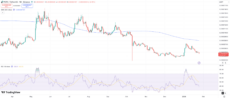
Pepe’s daily price chart with 200-day SMA and 14-day RSI. Source: TradingView
The chart above shows PEPE’s price alongside its 200-day simple moving average (SMA) and the 14-day relative strength index (RSI). The 200-day SMA averages roughly six months of price action and typically acts as a key support or resistance level.
PEPE is trading below its 200-day SMA, suggesting that the medium-term trend remains weak. For the technical picture to flip bullish, PEPE would need to reclaim and hold above the 200-day SMA, which would likely require a direct catalyst or a broader meme coin rally.
The RSI measures momentum on a 0–100 scale. Readings above 70 suggest overbought conditions; below 30 is oversold territory. PEPE’s RSI sits around 38, which is below neutral but not yet oversold. This is the kind of reading you see when selling pressure has eased, but buyers haven’t committed yet.
Bottom line: PEPE is in a weak technical position. Price is below the 200-day SMA, and momentum is soft. So without a clear catalyst, the path of least resistance remains sideways to lower.
US and Global Regulatory & Tax Considerations
- United States: The IRS treats PEPE as property. Selling, swapping, or spending PEPE triggers a taxable event that you must report on Form 8949 and Schedule D. Centralized exchanges require full KYC under AML rules. PEPE trades on Kraken and Binance.US, though state-by-state restrictions apply.
- United Kingdom: HMRC applies capital gains tax to PEPE disposals, with new CARF reporting requirements for UK platforms starting in January 2026. Exchanges must register under AML regulations.
- European Union: Tax treatment varies by country, but disposals are typically taxable events. MiCA classifies PEPE as “other cryptoassets” (not a stablecoin). EU travel rules require sender/beneficiary data for regulated transfers.
Exchange access varies a lot. Kraken and Binance list PEPE, but Coinbase UK explicitly does not offer spot trading. Always verify availability in your jurisdiction before trying to buy.
Forecasts represent possible scenarios based on current information, not guarantees. Cryptocurrency markets are highly volatile and unpredictable. Past performance does not indicate future results.
FAQ
What will PEPE be worth in 2026?
Can PEPE reach $1?
Is PEPE a good investment?
How accurate are crypto price predictions?
What factors affect PEPE’s price?
Where can I buy PEPE?
References
- Pepe Rich List (CoinLore)
- FedWatch Tool (CME Group)
- Understanding Bitcoin Halving: Impact on Price and Investment Strategies (Investopedia)
- PEPE Token Unlocks (CoinMarketCap)
- PEPE Price Stats (Gemini)
Coinspeaker in Numbers
250K+
Monthly Users
80+
Articles & Guides
5000+
Research Hours
23
Authors
guides
How to Keep Your Crypto Safe in 2026: Guide For Traders
March 6th, 2026
LiquidChain (LIQUID) Price Prediction 2026, 2027, and 2030
February 4th, 2026
IPO Genie Launch Date – When Does the Presale End?
February 4th, 2026
LiquidChain is a Layer 3 blockchain project that wants to unify the liquidity of Bitcoin, Ethereum, and Solana into a single execu...
The team behind IPO Genie has not yet announced an end date for the presale.
Otar Topuria
Crypto Editor, 40 postsI’m a crypto writer and analyst at Coinspeaker with over three years of experience covering fintech and the rapidly evolving cryptocurrency landscape. My work focuses on market movements, investment trends, and the narratives driving them, helping readers what is happening in the markets and why. In addition to Coinspeaker, my insights and analyses have been featured in other leading crypto and fintech publications, where I’ve built a reputation as a thoughtful and reliable voice in the industry.
My mission is to demystify the crypto markets and help readers navigate the noise, highlighting the stories and trends that truly matter. Before specializing in crypto, I worked in the IT sector, writing technical content on software development, digital innovation, and emerging technologies. That made me something of an expert in breaking down complex systems and explaining them in a clear, accessible way, skills I now find very useful when it comes to unpacking the intricate world of blockchain and digital assets.
I hold a Master’s degree in Comparative Literature, which sharpened my ability to analyze patterns, draw connections across disciplines, and communicate nuanced ideas. I’m particularly passionate about early-stage project discovery and crypto trading, areas where innovation meets opportunity. I enjoy exploring how new protocols, tokens, and DeFi projects aim to disrupt traditional systems, while also evaluating their potential risks and rewards. By combining market analysis with forward-looking research, I strive to provide readers with content that is both informative and actionable.