
 Fact-Checked by:
 12 mins
 Most crypto swap platforms have an identity threshold at some point in the process, such as a KYC trigger buried in the terms, a c...
What Is Dogecoin (DOGE)? Definition, Meaning & How It Works
Dogecoin (DOGE) is a meme coin cryptocurrency based on the Shiba Inu “Doge” meme. It launched in 2013 as a fork of Litecoin and uses a proof-of-work algorithm, although it doesn’t have a capped supply. Over the years, it gained a large following and is now the largest meme coin with a market cap of nearly $20 billon, sitting comfortably among the top 10 biggest cryptocurrencies.
In this guide, we’ll explain the Dogecoin ecosystem and discuss the characteristics that set the project apart from other well-known crypto assets like Bitcoin and its closest memecoin competitors like Shiba Inu. We’ll also discuss Dogecoin’s (intentional) inflation and why that’s not necessarily a bad thing. Let’s get started with some key takeaways before we dive deeper into Dogecoin.
Key Takeaways
- Dogecoin has an unlimited supply with a fixed annual inflation. This structure is designed to replace lost coins and keep transaction fees low.
- Dogecoin utilizes the Scrypt algorithm for Proof-of-Work consensus and is “merge-mined” with Litecoin. Miners secure both networks simultaneously without expending extra energy.
- Originally used for internet tipping, now Dogecoin is accepted by major corporations like Tesla for merchandise and even trades on the stock market via a spot Dogecoin ETF.
What Is Dogecoin (DOGE)? – Dogecoin Definition
Dogecoin (DOGE) is a Shiba Inu-themed meme coin with limited use cases beyond payment purposes. It is the largest meme coin by market capitalization.
Since its launch in late 2013, Dogecoin (DOGE) has proven to be a cryptocurrency of a different breed. It was initially envisioned as a lighthearted coin with little utility beyond payments, with its appeal being primarily in its quirky meme-themed design. Sending peer-to-peer payments on the Dogecoin network was intended to be cheap and easy, making it a cryptocurrency for everyone.
The project began as a tongue-in-cheek dig at the all-too-serious crypto industry of the era and featured an impish Shiba Inu dog as its mascot. Despite the coin’s irrelevance (or because of it), Dogecoin quickly found a market fit on platforms like Reddit, where DOGE became a tipping currency.

Dogecoin homepage. Source: Dogecoin
Two software engineers, Billy Markus (from IBM) and Jackson Palmer (from Adobe), launched Dogecoin as a new cryptocurrency in December 2013. Dogecoin lore has it that the code took three hours to write, using code forked from the Luckycoin project (which is now attempting a revival).
For years, the project effectively ran on autopilot. Palmer exited in 2014 and Markus followed him out the door in 2015, leaving the code entirely to a volunteer Dogecoin community. This worked fine until 2021, when the price exploded. Suddenly, Dogecoin was a $40 billion asset, and it became obvious that a global financial network needed more than just “vibes” to stay afloat.
The solution: Wake up the Dogecoin Foundation. The foundation was rebooted in 2021 to provide stewardship and legal structure. The resulting hierarchy looks very different today, now a blend of die-hard coders and corporate heavyweights. Principal Engineer Michi Lumin and CTO Timothy Stebbing manage the Dogecoin “Trailmap”, while a high-powered advisory board includes Ethereum co-founder Vitalik Buterin and Jared Birchall, the manager of Elon Musk’s family office.
How Does Dogecoin Work?
Dogecoin operates on its own dedicated blockchain. It’s an open-source, distributed ledger that lets you send value in the form of DOGE tokens directly to another person, anywhere on the planet. No banks, no payment apps, and no permission required.
The project was based on the code from an earlier project called Luckycoin, itself a Litecoin fork. While Dogecoin diverges from some principles of Bitcoin and Litecoin, the heritage remains. Like its predecessors, Dogecoin uses Proof-of-Work (PoW) to secure the network, centers around a permissionless design, and uses a decentralized ledger for transactions.
Dogecoin is designed to function as a payment cryptocurrency. Source: Dogecoin
To protect the decentralized ledger, Dogecoin activated merge mining (Auxiliary Proof-of-Work) in September 2014 (Block 371,337). This update allowed Litecoin miners to simultaneously secure the Dogecoin blockchain without expending extra energy and gave crypto’s favorite dog coin the security of a major blockchain.
Dogecoin’s Use Cases
Although the project began as a joke, Dogecoin’s usefulness became apparent immediately, as it proved to be a great currency for tipping and spending. Block times of 1 minute mean almost no waiting, while network fees typically cost less than a penny, making transactions quick and inexpensive. Nowadays, Dogecoin’s use cases range from tipping to buying merch and even contributing to charitable foundations.
- Tipping & Microtransactions: The community culture heavily favors tipping online content creators, developers, and charitable causes.
- Merchant Payments: A growing list of companies accept DOGE. This includes the Dallas Mavericks (for tickets and merch), Newegg (for electronics), and perhaps most notably, Tesla, which accepts Dogecoin for merchandise purchases in the Tesla Shop.
- Charitable Fundraising: Throughout the coin’s history, the “Doge Army” has mobilized for causes ranging from funding the Jamaican Bobsled team’s trip to the Olympics to building water wells in Kenya (Doge4Water).
Future use cases parallel those you’d find with most top-tier payment-oriented cryptocurrencies. This is helped by Dogecoin’s position as a top 10 cryptocurrency, making it easy to buy Dogecoin and convert it to any other digital assets as needed.
What Makes Dogecoin Important in Crypto
The project has survived the test of time and multiple crypto cycles. DOGE made it through bear markets in 2018 and 2022, adding new blocks regardless of market volatility. The project also boasts a few technical advantages that make it a better bet than many newer projects that came and went.
The “Doge” meme is universally recognized, reducing the barrier to entry for new retail investors. Many see it as the friendly crypto without the baggage associated with its more serious contemporaries. It is also easily accessible, as it is listed on nearly every major exchange and can be converted to other cryptocurrencies or fiat money with ease.

DOGE has a huge community and is one of the most famous cryptocurrencies. Source: Dogecoin
From the point of view of blockchain technology, Dogecoin’s auxiliary Proof of Work (AuxPoW) ties it with Litecoin’s Scrypt-based mining ecosystem. This makes for much stronger security, as it benefits from Litecoin’s mining hashpower, reducing the chance for a 51% attack, and also gives miners better incentives, since they are able to collect extra rewards.
Importantly, Dogecoin’s tokenomics are inflationary, with the supply growing by about 5.2 billion DOGE each year. This makes it similar to traditional currencies that also expand their supply, but with a predictable inflation rate. This ensures that the main use case, spending, remains possible, which is something that some of the biggest cryptocurrencies like Bitcoin and Ethereum have struggled with in recent years.
Elon Musk, the “Dogefather” of Dogecoin
It’s time to discuss the “Dogefather”, a moniker that Elon Musk often assigns himself in X posts. Musk stands out as the project’s most visible champion since 2019, frequently tweeting memes and often spiking the price with a mere mention of DOGE.
His involvement has been a double-edged sword. On one hand, he catapulted the coin into the mainstream consciousness. Musk’s 2021 Saturday Night Live appearance marked the asset’s all-time high when Dogecoin hit $0.7316. On the other hand, Musk’s influence often adds to DOGE’s price volatility, as fleeting Musk-fueled DOGE rallies typically end in profit-taking that erases most of the gains.

Elon Musk has been at the center of DOGE’s biggest price movements. Source: Internal stock
In 2024 and 2025, this relationship evolved from simple memes to the political stage. Following the 2024 US election, Musk was appointed to lead the Department of Government Efficiency (D.O.G.E.), the acronym being a deliberate nod to the cryptocurrency project. Arguably, the added attention helped fuel renewed market interest in the cryptocurrency, as Dogecoin briefly surpassed $0.48.
Beyond politics, Musk has integrated the coin into his business empire, with Tesla now accepting Dogecoin for merchandise. Speculation also remains high that X (Twitter) will eventually integrate DOGE into its “X Payments” system, potentially turning the social network into a global wallet for the currency.
Advantages and Limitations of Dogecoin
A large and vibrant community and its payment-focused design make Dogecoin one of the most popular cryptocurrencies today. But for each of its advantages, there is also a downside that needs to be weighed carefully before you decide to spend money on a DOGE investment. Let’s take a look at the main advantages and disadvantages of Dogecoin.
Pros
- Fast transactions with low fees: As it was designed for everyday transactions, simple transfers on Dogecoin are typically cheaper and faster than on many other top cryptos.
- Solid security via AuxPoW: Thanks to merge-mining with Litecoin, which validates transactions for both chains, Dogecoin is safer and less susceptible to attacks.
- Huge community and recognition: As the largest meme coin with a huge following, Dogecoin still dominates meme coin circles with excellent liquidity and presence on nearly all Tier-1 exchanges.
Cons
- High volatility: Dogecoin’s price is prone to violent swings based on hype, social media developments, and broader market sentiment. Endorsement by figures like Elon Musk can swing the price both ways.
- Concentration of holdings: Whales control a large portion of DOGE, with sudden flows often artificially inflating the price before a sell-off leaves smaller investors with losses.
- Limitless Proof of Work: Dogecoin’s algorithm has no set maximum supply, which can dilute value over time. As mining is based on PoW, this can raise environmental concerns.
How Dogecoin Relates to Other Cryptocurrencies
When it launched, Dogecoin found its niche by being faster and cheaper to use for daily transactions than its heavier, more serious relatives. While Bitcoin and Litecoin add blocks to their blockchains approximately every 10 minutes and 2.5 minutes, respectively, Dogecoin’s block time is only 1 minute. It also introduces a fundamentally different economic approach to inflation.
Bitcoin and Litecoin create value through their scarcity, as their total supply is limited (21 million for BTC and 24 million for LTC). Instead of capping the supply, the Dogecoin protocol releases 5 billion new DOGE into circulation each year. This fixed inflation discourages hoarding and encourages spending while using a diminished inflation rate to mitigate the effects of increased supply over time.
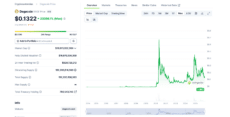
The price history of DOGE is defined by extreme volatility. Source: CoinGecko
Within Dogecoin’s meme coin niche, it still comfortably leads the scoreboards by some margin ahead of its closest competitor, Shiba Inu (SHIB). In fact, Dogecoin’s head start and viral prominence are so great that it basically started the whole meme coin sector as such, with many coins later trying to replicate its resounding success.
Coins like Shiba Inu have emerged to challenge Dogecoin in its own theme by offering advanced use cases and their own take on the “Doge” meme. Others, like Pepe (PEPE), have stuck to the barebones approach, attempting to dethrone it through virality alone. But none have so far managed to seriously threaten DOGE as the largest meme coin, with only SHIB momentarily surpassing DOGE during the 2021 meme coin surge.
Dogecoin’s Future: What to Expect Going Forward
After becoming one of the most successful meme coins of all time, Dogecoin is exiting its puppy phase. For the first decade, the project survived on community vibes, viral memes, and a lot of luck. The next decade depends on proving DOGE can actually function as global money.
The Dogecoin Foundation is currently executing a “Trailmap” that focuses less on hype and more on serious development. The problem they are solving is integration. Historically, adding Dogecoin to a business’s backend proved challenging. New tools like LibDogecoin and GigaWallet aim to fix this e-commerce impasse by giving developers plug-and-play building blocks. The goal is to make adding a “Pay with Doge” button as easy for a merchant as adding Stripe or PayPal.

Dogecoin enters an era of innovation with products like RadioDoge. Source: RadioDoge
They are even testing limits off-grid. The RadioDoge initiative uses Starlink satellites (another Musk connection) and radio waves to enable transactions in remote areas where traditional internet doesn’t exist. It sounds like sci-fi, but it highlights the project’s commitment to being an accessible, universal digital currency.
For investors, the long-term bet centers on adoption rather than scarcity. Dogecoin isn’t trying to be digital gold, the way Bitcoin is often regarded; it’s trying to be digital cash. The future value depends entirely on whether the new “House of Doge” entities and the cryptocurrency community can convince the world to stop hoarding the coin and start spending it.
FAQ
What is Dogecoin?
Who founded Dogecoin?
What is Dogecoin used for?
What was Dogecoin’s highest price?
What are the risks of Dogecoin?
References:
- Dogecoin Inflation – Dogepedia (Dogecoin)
- Luckycoin Foundation (Lucky Coin Foundation)
- Dogecoin Foundation Trailmap (Dogecoin Foundation)
- Using Crypto on Newegg (Newegg)
- Dogecoin Price Plummets as Elon Musk Hosts Saturday Night Live (CNBC)
- Department of Government Efficiency (DOGE)
- Dogecoin | Tesla Support (Tesla)
- GigaWallet – Dogecoin Foundation (Dogecoin Foundation)
- RadioDoge (RadioDoge)
Coinspeaker in Numbers
250K+
Monthly Users
80+
Articles & Guides
5000+
Research Hours
23
Authors
guides
How to Swap Crypto on Godex: A Step-by-Step Guide to No-KYC Crypto Swapping
June 12th, 2026
CoinDepo vs. WhiteBIT Earn Comparison: Yields, Features, Security and More
June 2nd, 2026
Divine Ray (DRC) Price Prediction 2026-2030
June 1st, 2026
In the competitive world of crypto yield generation, CoinDepo and WhiteBIT Earn have built notable reputations as centralized plat...
Although most Web3 social platforms struggle to move beyond the hype phase, Divine Ray has taken a more grounded route. Its team h...
Otar Topuria
Crypto Editor, 41 postsI’m a crypto writer and analyst at Coinspeaker with over three years of experience covering fintech and the rapidly evolving cryptocurrency landscape. My work focuses on market movements, investment trends, and the narratives driving them, helping readers what is happening in the markets and why. In addition to Coinspeaker, my insights and analyses have been featured in other leading crypto and fintech publications, where I’ve built a reputation as a thoughtful and reliable voice in the industry.
My mission is to demystify the crypto markets and help readers navigate the noise, highlighting the stories and trends that truly matter. Before specializing in crypto, I worked in the IT sector, writing technical content on software development, digital innovation, and emerging technologies. That made me something of an expert in breaking down complex systems and explaining them in a clear, accessible way, skills I now find very useful when it comes to unpacking the intricate world of blockchain and digital assets.
I hold a Master’s degree in Comparative Literature, which sharpened my ability to analyze patterns, draw connections across disciplines, and communicate nuanced ideas. I’m particularly passionate about early-stage project discovery and crypto trading, areas where innovation meets opportunity. I enjoy exploring how new protocols, tokens, and DeFi projects aim to disrupt traditional systems, while also evaluating their potential risks and rewards. By combining market analysis with forward-looking research, I strive to provide readers with content that is both informative and actionable.