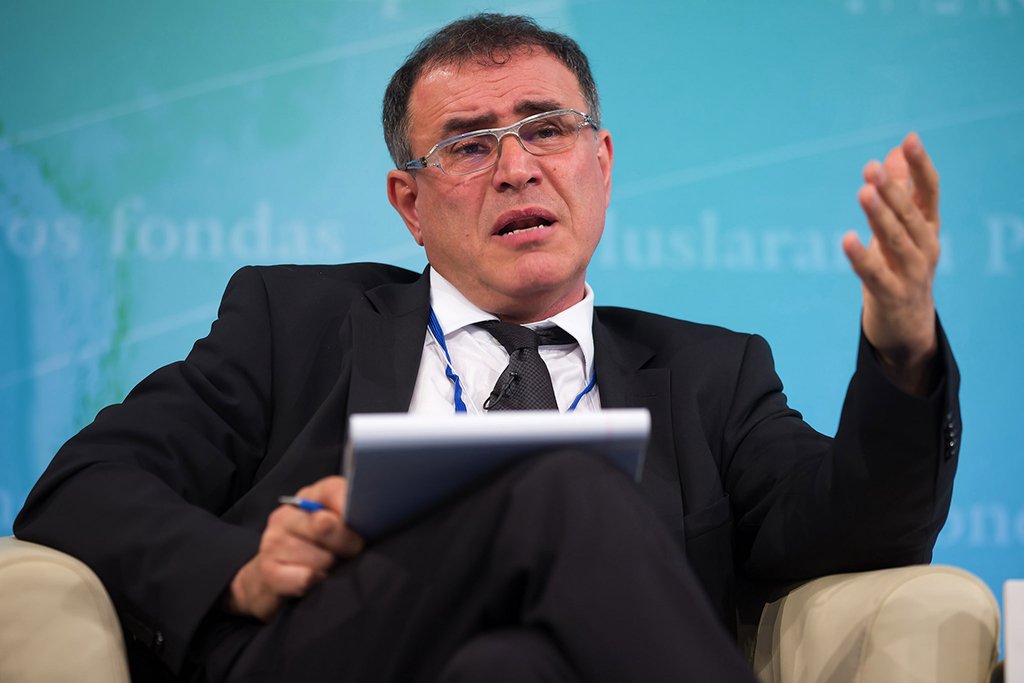
Nouriel Roubini Takes a Harsh Stance Against Cryptos and Blockchain at US Senate Hearing
Nouriel Roubini, the economist who predicted the 2008 financial crisis, has recently stated that cryptocurrencies are the “mother of all scams”, while blockchain is “the most over-hyped technology ever”.
By Julia Sakovich
Updated
3 mins readNouriel Roubini. Photo: International Monetary Fund / Flickr
The financial world has splintered into two parts. While one group of experts actively supports cryptocurrencies, making a lot of efforts aimed at promotion of their mass adoption, the second group is trying to convince the others that adoption and popularization of cryptos is a way to nowhere. Sometimes it seems that this battle will never come to an end.
On October 11, the U.S. Senate Committee on Banking, Housing, and Urban Affairs had an informational hearing that was devoted to the issues of “Exploring the Cryptocurrency and Blockchain Ecosystem”. One of the speakers was Dr. Nouriel Roubini, Professor of Economics and International Business, New York University Stern School of Business, the expert who had managed to predict a financial crash that occurred in 2008.
Dr. Roubini has always had an extremely negative stance towards cryptocurrencies and their underlying technology. His opinion hasn’t changed. In the framework of the hearing he decided to make sure U.S. senators have a clear understanding of the negative impact on the economy that cryptos may have. Describing the cryptocurrency ecosystem as an environment “full of scams, insecure, and useless technology,” he stated:
“Crypto is the mother or father of all scams and bubbles.”
Speaking on the issue he explained that blockchain is an absolutely useless technology that is aimed at solving the problems that are already solved even more effectively by the currently existing banking and fintech.
Dr. Roubini noted that it was necessary to stop and think over at the moment when alarming signs became obvious. He believed that the first sign of such a kind followed the period when Bitcoin got close to a high of almost $20,000 and practically everyone was extremely excited about the crypto. He said:
“Especially folks with zero financial literacy – individuals who could not tell the difference between stocks and bonds – went into a literal manic frenzy of Bitcoin and Crypto buying.”
Since the time when Bitcoin reached its record height, it has lost more than 65%. Such a situation was described by Dr. Roubini as “crypto-apocalypse”. The total market capitalization for cryptocurrencies has decreased by more than 60 percent and the major cryptocurrencies haven’t shown a stable growth for quite a long period of time already.
Given all the factors mentioned, Dr. Roubini said there is no reason to promote widespread adoption of Bitcoin and a lot of economists and Wall Street leaders have supported his point of view. Nevertheless, a few of them openly disagreed with him.
For example, Mr. Peter Van Valkenburgh, Director of Research, Coin Center, has another opinion. He said:
“Bitcoin is the world’s first globally accessible public money. Is it perfect? No. Neither was email when it was invented in 1972. Bitcoin’s not the best money on every margin. It’s not yet accepted everywhere. It’s not used often to quote prices and it’s not a stable store of value.”
He also emphasized such an important ability of blockchain as its independent work without intermediaries and added that though blockchain and cryptocurrencies may seem not perfect at present, they are an excellent attempt to improve the financial situation in the society.
I’m a content writer and editor with extensive experience creating high-quality content across a range of industries. Currently, I serve as the Editor-in-Chief at Coinspeaker, where I lead content strategy, oversee editorial workflows, and ensure that every piece meets the highest standards. In this role, I collaborate closely with writers, researchers, and industry experts to deliver content that not only informs and educates but also sparks meaningful discussion around innovation.
Much of my work focuses on blockchain, cryptocurrencies, artificial intelligence, and software development, where I bring together editorial expertise, subject knowledge, and leadership experience to shape meaningful conversations about technology and its real-world impact. I’m particularly passionate about exploring how emerging technologies intersect with business, society, and everyday life. Whether I’m writing about decentralized finance, AI applications, or the latest in software development, my goal is always to make complex subjects accessible, relevant, and valuable to readers.
My academic background has played an important role in shaping my approach to content. I studied Intercultural Communications, PR, and Translation at Minsk State Linguistic University, and later pursued a Master’s degree in Economics and Management at the Belarusian State Economic University. The combination of linguistic, communication, and business training has given me the ability to translate complex technical and economic concepts into clear, engaging narratives for diverse audiences.
Over the years, my articles have been featured on a variety of platforms. In addition to contributing to company blogs—primarily for software development agencies—my work has appeared in well-regarded outlets such as SwissCognitive, HackerNoon, Tech Company News, and SmallBizClub, among others.