
 17 mins
 Most crypto swap platforms have an identity threshold at some point in the process, such as a KYC trigger buried in the terms, a c...
Bitbase is a centralized cryptocurrency exchange that has been opening up to a global audience in 2026 and is an exchange built, in our opinion, for active, daily traders. It combines spot markets, USDT-margined perpetual futures, TradFi products, fiat purchases, and an Earn yield section on a single platform.
We reviewed Bitbase with particular attention to its trading interface, fee structure, derivatives offering, TradFi markets, account setup, Quick Buy service, mobile experience, and security infrastructure. One of the biggest attractions we found is how easy it is to move between different types of trading.
A user can buy Bitcoin, open a USDT-settled futures position, and then trade a product linked to gold, forex, equities, or an index without keeping accounts across several separate platforms.
Bitbase was founded in 2023 and has expanded its global offering considerably since then. The exchange offers more than 1,000 trading pairs, along with a separate TradFi section featuring 100+ popular trading pairs. Its base spot fees are 0.1% for makers and takers (which you can reduce with VIP status), while USDT-margined futures start at 0.02% for makers and 0.06% for takers.
The overall goal of our Bitbase review is to determine whether that combination makes it one of the best exchanges for crypto traders in 2026, and how the platform compares with more basic exchanges.
Our Bitbase Review Verdict Summarized
Bitbase is one of the more complete newer exchanges we have reviewed for traders who want crypto and conventional market themes under one roof.
Spot trading is straightforward and competitively priced, while the USDT-margined futures platform gives more experienced users cross and isolated margin, long and short positions, conditional orders, and a maker fee of 0.02%. The exchange is clearly designed around active trading rather than simply buying spot crypto, although it is user-friendly and well-priced for the occasional buyer, too.
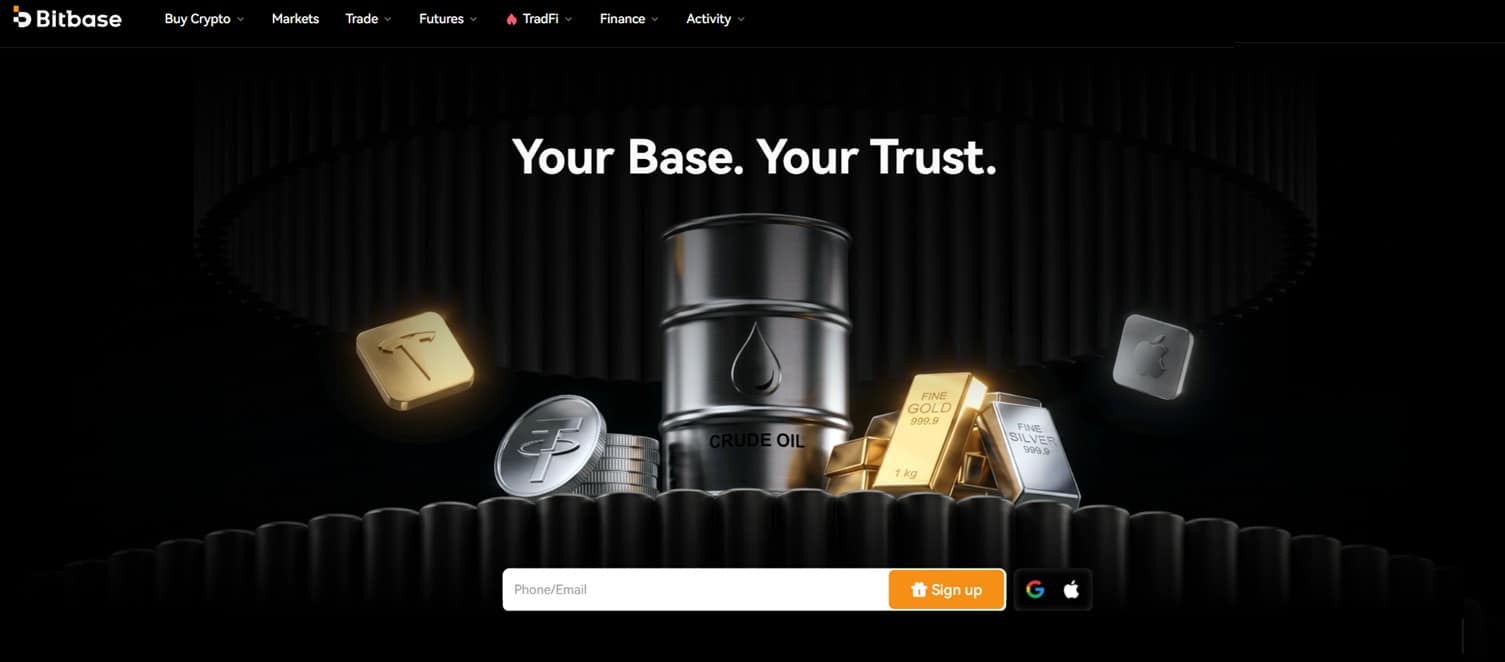
We were excited by the TradFi offering, with Bitbase offering products linked to stocks, precious metals, forex, crude oil, indices, and digital assets. Depending on the instrument, leverage can reach 200x. These are price-linked products rather than conventional ownership of the underlying stock, currency, or commodity, so users need to understand what they are trading before opening a position. But as a way to find price exposure, it’s an excellent and easy-to-use platform
Security is another area where Bitbase has put considerable infrastructure in place, including separation of hot and cold wallets, MPC-based multi-signature technology, tiered access controls, multi-layer approval processes, and real-time monitoring for suspicious withdrawals.
We also appreciate that you are not dragged into KYC before you begin trading, and that it’s only for certain features or large daily withdrawals that you need to go through the process.
Taken together, Bitbase is an excellent fit for active users who would otherwise maintain separate crypto, derivatives, and traditional-market trading accounts.
Bitbase Key Takeaways
- Bitbase is a centralized exchange founded in 2023 that supports more than 1,100 trading pairs and offers both spot crypto and USDT-margined perpetual futures.
- Base spot fees are 0.1% maker and 0.1% taker, while futures start at 0.02% maker and 0.06% taker.
- The TradFi platform covers stocks, precious metals, forex, crude oil, indices, and digital assets, offering 100+ popular trading pairs and up to 200x leverage on supported products.
- Bitbase supports fiat-to-crypto purchases via Quick Buy, with Visa, Mastercard, Google Pay, and Apple Pay. Availability depends on the currency, provider, and country.
- Security measures include hot/cold wallet separation, MPC-based multi-signature technology, layered approvals, access controls, and withdrawal monitoring.
Bitbase Pros & Cons
We think of Bitbase as fully comprehensive, particularly for users who move regularly between spot, derivatives, and different asset classes.
Pros
- Crypto and TradFi in one account: Bitbase lets traders move between crypto spot markets, perpetual futures, forex, metals, stocks, oil, and indices without maintaining several unrelated trading platforms.
- Competitive futures fees: The standard 0.02% maker and 0.06% taker rates make the derivatives service particularly attractive to traders placing limit orders.
- Strong TradFi selection: More than 100 TradFi trading pairs cover several conventional asset classes, giving crypto-native traders a simple route into other markets.
- Flexible margin tools: Futures traders can switch between isolated and cross-margin modes and use market, limit, and advanced conditional orders.
- Straightforward fiat entry: Quick Buy supports major card and digital-wallet payment methods (subject to regional and provider availability).
- Strong security setup: Bitbase combines hot/cold wallet separation with MPC-based multi-signature technology, layered approvals, permissions, and active withdrawal monitoring.
- 24/7 support: Bitbase advertises round-the-clock user support, useful for a platform operating continuously across global markets.
Cons
- TradFi products require experience: Price-linked products and leverage of up to 200x introduce risks that differ significantly from simply buying crypto on the spot market.
- KYC is needed for some services: Users can begin the account-opening process quickly, but Quick Buy and other functions may require identity verification.
- Shorter global track record: Bitbase was founded in 2023 and has only recently developed into the broader exchange reviewed here.
- Availability varies by location: Specific products and fiat payment methods may be restricted under local regulations.
What Is Bitbase?
Bitbase is a centralized digital asset exchange that describes professional futures trading as the core of its product. The company was founded in 2023 and is steadily becoming a global player.
The futures emphasis explains much of the design across the site – Bitbase does not feel like a simplified brokerage where users make a few recurring Bitcoin purchases each month. There are order books, charts, margin settings, perpetual contracts, risk controls, and all of the advanced options you’d expect, but always in a clean interface that never gets too confusing.
The exchange is broader than derivatives – users can trade crypto on the spot market, buy assets with fiat through Quick Buy, access an Earn section, and use apps for iOS and Android. Bitbase currently reports 99.99% system uptime, order-matching speeds below 10 milliseconds, and more than 1,000 supported trading pairs.
We consider its strongest differentiator to be its ability to move beyond crypto without opening a separate traditional brokerage account. The TradFi section provides traders with price exposure to stocks, forex, metals, crude oil, and indices.
Bitbase Products & Services
The Bitbase platform is easiest to understand as a set of trading services within the same ecosystem.
Spot Trading
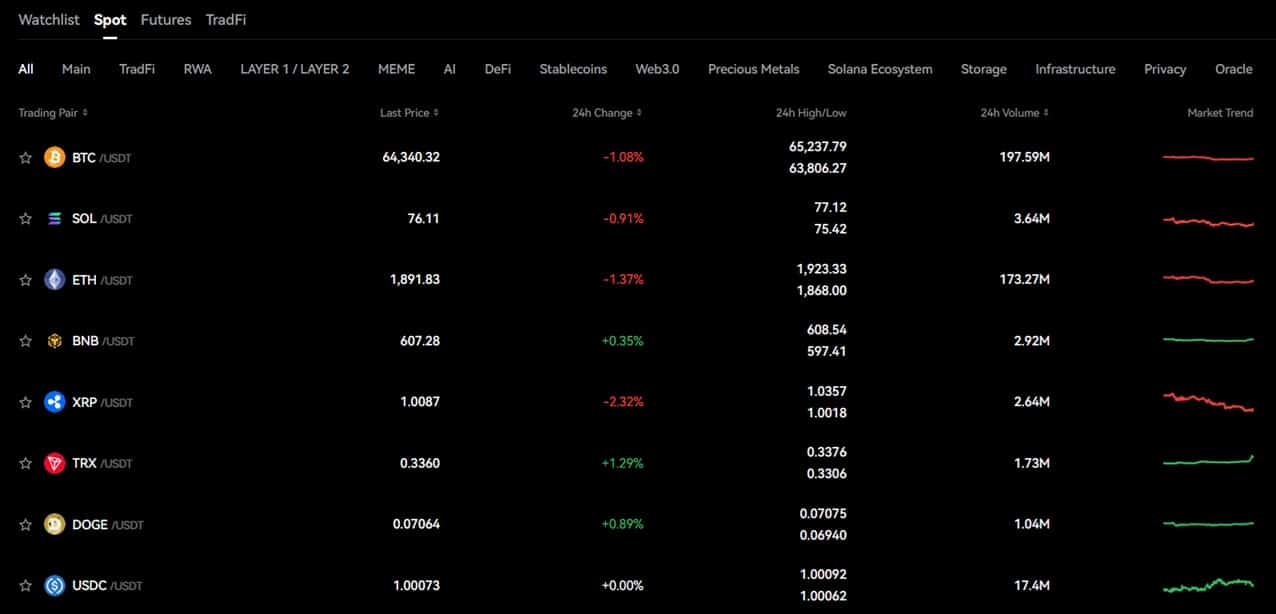
Bitbase uses a conventional order-book model for spot trading, probably familiar to most readers. Users can exchange supported digital assets directly, with settlement taking place in the account once an order is matched.
The platform supports market and limit orders, as well as advanced conditional instructions. The base spot charge is set at 0.1% for both makers and takers.
For perspective, a $1,000 spot trade at the standard 0.1% rate incurs a $1 trading fee, excluding any separate withdrawal or payment provider costs. It is a simple fee model and easy to understand before placing an order.
USDT-Margined Futures
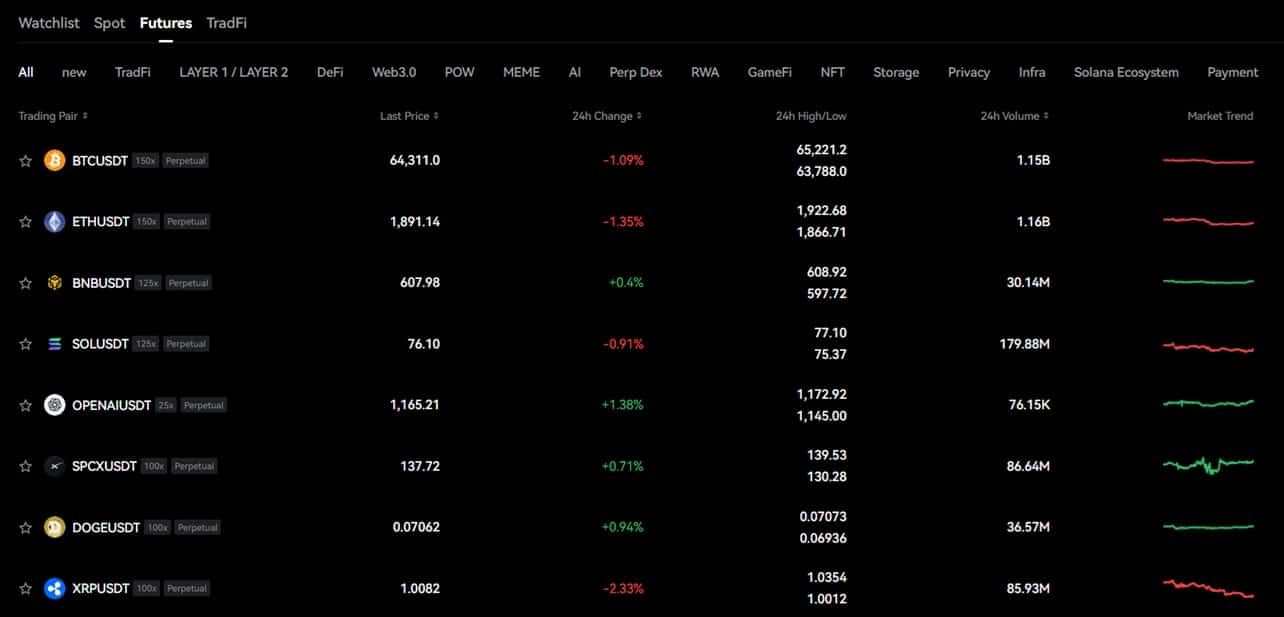
Futures are closer to the center of the Bitbase, with perpetual contracts using USDT as the denomination and settlement asset. That means collateral, profit, losses, and account values can be calculated in a stablecoin rather than separately for each underlying cryptocurrency.
Perpetual contracts have no fixed expiry date, so traders can open long positions when they expect an asset to appreciate, or short positions when they expect it to decline, although funding payments and liquidation risk remain associated with holding a leveraged position.
Bitbase supports cross and isolated margin – isolated margin confines assigned collateral to one position, limiting how much of the wider futures balance is exposed to that trade. Cross-margin can use available collateral across positions, potentially improving capital efficiency while increasing the amount of capital exposed when a trade moves sharply against the user.
The platform also offers market and limit orders, advanced conditional instructions, risk limits, and liquidation controls. Bitbase says its fair-price mechanism uses weighted spot-market indices from major exchanges rather than relying solely on its own order book.
Standard futures fees are 0.02% for makers and 0.06% for takers – but our VIP table below shows how you can get discounted rates.
TradFi Markets
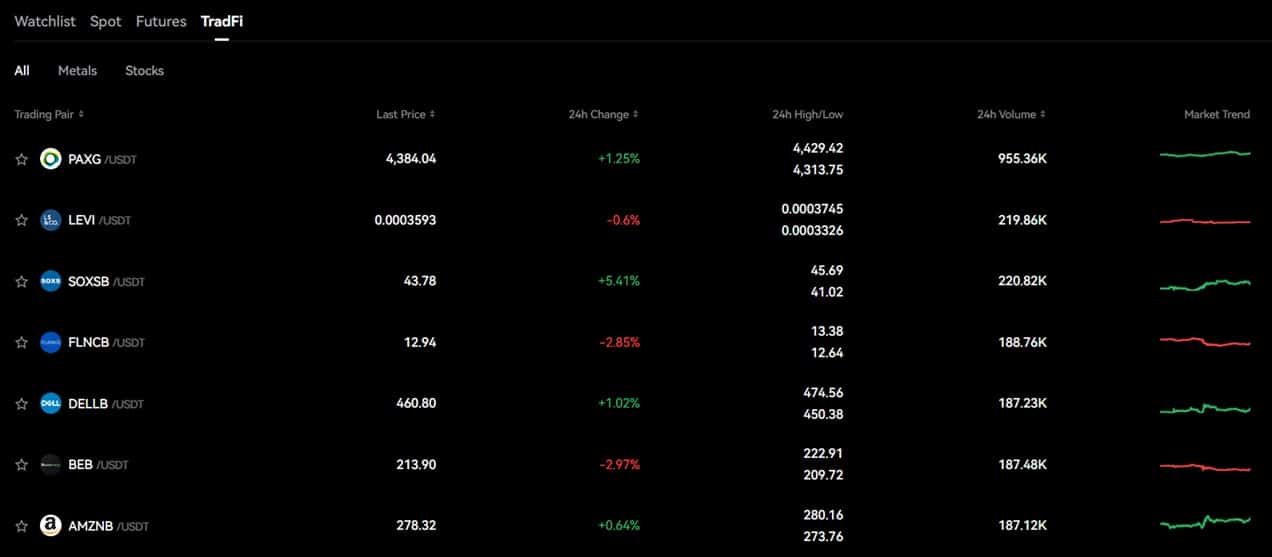
Instead of limiting the platform to cryptocurrency, Bitbase offers trading products tied to stocks, precious metals, forex, crude oil, indices, and digital assets. The exchange currently advertises more than 100 popular trading pairs in this part of the platform – we spotted the range growing over the few weeks of our review, so expect the number to grow over the coming months.
Bitbase describes its TradFi assets as digital certificates that track the prices of corresponding traditional financial markets. A trader can therefore gain price exposure without opening a conventional brokerage account, but remember that holding a stock-linked Bitbase product is different from owning shares through a stockbroker – shareholder rights and the behavior of the product outside the underlying market’s normal trading hours are worth understanding. Liquidity can also be lower when the conventional market is closed.
Leverage of up to 200x is available on supported TradFi products, which is excellent and pretty novel for experienced traders who understand margin and position sizing. Used sensibly, the service solves a real problem – someone already trading BTC or ETH futures can add gold, oil, forex, or an equity-market theme without sending capital to another platform.
Bitbase Earn
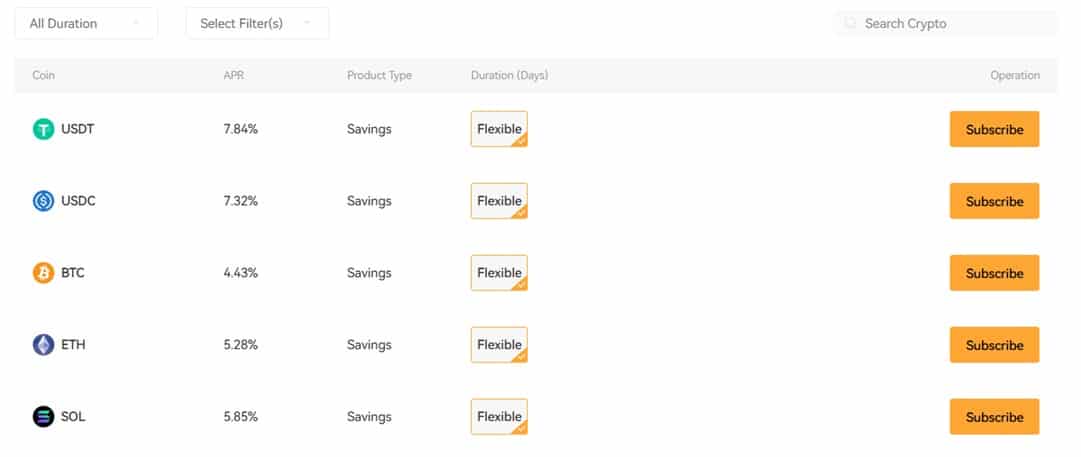
Bitbase also maintains an Earn section for users who want to put idle assets to work rather than actively trade them.
The live platform lists Earn products by coin, APR, product type, and duration. At the time of writing (August 2026), rates were:
USDC
- Minimum: 1 USDC
- APR: 7.32%
- Duration: Flexible
USDT
- Minimum: 1 USDT
- APR: 7.84%
- Duration: Flexible
BTC
- APR: 4.43%
- Duration: Flexible
We also found ETH and SOL available, at about 5% APR, and consider this an excellent feature if you have coins sitting around in wallets, earning 0%.
Bitbase Fees
Bitbase has a straightforward base trading-fee schedule.
Spot Trading Fees
Standard spot trades carry a 0.1% maker fee and 0.1% taker fee, but the tiered VIP structure applies depending on how much you trade, and in turn leads to lower rates and higher withdrawal limits.
| VIP Level | 30D Spot Trading Volume (USDT) | Daily Balance (USDT) | 30D Average Balance (USDT) | Maker Fee | Taker Fee |
| VIP0 | ≥0 | ≥0 | ≥0 | 0.100% | 0.100% |
| VIP1 | ≥500,000 | ≥30,000 | ≥30,000 | 0.080% | 0.090% |
| VIP2 | ≥2,000,000 | ≥50,000 | ≥50,000 | 0.070% | 0.080% |
| VIP3 | ≥8,000,000 | ≥250,000 | ≥250,000 | 0.050% | 0.060% |
| VIP4 | ≥30,000,000 | ≥750,000 | ≥750,000 | 0.040% | 0.050% |
| VIP5 | ≥50,000,000 | ≥2,000,000 | ≥2,000,000 | 0.030% | 0.040% |
| VIP6 | ≥75,000,000 | ≥5,000,000 | ≥5,000,000 | 0.020% | 0.030% |
| VIP7 | ≥100,000,000 | ≥10,000,000 | ≥10,000,000 | 0.010% | 0.020% |
Futures Trading Fees
The same logic applies to USDT-M futures, dropping your rates depending on VIP status:
| VIP Level | 30D Futures Trading Volume (USDT) | Daily Balance (USDT) | 30D Average Balance (USDT) | USDT-M Maker Fee | USDT-M Taker Fee |
| VIP0 | ≥0 | ≥0 | ≥0 | 0.020% | 0.060% |
| VIP1 | ≥500,000 | ≥30,000 | ≥30,000 | 0.018% | 0.050% |
| VIP2 | ≥2,000,000 | ≥50,000 | ≥50,000 | 0.016% | 0.040% |
| VIP3 | ≥8,000,000 | ≥250,000 | ≥250,000 | 0.014% | 0.0375% |
| VIP4 | ≥30,000,000 | ≥750,000 | ≥750,000 | 0.012% | 0.035% |
| VIP5 | ≥50,000,000 | ≥2,000,000 | ≥2,000,000 | 0.010% | 0.032% |
| VIP6 | ≥75,000,000 | ≥5,000,000 | ≥5,000,000 | 0.008% | 0.030% |
| VIP7 | ≥100,000,000 | ≥10,000,000 | ≥10,000,000 | 0.005% | 0.020% |
User Experience: Is Bitbase User-Friendly?
Despite offering several types of trading, Bitbase keeps the interface relatively clean, with a trading terminal that uses a layout experienced exchange users will already recognize: charts, an order book, order controls, available markets, open positions, and trading history, all within easy reach.
That familiarity works in Bitbase’s favor – someone arriving from another major centralized exchange will not need to relearn how an order book or futures terminal works before placing a trade.
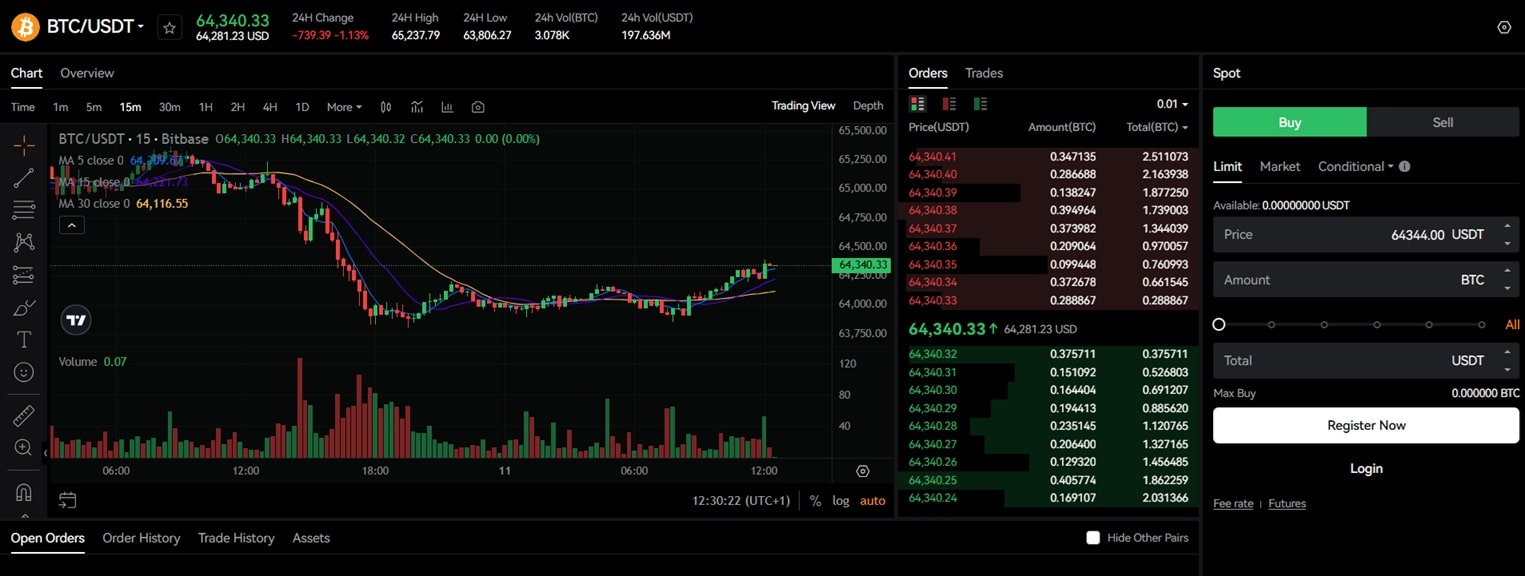
Our earlier testing also found navigation between spot, futures, and TradFi straightforward and similar between sections. The products feel like parts of the same exchange rather than separate services stitched together, and is particularly useful (and user-friendly) for anyone moving regularly between crypto and conventional-market themes.
Beginners can still use Bitbase, especially through Quick Buy and the spot market, although we think the platform makes most sense once a user already understands basic trading terminology.
Bitbase Mobile App
Bitbase provides mobile apps for iOS and Android, and while we primarily tested on Android, we found the mobile app carries over the core exchange experience on both platforms, making it possible to follow markets and manage trading activity away from a desktop.
We still prefer a large screen for detailed chart work or configuring leveraged positions, but mobile is particularly useful for monitoring an existing position, checking prices, or managing an account when away from a computer.
Bitbase Wallet & Security
Bitbase is a custodial exchange, so users entrust their deposited assets to the platform while they remain in the exchange account, making the security architecture important.
Bitbase’s funds are protected through separation between hot and cold wallets, MPC-based multi-signature technology, multi-layer approval workflows, tiered access permissions, and real-time monitoring designed to identify suspicious withdrawals.
MPC technology reduces reliance on a single private key being held in one place. Signing authority can instead be divided among multiple parties or components, reducing the risk posed by a single compromised credential.
Its About page additionally describes wallet whitelisting and real-time anomaly monitoring as part of the platform’s security infrastructure.
It’s basically the full security suite for 2026 – nothing left to chance and everything in order. We wouldn’t expect less, but we can ask for much more, either.
Bitbase Regulatory Registrations
Bitbase now publishes considerably more compliance information than was available in its earlier global rollout.
The company says Bitbase Global Inc. maintains a U.S. Money Services Business registration with FinCEN, registration number 31000331133865, for declared MSB activities, including money transmission and foreign exchange dealing. Bitbase has headquarters in Panama City, with regional teams in Hong Kong, Singapore, and Dubai.
In Australia, it lists BITBASE PTY LTD as a registered Digital Currency Exchange/VASP under an AML/CTF framework overseen by AUSTRAC. Australia’s official ABN Lookup separately confirms that BITBASE PTY LTD is an active Australian private company under ABN 19 671 902 168.
Deposits & Withdrawals
Crypto users can fund Bitbase from an external wallet, while Quick Buy offers an alternative for those entering with fiat.
Bitbase currently lists Visa, Mastercard, Google Pay, and Apple Pay as possible Quick Buy payment methods. The exact choices depend on the fiat currency, cryptocurrency, provider, and user location.
We found that crypto purchases typically arrived within 1 to 5 minutes after payment, although the terms allow for longer delays. Quick Buy requires KYC, and a third-party provider can also request its own identity or payment checks.
Account Types and KYC
Creating a Bitbase account begins with an email address or phone number. Something we particularly like is that you don’t need to go through a full KYC process to begin trading. Verification may be required for fiat purchases, withdrawals, and higher limits, but you can absolutely use the platform for a decent length of time and within generous limits before having to share your identity.
This makes Bitbase’s onboarding relatively light at the first stage without making the exchange an anonymous trading venue.
How to Use Bitbase
Follow these steps to set up an account and begin trading on Bitbase.
Step 1: Create a Bitbase Account
Go to the Bitbase website or install the official app, then register with an email address or phone number.
Use a unique password that is not shared with another financial or crypto account.
Step 2: Complete Identity Verification
Open the KYC section and complete any identity checks required for the services you intend to use.
Quick Buy requires verification, while Bitbase can apply limits or feature restrictions according to your account’s verification status.
Step 3: Secure the Account
Enable two-factor authentication and review the security controls available within the account.
Bitbase recommends using an authenticator app for 2FA rather than relying solely on SMS.
Step 4: Deposit or Buy Crypto
Existing crypto holders can deposit supported assets from an external wallet.
Alternatively, choose Quick Buy and check which card, digital wallet, or local payment options are currently available for your selected currency and region.
Step 5: Choose Your Market
Use Spot if you want straightforward ownership of a supported cryptocurrency without leverage.
Open USDT-M Futures if you understand perpetual contracts, margin, funding rates, and liquidation risk.
TradFi is available for traders seeking price exposure linked to markets such as equities, forex, metals, crude oil, and indices.
Step 6: Place Your Order
Select the trading pair and choose the appropriate order type.
A market order prioritizes immediate execution. A limit order gives more control over the price but may remain unfilled if the market never reaches it.
For futures positions, check the chosen leverage, margin mode, available collateral, and liquidation level before confirming the trade.
Our Bitbase Review Methodology
Our assessment combined hands-on Bitbase testing over close to a month, using our own funds, with a final August 2026 check of the platform’s current rates and pairs.
We examined the spot and futures structure, TradFi offering, order types, margin options, current published trading fees, fiat purchase process, KYC requirements, mobile availability, security documentation, corporate information, and current regulatory and registration disclosures.
For variable items such as Earn APRs, payment-provider costs, withdrawal fees, VIP thresholds, and individual asset leverage, the figures are correct as of mid-August 2026 but may change over time.
Bitbase Review: Final Verdict
Bitbase has developed into an extremely capable exchange for active crypto traders. The base spot fee of 0.1% is straightforward, while futures traders get a very comptitive 0.02% maker rate alongside USDT settlement, isolated and cross-margin choices, conditional orders, and built-in liquidation controls. The VIP rates, which vary based on how much you trade over 30 days, make it better and better.
TradFi gives Bitbase a distinctive edge, and being able to move from a BTC position into gold, forex, oil, stocks, or indices without shifting trading capital to a separate broker genuinely makes the platform useful for traders working across markets.
The security design is excellent, and the no-KYC start makes for an easier setup and a privacy edge, although you may need to authenticate yourself at some point during your trading.
Bitbase combines low trading costs, thousands of pairs, a polished interface, crypto spot and derivatives, straightforward fiat entry, and a broad TradFi offering without making the service feel unnecessarily complicated.
For active traders who want crypto and traditional-market exposure in one account, Bitbase is one of the best crypto exchanges we have reviewed in 2026, and is especially excellent for advanced traders.
FAQ
Is Bitbase a legitimate crypto exchange?
What are Bitbase’s trading fees?
Does Bitbase require KYC?
Does Bitbase offer stocks and forex?
How much leverage does Bitbase offer?
Coinspeaker in Numbers
250K+
Monthly Users
80+
Articles & Guides
5000+
Research Hours
23
Authors
guides
How to Swap Crypto on Godex: A Step-by-Step Guide to No-KYC Crypto Swapping
June 12th, 2026
CoinDepo vs. WhiteBIT Earn Comparison: Yields, Features, Security and More
June 2nd, 2026
Divine Ray (DRC) Price Prediction 2026-2030
June 1st, 2026
In the competitive world of crypto yield generation, CoinDepo and WhiteBIT Earn have built notable reputations as centralized plat...
Although most Web3 social platforms struggle to move beyond the hype phase, Divine Ray has taken a more grounded route. Its team h...
Daniel Francis
, 318 postsDaniel Frances is a technical writer and Web3 educator specializing in macroeconomics and DeFi mechanics. A crypto native since 2017, Daniel leverages his background in on-chain analytics to author evidence-based reports and deep-dive guides. He holds certifications from The Blockchain Council, and is dedicated to providing "information gain" that cuts through market hype to find real-world blockchain utility.