
 17 mins
 The best decentralized exchanges increasingly cover more than simple token swaps. They are places where traders can use on-chain o...
We signed up for a MEXC account and used our own capital throughout the platform to see if the exchange’s reputation holds up under scrutiny.
Our research focused on the exchange’s massive altcoin inventory, its zero-fee promises, its high-leverage futures market, its spot and futures trading experience, and the transparency of its proof-of-reserves.
The overall goal of our MEXC review is to determine if MEXC is a legitimate home for serious traders and, if so, how to get the best out of the platform as a crypto exchange.
Our MEXC Review Verdict Summarized
MEXC has carved out a unique selling point as the primary liquidity provider for low-cap “gems” before they hit larger venues like Binance. One of the exchange’s key features is its fee structure; at the time of writing, MEXC maintains 0% maker and taker fees for spot trading, including zero maker fees on most major pairs, making it one of the most cost-effective venues for high-frequency spot traders.
We would describe the interface as functional and one that borrows heavily from industry standards, so there is a low learning curve for anyone moving from other exchanges or another major exchange platform.
The platform supports leverage up to 500x on major futures pairs, giving high-risk appetite traders a massive opportunity and making it a strong fit for experienced traders.
We see MEXC as an excellent choice for traders who prioritize asset variety, competitive fees, and bottom-line costs over the hand-holding of a regulated Western brokerage.
MEXC Key Takeaways
- MEXC lists over 2,000 cryptocurrencies, significantly more than most Tier-1 centralized exchanges.
- The exchange offers 0% spot trading fees for makers and 0.05% for takers, alongside highly competitive futures trading fees.
- Futures traders can access up to 200x leverage on Bitcoin and Ethereum perpetual contracts.
- The platform features a “Kickstarter” program where MX token holders receive daily airdrops of new project listings.
- Regulatory restrictions apply; MEXC does not officially support users from the United States, Canada, and several other jurisdictions.
MEXC Pros & Cons
Our hands-on evaluation of MEXC identified several distinct advantages and a few operational risks:
Pros
- Excellent asset selection: With 2,000+ assets, MEXC is often the first centralized exchange to list new cryptocurrencies, offering access to high-volatility projects before they go mainstream.
- Industry-low fees: The 0% spot fee policy removes the largest friction point for traders, allowing for profitable scalping on small price movements and more efficient crypto trading.
- High leverage: The 500x leverage cap on futures is among the highest in the industry, providing extreme capital efficiency for experienced margin trading users.
- Passive airdrops: By holding the native MX token, users can vote on new listings and receive free tokens through the Kickstarter and Launchpad initiatives.
- No-KYC limitations: While MEXC has tightened rules, it remains more flexible regarding withdrawal limits for unverified accounts compared to strictly regulated competitors.
- Fast listing speed: The exchange is known for listing trending meme coins and DeFi tokens within hours of their decentralized launch, especially in fast-moving decentralized token markets.
Cons
- Regulatory gray area: MEXC is Seychelles-registered and operates under a MISA license in Estonia for compliance in Europe, but lacks approval in major markets like the US and UK, so expect account restrictions if you try to use MEXC in those regions.
- Customer support speed: During high-traffic periods, the live chat response times can lag, and some users report generic responses to complex technical issues.
- Liquidity variance: While major pairs are deep, some micro-cap tokens suffer from high slippage due to thin order books.
What Is MEXC?
MEXC, founded in 2018, is a centralized cryptocurrency exchange (CEX) that has rapidly scaled to serve over 40 million users across 170 countries. Originally known as MXC, the exchange rebranded to MEXC Global to signal its intent to compete with the likes of OKX and Bybit. It describes itself as the “Exchange of Gems,” focusing on the rapid deployment of new trading pairs as a unique edge.
The exchange is registered in the Seychelles but maintains a decentralized corporate structure with global offices. It has avoided the heavy-handed regulatory settlements that have plagued other large exchanges, largely by restricting its services in jurisdictions with strict “Travel Rule” compliance.
MEXC is speedy in use, and the exchange claims it can handle 1.4 million transactions per second. It is a critical feature for its futures market, where thin spreads and fast execution are the difference between a successful hedge and a liquidation. The ecosystem is supported by the MX token, which serves as both a utility asset for fee discounts and a ticket for the platform’s airdrop program (Kickstarter). As an exchange platform built around fast-moving digital assets, MEXC is clearly aimed at traders who want broad market access rather than a stripped-back brokerage experience.
MEXC’s Products & Services
While MEXC offers the usual array of spot and futures trading products, it differentiates itself through its “Kickstarter” and “Launchpad” features. These essentially allow new projects to gain exposure quickly while rewarding MEXC users for their loyalty.
For the active trader, the “Quantitative Trading” tool allows for the deployment of grid trading bots that capitalize on the 0% fee structure. In a traditional exchange, a grid bot might lose a significant portion of its profit to maker/taker fees. On MEXC, every micro-spread captured is pure profit.
MEXC also provides a “Copy Trading” platform, which lets novice users mirror the trades of high-performing futures traders automatically. We found this easy to use – simply a few clicks to select your trader – and the major trader statistics are transparent, showing win rates, total PnL, and the number of followers. Note that high-leverage copy trading can deplete a balance quickly if the lead trader takes on excessive risk, so make choices carefully if you go down this route.
The P2P (Peer-to-Peer) market makes it easy to get fiat currency into the ecosystem. MEXC acts as an escrow service, allowing users to buy USDT via local bank transfers, Alipay, or third-party processors such as Banxa and Simplex. The availability of these methods varies significantly by region and the local supplier, but P2P has become a very popular service in locations where banking is a little less reliable than in the US and Europe.
Beyond its core execution layer, MEXC also offers other trading tools that support active portfolio management, particularly for users who do more than occasional buy-and-hold investing.
Which Cryptocurrencies Can You Trade on MEXC?
Asset selection is where MEXC beats almost every other centralized competitor. The exchange currently supports over 2,000 cryptocurrencies. This includes the stalwarts like Bitcoin (BTC), Ethereum (ETH), and Solana (SOL), but the real draw is the thousands of altcoins and the speed at which they list.
The exchange broadly categorizes tokens into sectors such as:
Meme: The latest high-risk tokens from Solana and Base chains.
Innovation: New DeFi protocols and experimental tokens.
RWA (Real World Assets): Tokens representing gold, real estate, or US Treasuries.
AI: Infrastructure tokens for decentralized artificial intelligence.
MEXC is frequently the first CEX to list a project after its initial DEX offering (IDO). For example, many tokens that later listed on Binance at a multi-billion dollar valuation were tradable on MEXC when their market cap was under $50 million. This “early access” is MEXC’s primary value proposition, though it comes with the inherent risk of trading low-liquidity assets.
MEXC Fees
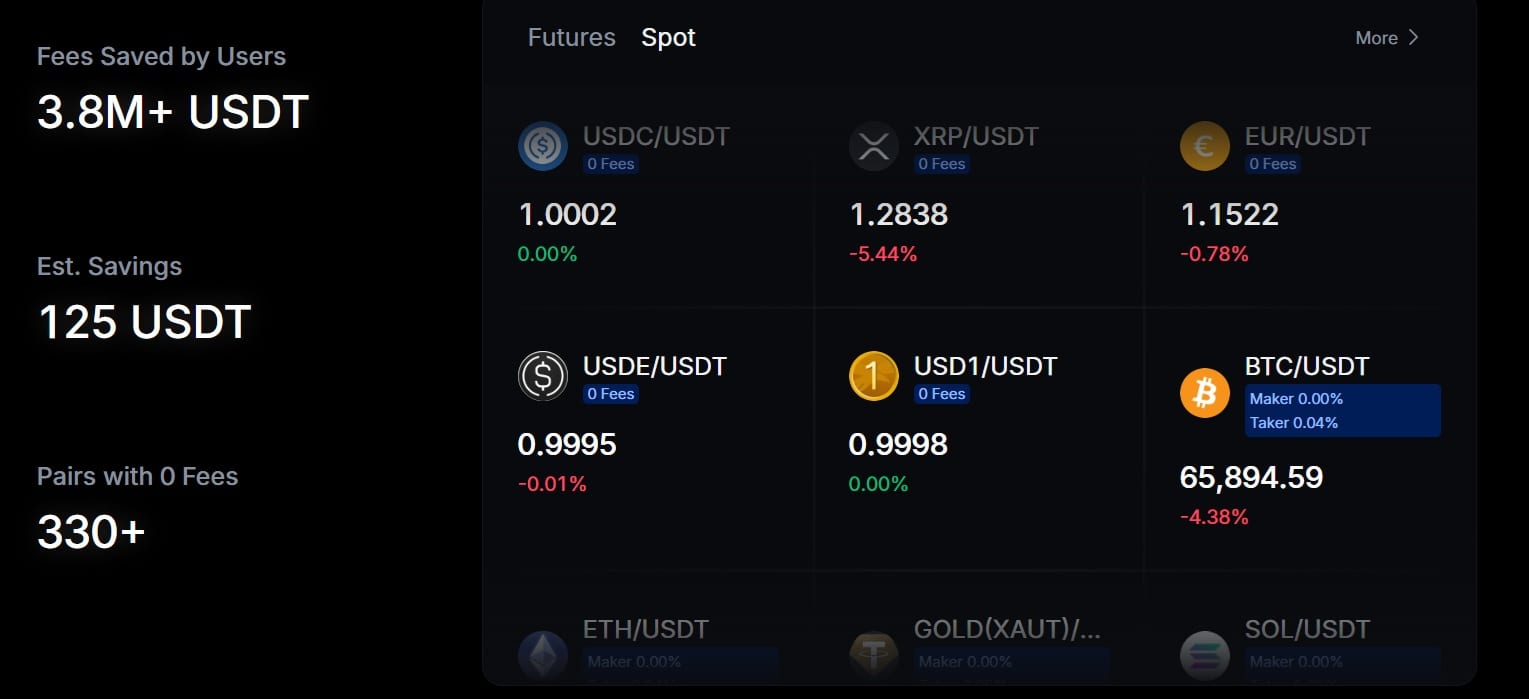
MEXC’s fee schedule is extremely competitive, with the exchange offering 0% maker and 0.05% taker fees, with possible MX token discounts reducing them further, e.g., to 0.025–0.04%. These rates have been around for years now, rather than following a promotional beat like many exchanges employ to attract new users.
Spot Trading Fees
Currently, MEXC charges 0.00% for Makers and 0.05% for Takers on the spot market across most trading pairs. This makes MEXC the best crypto exchange for traders who use scalping strategies, grid trading bots, or high-frequency trading bots, and is a great deal anyway for people who just want to buy and hold.
Derivative Trading Fees
MEXC’s futures fees are lower than the industry average, with standard fees for perpetual futures at 0.00% for Makers and 0.01% for Takers.
To put this in perspective, most major exchanges typically charge 0.02% for Makers and 0.05% for Takers, making MEXC’s Taker fee around 80% lower than theirs. Even seasoned traders often underestimate how much fees can eat into their profit. Users who hold the MX token or reach high-volume VIP tiers can see even further reductions or rebates.
Non-Trading Fees
MEXC does not charge for deposits. Withdrawal fees are dynamic and depend on the specific blockchain’s congestion and the token being moved. For instance, withdrawing USDT via the Tron (TRC-20) network typically costs around $1, while Ethereum (ERC-20) withdrawals are usually higher, depending on gas prices.
| Max Spot Commission | 0% (0.05% Takers) |
| Max Futures Commission (market) | 0.01% |
| Max Futures Commission (limit) | 0% |
| Funding Fees | Every 8 hours; variable based on market longs vs shorts |
| MX Token Discount | Up to 10% on futures fees, higher with promotions |
| Crypto Deposits | Free |
| Fiat Purchase Fee | Varies by 3rd party provider (typically 2% – 5%) |
User Experience: Is MEXC User-Friendly?
The MEXC interface does exactly what is needed. It doesn’t attempt to reinvent the wheel, and you can decide if that is a positive or a negative. It is easy to learn, and people who know their way around a chart will already know how to use it. The layout places the order book on the right, the TradingView-powered charts in the center, and the order entry box on side.
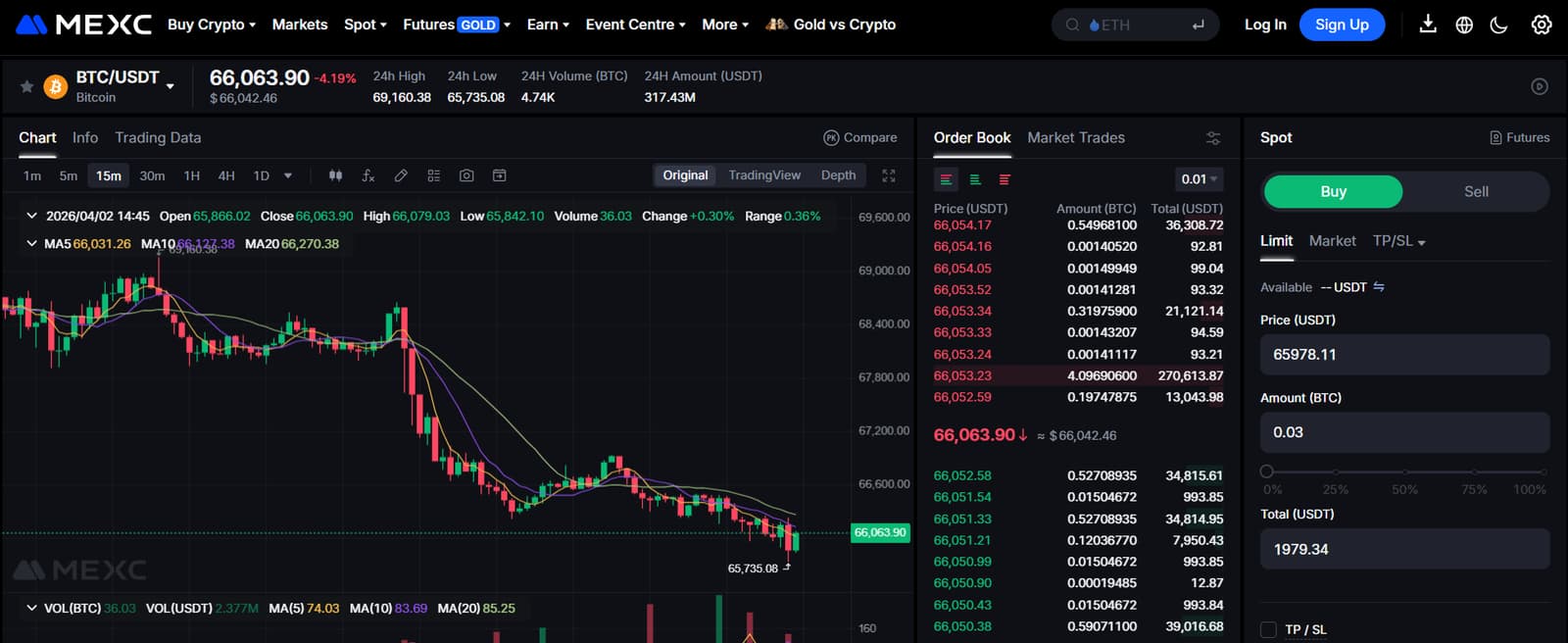
For beginners, the “Buy Crypto” button is the primary entry point and leads to a simplified interface that lets you use a credit card or Apple Pay. However, the exchange is clearly designed for intermediate users who understand how to trade.
One area where MEXC excels is its “Sub-Account” feature. This allows users to create up to 30 sub-accounts to test different strategies or isolate high-risk “moonshot” trades from their main portfolio. Each sub-account has its own API key, which is a huge selling point for anyone who can take advantage of the feature.
The KYC (Know Your Customer) process is tiered. “Primary KYC” requires basic ID and enables withdrawals up to 80 BTC per day. “Advanced KYC” involves facial recognition and increases limits to 200 BTC.
The platform also includes price alerts, watchlists, and a clean layout for monitoring open positions, which helps make the trading experience more manageable even when markets get chaotic.
MEXC Mobile App
The MEXC app is available for both iOS and Android. It is fully-fledged, meaning it packs nearly every feature of the desktop site into the mobile experience.
We found the app to be stable, though the sheer density of information can be overwhelming on smaller screens. The push notifications are highly customizable, allowing users to set alerts for price movements, filled orders, and the start of new Kickstarter voting rounds.
Features & Tools
MEXC offers several ecosystem features that go beyond a simple exchange.
MX Token & Kickstarter
The MX token offers holders plenty of exclusive uses. Along with fee discounts, its primary use is in the “Kickstarter” program. Projects that want to list on MEXC must provide a token pool as a reward. MX holders “vote” with their tokens (which aren’t spent, just committed) to support the listing. In return, they receive a pro-rata share of the new token’s airdrop.
This creates a daily stream of passive income for MX holders, often resulting in dozens of new tokens being added to their wallets every week.
Futures Leverage & Copy Trading
MEXC supports a leverage range from 1x to 500x. A 200x-500x leverage is typically the limit for BTC/USDT and ETH/USDT pairs. For altcoins, the limit is usually 50x or 100x. The “Copy Trading” tool is integrated directly into the futures dashboard, allowing users to follow “Elite Traders.” The platform ranks these traders by ROI and “Drawdown,” which is a crucial metric for evaluating risk.
Savings & Staking
MEXC “Savings” offers flexible and fixed-term options across various assets. While yields on BTC and ETH are modest (around 1-2%), stablecoins like USDT can often earn between 5% and 8% APY (at least at the time of writing). The “Launchpool” also allows users to stake MX or other designated tokens to earn high-yield rewards on newly listed projects.
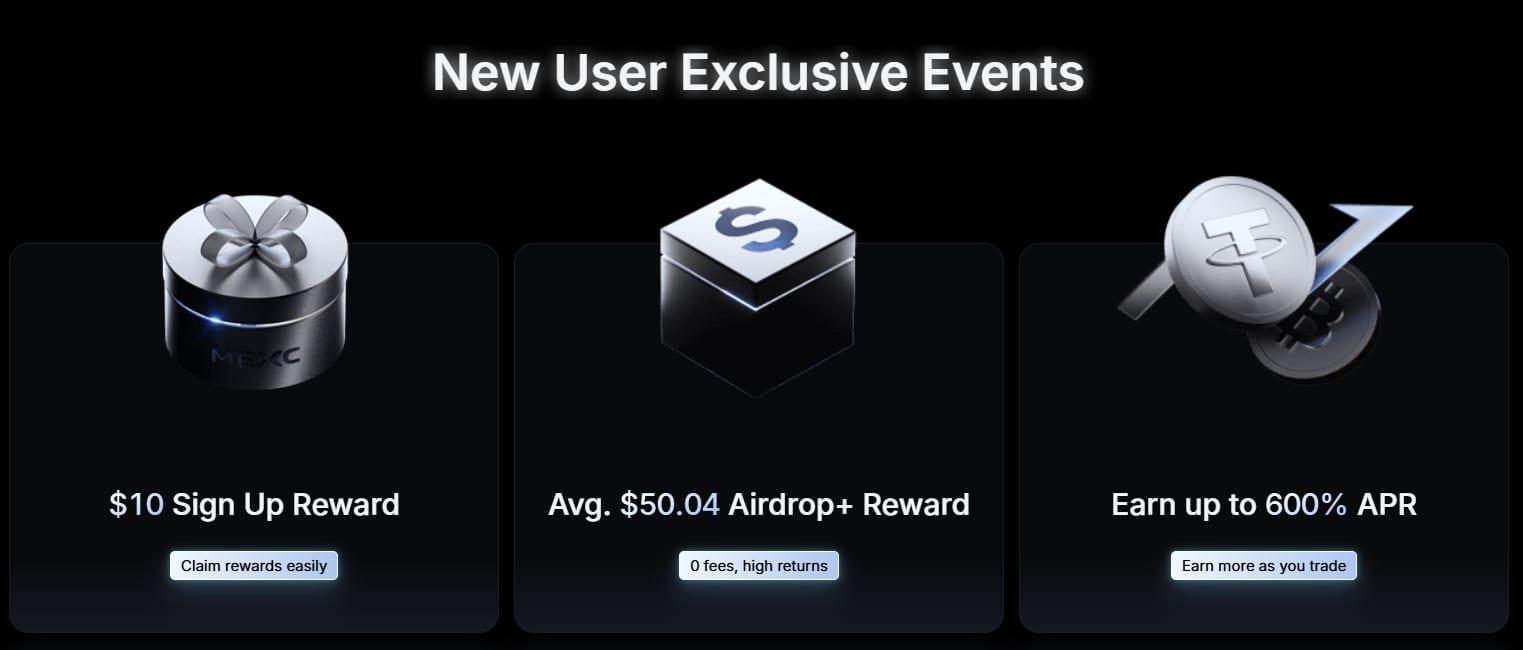
There are regular promotions available for new and existing users on savings products, some offering extremely high APRs (20%+), although we did not test these during our review period. We should also note the regular sign-up promotions the exchange offers, which seem to change almost weekly.
MEXC Wallet & Security
MEXC is a custodial exchange, meaning they hold the keys to your assets. To mitigate the risks associated with centralization, MEXC has implemented several security protocols.
Proof of Reserves (PoR)
MEXC publishes monthly Proof of Reserves reports. These reports use Merkle Trees to allow users to verify that their individual account balances are reflected in the exchange’s total holdings.
In our review of the most recent data, MEXC showed a reserve ratio of over 100% for BTC, ETH, USDT, and USDC, indicating that it holds more assets than users have deposited.
Security Features
- Two-Factor Authentication (2FA): Support for Google Authenticator, SMS, and Email verification.
- Anti-Phishing Code: A custom code included in all official MEXC emails to verify their authenticity.
- Withdrawal Whitelist: Users can restrict withdrawals to only pre-approved addresses.
- Cold Storage: MEXC states that the vast majority of user funds are kept in multi-signature offline wallets.
Deposits & Withdrawals
We found depositing crypto to MEXC straightforward (and free). The exchange provides a unique deposit address for each supported network.
For fiat, the process is more complex. MEXC does not have its own banking licenses to accept direct wires in the same way a local bank would. Instead, it uses:
1. P2P trading: Buy from other users using local bank transfers.
2. Global fiat: Use providers like Banxa, MoonPay, or Mercuryo to buy crypto with a debit card.
3. Third-Party SEPA: Available for European users through specific payment gateways.
Withdrawals are processed quickly and, for verified accounts, automated withdrawals for major coins usually take less than 10 minutes. It is worth noting that if you have a large withdrawal (e.g., over 10 BTC), it may be flagged for manual review, which can take up to 24 hours.
Account Types
MEXC offers a unified account structure but provides a “VIP Program” for high-volume traders.
The VIP tiers are based on either a 30-day trading volume or a minimum asset balance.
- VIP 1: Requires a balance of $100,000 or significant volume. Perks include a dedicated account manager and higher withdrawal limits.
- Institutional Accounts: For hedge funds and market makers, offering customized API rate limits and lower taker fees.
For the average retail user, the standard account provides full access to all spot, futures, and “Earn” products, along with other trading tools that make the platform more useful than a simple buy-and-sell app.
How to Use MEXC
Follow these steps to set up and start trading on the MEXC exchange.
Step 1: Create Your Account
Visit the MEXC website and sign up using an email address or phone number. You will receive a verification code to confirm your registration.
Step 2: Complete Identity Verification
Navigate to the “Identification” section. For most users, “Primary KYC” is sufficient. You will need to upload a photo of your ID. The approval process is usually automated and MEXC says it will take up to 24 hours, but in practice we found it took 10-15 minutes (this might vary by region).
Step 3: Deposit Assets
Click on “Wallet” then “Deposit.” Choose the cryptocurrency you wish to send to the exchange. Ensure you select the correct network (e.g., use the Solana network for SOL tokens) to avoid losing your funds.
Step 4: Execute a Trade
Go to the “Spot” trading tab. Search for your desired pair (e.g., BTC/USDT).
- Limit Order: Set the price you want to buy at. The order stays open until the market hits that price.
- Market Order: Buy immediately at the current market price. Since MEXC has 0% fees, there is no fee penalty for using market orders on spot.
Step 5: Move to Futures (Optional)
If you want to use leverage, transfer USDT from your “Spot” wallet to your “Futures” wallet. Select your leverage (e.g., 10x) and choose “Open Long” (betting on price increase) or “Open Short” (betting on price decrease). Users who want a demo trading tool can also explore MEXC’s test environment before committing real funds.
MX Token: Utility and Performance
The MX Token is more than just a fee-discount coin and is more analogous to a membership token. It offers:
Airdrop Eligibility: The sheer volume of tokens given away via the Kickstarter program has historically created a “yield” for MX holders that often exceeds 20% APY in token value.
Governance: Holders can vote on operational changes and which new projects get priority listing.
Burn Mechanism: MEXC uses a portion of its profits to buy back and burn MX tokens, thereby reducing the total supply over time and creating deflationary pressure.
Our MEXC Review Methodology
To ensure this review was grounded in reality, our team performed the following:
- Deposited ~$2,500 in USDT and ETH via external wallets.
- Executed 50+ spot trades across major and micro-cap pairs to check slippage.
- Opened and closed futures positions with 50x leverage.
- Verified the withdrawal process by moving $1,000 back to a non-custodial Ledger wallet.
- Interacted with customer support via live chat during both peak and off-peak hours.
MEXC Review: Final Verdict
We find that MEXC is currently the most efficient place between the decentralized “on-chain” world and the centralized exchange world. Its 0% spot fee is a massive advantage for active traders, and its willingness to list thousands of altcoins makes it the default choice for investors looking for the “next 100x” project.
Its lack of high-tier regulatory licenses in the US and UK means it is not for every market, and you may have certain trading preferences served better elsewhere. But for anyone looking to trade with minimal overhead, access a huge range of digital assets, and use a fast crypto exchange with competitive fees, MEXC is a clear market leader.
FAQ
Is MEXC safe to use?
Can US citizens use MEXC?
Why are the fees 0% on MEXC?
What is the minimum deposit on MEXC?
Does MEXC have a demo account?
References
Coinspeaker in Numbers
250K+
Monthly Users
80+
Articles & Guides
5000+
Research Hours
23
Authors
guides
Best Decentralized Exchanges (DEXs) in September 2026
September 8th, 2026
How to Swap Crypto on Godex: A Step-by-Step Guide to No-KYC Crypto Swapping
June 12th, 2026
CoinDepo vs. WhiteBIT Earn Comparison: Yields, Features, Security and More
June 2nd, 2026
Most crypto swap platforms have an identity threshold at some point in the process, such as a KYC trigger buried in the terms, a c...
In the competitive world of crypto yield generation, CoinDepo and WhiteBIT Earn have built notable reputations as centralized plat...
CoinSpeaker Editorial Team
, 1 postsThe CoinSpeaker Editorial Team is a collective of veteran financial journalists, blockchain researchers, and market analysts who have been documenting the evolution of the digital economy since 2014. With a combined experience of over 15 years in traditional finance (TradFi) and decentralized technologies (DeFi), our editors ensure every piece of content meets the highest standards of accuracy, objectivity, and technical depth.