‘Cryptocurrencies Don’t Pose Risks to Financial Stability,’ Says G20 Watchdog Mark Carney
In the run-up-to G20 summit, the news about the FSB’s positive approach to cryptocurrencies has resulted in an optimistic upturn in the market.
By Julia SakovichUpdated
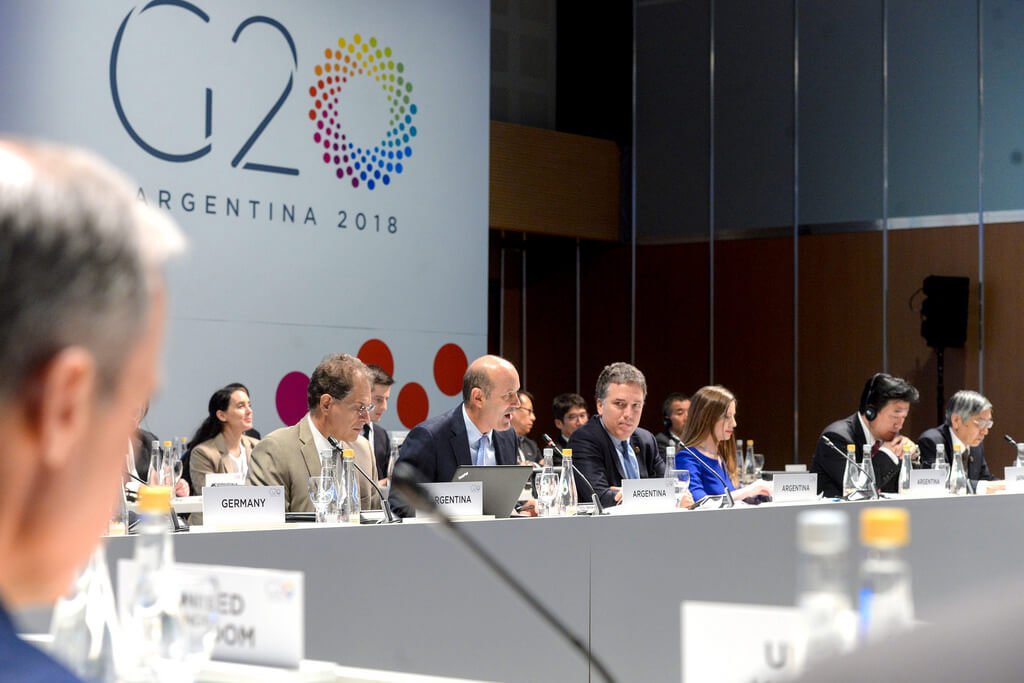
3 mins readPhoto: G20 Argentina / Flickr
While 2018 G20 Buenos Aires summit meetings are getting closer, the global community is discussing the issues of its agenda. It is already clear that being one of the most widely discussed issues cryptocurrencies can’t be omitted from the list of the main topics for the upcoming event. The cryptocurrency market was holding its breath in waiting for the verdict according the necessity of imposing strict regulations.
Nevertheless, after an official Financial Stability Board’s letter that was published on March 18, the crypto community can heave a sigh of relief. According to the chairman of the Financial Stability Board (FSB) Mark Carney, who is also the governor of the Bank of England, cryptocurrencies don’t pose a threat to global financial stability.
The FSB is an international group of central bank regulators and government ministers that is a coordinator of financial regulation for the G20. Its main task is to monitor and develop recommendations for the global financial system that’s why its opinion has significant weight for the future of crypto world. Nevertheless, there is no any serious premises to worry at the moment. Carney wrote: “The FSB’s initial assessment is that crypto-assets do not pose risks to global financial stability at this time. This is in part because they are small relative to the financial system.”
As it is explained, at the recent peak of cryptocurrencies their combined global market value was less than 1% of total global GDP. “Their small size, and the fact that they are not substitutes for currency and with very limited use for real economy and financial transactions, has meant the linkages to the rest of the financial system are limited,” – said Carney in the official letter.
Carney prefers a balanced approach to cryptocurrencies. Today there are a lot of talks about investor protection and usage of crypto assets in criminal activities such as money laundering. Nevertheless, he believes that the technology underlying crypto currencies could be potentially applied for enhancing the efficiency and inclusiveness of the financial system and the economy in general.
Concerning the control of cryptocurrencies, Carney underlined the necessity of international coordination as it deals with a global sphere. In the letter it is said that the crypto market continues to develop, and the FSB may change its initial point of view if it is needed. At the moment, Carney said that the FSB would carry out regular monitoring that would ensure timely identification of any emerging risks or gaps.
As noted in Carney’s letter, a range of major countries, including France, Germany, Japan and the U.S., had called for a unified response to speculation around cryptocurrencies. Earlier, it has become known that France and Germany are working on a joint proposal for crypto regulation that will be presented at the G20 summit.
Nevertheless, the further fate of cryptocurrencies and their regulation will become clear after the meetings of the world leaders at the G20 summit on Monday and Tuesday this week.
I’m a content writer and editor with extensive experience creating high-quality content across a range of industries. Currently, I serve as the Editor-in-Chief at Coinspeaker, where I lead content strategy, oversee editorial workflows, and ensure that every piece meets the highest standards. In this role, I collaborate closely with writers, researchers, and industry experts to deliver content that not only informs and educates but also sparks meaningful discussion around innovation.
Much of my work focuses on blockchain, cryptocurrencies, artificial intelligence, and software development, where I bring together editorial expertise, subject knowledge, and leadership experience to shape meaningful conversations about technology and its real-world impact. I’m particularly passionate about exploring how emerging technologies intersect with business, society, and everyday life. Whether I’m writing about decentralized finance, AI applications, or the latest in software development, my goal is always to make complex subjects accessible, relevant, and valuable to readers.
My academic background has played an important role in shaping my approach to content. I studied Intercultural Communications, PR, and Translation at Minsk State Linguistic University, and later pursued a Master’s degree in Economics and Management at the Belarusian State Economic University. The combination of linguistic, communication, and business training has given me the ability to translate complex technical and economic concepts into clear, engaging narratives for diverse audiences.
Over the years, my articles have been featured on a variety of platforms. In addition to contributing to company blogs—primarily for software development agencies—my work has appeared in well-regarded outlets such as SwissCognitive, HackerNoon, Tech Company News, and SmallBizClub, among others.