Coinbase Transparency Report 2025: What Rising Data Requests from Regulators Mean for Crypto Users
This content is provided by a sponsor
As crypto continues to go mainstream, companies in the Web3 space are attracting far more attention from regulators worldwide. In this context, transparency has become central to keeping exchanges aligned with new rules and, perhaps even more importantly, maintaining user trust.
Coinbase, one of the largest global exchanges, has been publishing an annual transparency report for about six years now. The Coinbase Transparency Report 2025, covering the period from October 1, 2024, through September 30, 2025, highlights the frequency with which authorities requested customer data and how Coinbase protects its users’ privacy.
Read on to find out what the data shows and what every user should know about crypto privacy and security before we enter 2026.
Global Law Enforcement Requests Reached New Highs in 2025
The Coinbase transparency report outlines a few critical shifts in how and where government data requests that crypto exchanges receive originate. Below are the key takeaways.
Coinbase Received 12,716 Information Requests
During the reporting period, Coinbase received 12,716 requests from authorities for customer information, which is about 19% more than the 10,707 requests it received the year before. Even with that jump, the total remains within the 10,000 to 13,000 range it has been in for the past four years. As a result, it’s becoming clear that official interest is growing steadily rather than quickly.
These requests typically come in several legal forms, including subpoenas, court orders, search warrants, and other formal demands. More often than not, they’re sent to identify account owners or trace fraudulent transactions.
Foreign Agencies Now Lead Data Request Volume
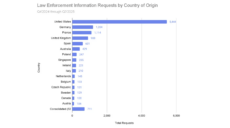
It’s worth noting that most information requests from regulators this year have come from outside the United States (US). For perspective, roughly 53% of the information requests were issued by foreign authorities, up slightly from about 51% in the previous report.
Law Enforcement Information Requests by Country of Origin. Source: Coinbase
On the other hand, the US still accounted for the remaining 47% and retained the top spot in request volume. But the fact that more than half of requests now come from abroad shows how far global crypto regulation 2025 has come.
Regional Trends Show Sharp Contrasts Across Key Markets
When breaking the data down by country, here are some clear regional patterns that have started to emerge:
France, the UK, Spain, and Emerging Markets Drive Significant Growth
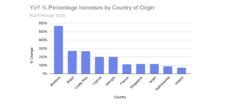
Some jurisdictions are ramping up their requests much faster than others. For example, France stands out with a 111% year-over-year (YoY) surge in requests (reaching around 1,114), putting it among Coinbase’s top non-US markets. Similarly, the UK increased its requests by roughly 16%, Spain by 27%, and Australia by a smaller 1% off an already high base.
Year-on-Year Percentage Increases in Requests by Country of Origin. Source: Coinbase
Interestingly, smaller markets like Moldova and Brazil also saw sharp jumps from their low baselines. This trend points to relatively more active crypto investigations across Europe and Latin America.
Germany, Sweden, and South Korea See Declines in Requests
To begin with, Germany saw about 5% fewer requests than in 2024. But on an even larger scale, there was a 31% drop in Sweden and a 67% drop in South Korea’s request volume YoY. These decreases could be due to shifts in local enforcement priorities or even the conclusion of a few major investigations.
Even with these declines, Germany remains one of the top requesting countries by volume. In fact, when looking at the overall distribution, a handful of countries still dominate these requests. These include the US, Germany, the UK, France, Spain, and Australia, which together accounted for roughly 80% of all law enforcement information requests to Coinbase in 2025.
What Information Authorities Typically Request From Coinbase?
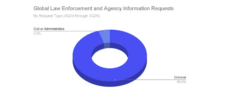
A closer look at the latest Coinbase transparency report reveals a clear trend: most requests are for law enforcement purposes. For context, about 95% of requests from around the world relate to criminal cases like fraud, scams, money laundering, and other illegal activities.
Global Law Enforcement and Agency Information Requests Pie Chart. Source: Coinbase
Only a small number of requests concern civil or administrative matters, like tax or regulatory questions. Though relatively small in number, Coinbase also receives several requests related to national security.
How Coinbase Reviews and Responds to Government Requests
Coinbase explains how it protects user privacy by breaking down the steps it takes internally before responding to any request.
Every Request Goes Through Legal Review Before Action
Coinbase has been quite upfront about its intentions to keep user data confidential. In practice, this means they have a set way of handling Coinbase law enforcement requests. This includes vetting the request by a group of experts, including lawyers and compliance officers, to determine whether it is legal and genuine.
The exchange will also seek to make a request more specific if it seems too broad, like when the authorities request information about multiple users without an apparent reason. In fact, Coinbase will occasionally even challenge or outright refuse a request if it doesn’t meet legal requirements. The platform even states that it aims to provide data in aggregated or anonymized form rather than raw personal information.
Data Shared Is Limited to What the Law Requires
When Coinbase does comply with a government request, the scope of user data provided is limited to what the law requires. Per the report, the exchange may hand over identifying details and account information, such as a customer’s name, a recently used IP address, and payment information.
These are the kinds of data points that authorities use to link blockchain activity to real-world individuals. Coinbase clarifies that this is an individually reviewed process, with no open-ended data feeds and no disclosure of information outside its published privacy policy and applicable law.
No Bulk Data or Real-Time Surveillance
Coinbase makes it clear that it never allows any government direct access to its systems or customer data. There are no “back doors” or live data feeds for law enforcement, and Coinbase prohibits bulk data collection beyond the scope of specific requests. Every request must go through the proper legal channels and be handled on a case-by-case basis.
Privacy and the Growing Role of Crypto Oversight in 2025
Regulators around the world are now keeping a closer eye on digital assets in response to the growing adoption of crypto and past industry issues. Many jurisdictions have already passed new rules, the second-order effects of which are yet to fully unfold. For example, the EU now follows its new MiCA rules, and many other countries have toughened their anti-money-laundering laws for Web3 companies.
New rules around the world mean crypto exchanges and regulators now work hand-in-hand more than ever. At the same time, there’s a bigger push to guard user privacy. Tech like zero-knowledge proofs lets firms prove they’re compliant or flag risks without exposing all your details.
The aim is a fair trade-off, ensuring authorities have enough information to fight crime while regular users keep their data safe. Coinbase’s careful vetting of every request and its public transparency reports show how it’s trying to nurture that balance.
Why Transparency Reporting Matters for Crypto Users
If you trade or hold crypto, Coinbase’s Transparency Report lets you see exactly how your personal data is handled. It makes clear that government requests must follow proper legal procedures and that Coinbase provides only the minimum required details.
Coinbase has been able to set itself apart from other crypto exchanges because of its sheer reporting transparency. As regulations get stricter, Users tend to stick with platforms that openly communicate and protect customer privacy. This is precisely why reports like the Coinbase transparency report help the exchange win trust and loyalty.
How to get started with Coinbase? Visit Coinbase to sign up for a new account and explore its full range of tools designed to help you trade confidently.
Disclaimer: This publication is sponsored. Coinspeaker does not endorse or assume responsibility for the content, accuracy, quality, advertising, products, or other materials on this web page. Readers are advised to conduct their own research before engaging with any company mentioned. Please note that the featured information is not intended as, and shall not be understood or construed as legal, tax, investment, financial, or other advice. Nothing contained on this web page constitutes a solicitation, recommendation, endorsement, or offer by Coinspeaker or any third party service provider to buy or sell any cryptoassets or other financial instruments. Crypto assets are a high-risk investment. You should consider whether you understand the possibility of losing money due to leverage. None of the material should be considered as investment advice. Coinspeaker shall not be held liable, directly or indirectly, for any damages or losses arising from the use or reliance on any content, goods, or services featured on this web page.