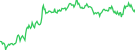
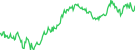
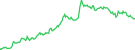
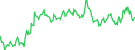
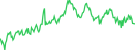
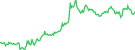
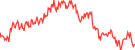
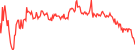
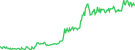
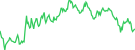
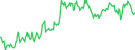
IOTA price today
Today's live IOTA price is $0.0358 USD, with a 24-hour trading volume of $3 371 377 USD. We provide real-time updates for the IOTA to USD price. IOTA has decreased by 1% in the last 24 hours. Currently ranked 189 in the cryptocurrency market, IOTA has a live market cap of $162 722 929 USD, with a circulating supply of
4 541 545 928IOTA coins and the maximum supply not available.
IOTA is an open-source distributed ledger protocol launched in 2015 that goes ‘beyond blockchain’ through its core invention of the blockless ‘Tangle’. The IOTA Tangle is a quantum-resistant Directed Acyclic Graph (DAG), whose digital currency ‘iota’ has a fixed money supply with zero inflationary cost.
IOTA uniquely offers zero-fee transactions & no fixed limit on how many transactions can be confirmed per second. Scaling limitations have been removed, since throughput grows in conjunction with activity; the more activity, the more transactions can be processed & the faster the network. Further, unlike blockchain architecture, IOTA has no separation between users and validators (miners / stakers); rather, validation is an intrinsic property of using the ledger, thus avoiding centralization.
IOTA is focused on being useful for the emerging machine-to-machine (m2m) economy of the Internet-of-Things (IoT), data integrity, micro-/nano- payments, and other applications where a scalable decentralized system is warranted.
Click to see more
How much is 1 IOTA?
Conversion Table
IOTA/USD
(US Dollar)
0.0358 USD
IOTA/EUR
(Euro)
0.0316 EUR
IOTA/JPY
(Japanese Yen)
5.11 JPY
IOTA/CHF
(Swiss Franc)
0.0293 CHF
IOTA/CNY
(Chinese Yuan)
0.26 CNY
IOTA/GBP
(British Pound Sterling)
0.0270 GBP
IOTA/INR
(Indian Rupee)
3.07 INR
IOTA/KRW
(South Korean Won)
51.20 KRW
IOTA/CAD
(Canadian Dollar)
0.0500 CAD
IOTA/NGN
(Nigerian Naira)
57.52 NGN
IOTA/BRL
(Brazilian Real)
0.21 BRL
IOTA/SGD
(Singapore Dollar)
0.0472 SGD