
 Fact-Checked by:
 23 mins
 AI cryptocurrencies combine blockchain with artificial intelligence to power decentralized machine learning networks, GPU computin...
Best AI Crypto in 2026: Top Artificial Intelligence Cryptocurrencies
AI cryptocurrencies combine blockchain with artificial intelligence to power decentralized machine learning networks, GPU computing, and AI agent platforms.
These tokens let developers build AI apps on-chain and access computing resources without relying on centralized tech companies.
The AI crypto market has grown, with a total market capitalization exceeding $26 billion (CoinGecko snapshot, January 2026). AI crypto offers real utility beyond hype. Projects like Bittensor run decentralized machine learning networks, Render provides GPU power for AI workloads, Chainlink connects AI to real-world data, and NEAR builds infrastructure for AI agents.
When choosing the best AI crypto, look for genuine AI utility, strong token economics, active development, good liquidity, and long-term viability. The best projects solve real problems in machine learning, data processing, or AI agents.
Best AI Crypto Coins by Market Cap
Here are the top AI cryptocurrencies ranked by market capitalization as of February 2026.
| Rank | Cryptocurrency | Ticker | Approx. Market Cap | Primary Category / Notes |
|---|---|---|---|---|
| 1 | Chainlink | LINK | $9.49B | Major oracle & data layer in AI ecosystem |
| 2 | Bittensor | TAO | $3.97B | Decentralized machine learning network |
| 3 | Internet Computer | ICP | $1.39B | On-chain compute for AI apps |
| 4 | NEAR Protocol | NEAR | $1.44B | Scalable L1 with AI tooling support |
| 5 | Render | RENDER | $801.02M | Decentralized GPU compute |
| 6 | Story IP | STORY | Coin data not available | AI content / IP platform |
| 7 | Beldex | BDX | Coin data not available | Privacy-oriented with AI applications |
| 8 | Virtuals Protocol | VIRTUAL | $604.80M | AI agents & virtual experiences |
| 9 | Artificial Superintelligence Alliance | FET/ASI | $500.12M | AI alliance tokens |
| 10 | The Graph | GRT | $324.13M | Data indexing used by AI analytics |
Market capitalizations are approximate and subject to daily fluctuations. Always verify current data on major exchanges or tracking platforms like CoinMarketCap or CoinGecko.
How We Selected and Ranked the Best AI Coins (February 2026)
Our ranking methodology combines data-driven market analysis with fundamental project evaluation. We started with market capitalization; it shows you both the token price and how much is actually circulating, which tells you if there’s real liquidity.
But we didn’t stop there. We checked if the AI integration is real or just marketing fluff. We looked at partnerships to see if anyone’s actually using these projects. And we made sure you can actually buy and sell these tokens on major exchanges without losing money to slippage.
Risk factors matter too. We evaluated each project’s dependence on speculative narratives versus sustainable tokenomics, technical execution risk, and competitive positioning against both Web2 AI giants and other crypto projects.
This analysis was last updated on January 26, 2026, using market data from CoinGecko.
Top AI Coins 2026 – Editor’s Pick
BMIC (BMIC)
 Visit Presale
Payment methods
Visit Presale
Payment methods

BMIC AI – Emerging AI Cryptocurrency Project
BMIC AI is a newly born AI crypto, building infrastructure for AI-powered blockchain applications and machine learning integration. The project aims to bridge artificial intelligence capabilities with decentralized networks, though as an emerging token, it carries a higher risk than established projects.
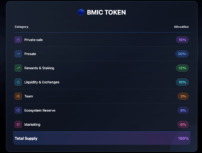
The BMIC Token distribution table lists key allocations, including 50% for the presale, 12% for rewards and staking, and 10% for liquidity and exchanges. Source: BMIC Token
Why It’s a Top AI Coin
BMIC AI offers early-adopter opportunities for investors willing to take on additional risk. Newer projects can bring high returns if the team executes on their roadmap and the technology gains traction.
For those looking beyond established tokens like Chainlink or Bittensor, BMIC can be the potential upside of getting in early on AI-crypto infrastructure, though you should only invest amounts you can afford to lose, given the project’s early stage.
| Project | Ticker | Chain | Status | Current Price | Max Supply | Projected APY | Exchanges | Community Focus |
| BMIC AI | BMIC | Multi-chain | Active Development | Varies | 1,500,000,000 | Variable | TBD | AI integration & blockchain automation |
Top 5 AI Crypto Projects: Detailed Analysis
In this section, we will discuss the characteristics of the most prominent AI projects.
1. Chainlink (LINK) – The Oracle Layer for AI Data
Market Cap: $9.49B Current Price: $9.49 Ticker: LINK
Why It’s a Top AI Coin
Chainlink dominates the AI crypto space as the largest AI cryptocurrency by market capitalization. While it’s primarily known as an oracle network, Chainlink’s role in AI is fundamental, it provides the data infrastructure that AI applications need to function on-chain.
Chainlink recently powered Swift’s multi-bank tokenization trial with major institutions like BNP Paribas and Société Générale, showing its ability to handle enterprise-grade AI and financial data flows.

Chainlink (LINK)
24h7d30d1yAll time
The Chainlink 2.0 roadmap focuses on key innovations, including hybrid smart contracts, scaling, confidentiality, and cryptoeconomic security. Source: Chainlink
The network’s Cross-Chain Interoperability Protocol (CCIP) enables AI applications to access data across multiple blockchains, while the upcoming Confidential Compute feature will allow private smart contracts using decentralized key management, critical for AI applications handling sensitive data.
| Project | Ticker | Chain | Status | Current Price | Max Supply | Circulating Supply | Exchanges | Community Focus |
| Chainlink | LINK | Ethereum | Mainnet Active | $9.49 | 1.00B | 1.00B | Binance, Coinbase, Kraken, KuCoin | Oracle data for DeFi & AI |
2. Bittensor (TAO) – Decentralized Machine Learning Network
Market Cap: $3.97B Current Price: $189.24 Ticker: TAO
Why It’s a Top AI Coin
Bittensor powers a decentralized machine learning network where models train collaboratively and earn rewards in TAO based on the informational value they provide. This is a functioning protocol with real economic incentives for AI development.
The network’s subnet architecture allows specialized AI tasks to scale independently. Bittensor’s development is strategically focused on hardening security, refining economic incentives, and empowering builders through iterative upgrades. Recent developments include expanding subnet capacity to 256 in Q1 2026, doubling the number of specialized AI services that can run on the network.
Bittensor (TAO)
24h7d30d1yAll time
Institutional interest is growing. Grayscale filed an S-1 to convert its Bittensor Trust into an ETF, signaling a deepening institutional commitment. The network recently completed a halving event, reducing TAO emission and potentially supporting price stability as adoption continues.
| Project | Ticker | Chain | Status | Current Price | Max Supply | Circulating Supply | Exchanges | Community Focus |
| Bittensor | TAO | Substrate | Mainnet Active | $189.24 | 21.00M | 21.00M | Coinbase, Binance, Kraken | Decentralized ML marketplace |
3. Internet Computer (ICP) – On-Chain AI Compute
Market Cap: $1.39B Current Price: $2.63 Ticker: ICP
Why It’s a Top AI Coin
Internet Computer is a decentralized cloud blockchain created to host applications, websites, and enterprise systems fully on-chain. Its “self-writing cloud” vision lets AI tools generate applications through natural-language instructions, and users can experiment with platforms like caffeine.ai or write serverless code through ICP Ninja.
The ICP token fuels this ecosystem through a burn-based model where computation costs are paid by burning ICP tokens, creating inherent deflationary pressure as network usage grows. DFINITY’s ‘Mission 70’ targets cutting ICP annual inflation from ~9.7% to under 3% by end-2026 through shorter neuron delays, reduced node rewards, and increased burn rates.

Internet Computer (ICP)
24h7d30d1yAll time
The Internet Computer (ICP) help center provides a conversational interface where users can ask questions or explore various topics. Source: Internet Computer
For AI applications, Internet Computer provides the infrastructure to run AI models on-chain with built-in multi-chain support and robust security. The network’s canister smart contracts can handle up to 4GB of storage each, sufficient for many AI workloads.
| Project | Ticker | Chain | Status | Current Price | Max Supply | Circulating Supply | Exchanges | Community Focus |
| Internet Computer | ICP | IC Protocol | Mainnet Active | $2.63 | 530.11M | 530.11M | Binance, Coinbase, Kraken | On-chain AI execution |
4. NEAR Protocol (NEAR) – AI-Native Blockchain
Market Cap: $1.44B Current Price: $1.17 Ticker: NEAR
Why It’s a Top AI Coin
NEAR Protocol is positioning itself as the blockchain for AI, creating the infrastructure AI needs to transact, operate, and interact across Web2 and Web3. The network combines three core elements: User-Owned AI (ensuring agents act in users’ best interests), Intents and Chain Abstraction (eliminating blockchain complexity), and high-performance infrastructure optimized for AI workloads.
NEAR joined NVIDIA’s Inception Program in January 2026, gaining access to GPU resources and venture capital connections to accelerate its privacy-first AI tools. The partnership builds on the integration of NVIDIA’s Confidential Computing into NEAR’s AI stack for secure data processing, critical for enterprise adoption.

Near Protocol (NEAR)
24h7d30d1yAll time
NEAR is a specialized blockchain protocol designed to allow AI to transact and coordinate on behalf of users by acting as the primary front-end interface. Source: NEAR Protocol
NEAR’s sharded architecture delivers sub-second finality, making it suitable for real-time transactions involving AI agents. NEAR Intents processed over $3 billion in volume, demonstrating the network’s capacity to handle cross-chain operations at scale.
| Project | Ticker | Chain | Status | Current Price | Max Supply | Circulating Supply | Exchanges | Community Focus |
| NEAR Protocol | NEAR | NEAR Blockchain | Mainnet Active | $1.17 | 1.24B | 1.24B | Binance, Coinbase, Kraken | AI-native infrastructure |
5. Render (RENDER) – Decentralized GPU Marketplace
Market Cap: $801.02M Current Price: $1.50 Ticker: RENDER
Why It’s a Top AI Coin
Render Network is a decentralized GPU compute platform for applications ranging from 3D rendering to machine learning and generative AI. The network connects node operators with idle GPU power to artists and developers who need computational resources, achieving high levels of scale, speed, and economic efficiency through peer-to-peer coordination.
Originally launched as RNDR on Ethereum, the network migrated to Solana and rebranded as RENDER between 2023 and 2024 for faster speeds and better integration with other DePIN (Decentralized Physical Infrastructure Network) projects. The token implements a Burn-Mint Equilibrium model that adjusts supply based on network demand and activity.

Render (RNDR)
24h7d30d1yAll time
For AI applications, Render provides the GPU infrastructure needed for training models, running inference, and processing large-scale computations. As AI workloads become more demanding, decentralized GPU networks like Render offer cost-effective alternatives to centralized cloud providers.
| Project | Ticker | Chain | Status | Current Price | Max Supply | Circulating Supply | Exchanges | Community Focus |
| Render | RENDER | Solana | Mainnet Active | $1.50 | 532.45M | 532.45M | Binance, Coinbase, Kraken | GPU rendering & AI compute |
What Is AI Crypto?
AI cryptocurrencies are tokens that power blockchain platforms integrating artificial intelligence capabilities. Using “AI” in marketing is not just a trend following, these projects are building infrastructure for AI marketplaces, decentralized data sharing for machine learning, autonomous agent networks, and distributed compute resources.
Different Types of AI Crypto Projects
Projects like Bittensor create marketplaces where AI models compete and get rewarded for valuable outputs. Think of it as an open marketplace for intelligence where anyone can contribute models and earn tokens based on performance.
Many AI projects focus on data, the fuel that makes machine learning work. These platforms let data providers monetize their information while maintaining privacy and control, solving one of AI’s biggest challenges: accessing quality training data.
The newest category involves AI agents that can transact and coordinate on-chain without human intervention. These agents use crypto tokens to pay for services, access resources, and interact with other protocols.
Projects like Render connect people with spare GPU capacity to those who need it for AI workloads. This decentralizes the infrastructure layer, making AI computing more accessible and cost-effective.
So, AI crypto projects fall into four main categories: AI marketplaces where models compete for rewards, data platforms that monetize training information, autonomous agent networks that transact independently, and GPU compute marketplaces that decentralize infrastructure.
How It Works: Technical Infrastructure
Most AI crypto projects run on existing blockchains like Ethereum or Solana instead of building new ones from scratch. The tokens do three main jobs: pay for AI services, reward contributors, and let holders vote on network decisions.
A typical transaction works in the following way:
- You need to render a 3D animation. You deposit RENDER tokens into a smart contract. A GPU operator picks up your job, renders it, and submits proof of completion. The network verifies the work, then releases your tokens to the operator. No middleman taking cuts.
- On Bittensor, you submit a task to the network. Multiple AI models compete to provide the best answer. The network scores their outputs, and the winning models earn TAO tokens. Your tokens pay for the service; top performers get rewarded automatically.
- You need training data for your AI model. You lock tokens in a smart contract and request specific data. The data provider delivers it, the network confirms delivery, and tokens transfer automatically, all without a platform like Amazon or Google controlling access or charging platform fees.
The key advantage is that smart contracts handle everything automatically. No company sits in the middle, extracting fees or controlling who gets access.
Methodology: How We Evaluated the Best AI Crypto
Our team analyzed 50+ AI cryptocurrency projects across all market cap tiers to identify which actually deliver on their AI promises. We built a five-factor evaluation system that separates real AI utility from marketing hype. Here’s what we look for:
Real AI Utility & Technical Integration (20%)
Does the project actually use AI, or just slap it on the marketing? We check whether AI is core to how the protocol works, not just a roadmap promise. Bittensor’s subnet architecture shows real ML models competing on-chain. Render’s proof-of-render verifies that actual GPU work happened. Chainlink’s oracles feed live data to AI systems.
If the “AI integration” is vague or always “coming soon”, that’s a red flag.
Token Utility & Economic Design (20%)
A token needs to do something real in the AI system. We look at whether tokens pay for actual services (GPU compute, model inference, data access), encourage network participants (miners, validators, data providers), and create sustainable demand through network usage.
Internet Computer burns ICP for computation, more AI apps mean more tokens burned. Render’s Burn-Mint Equilibrium ties supply directly to rendering demand. These mechanics work. Governance-only tokens without economic flow? They don’t.
Market Strength & Liquidity (20%)
Can you actually buy and sell this token without getting wrecked? We check market cap, trading volume across multiple exchanges (not just one), and whether you can exit positions without massive slippage.
Data comes from CoinGecko and CoinMarketCap. We cross-reference everything. If a token shows solid volume but it’s all on sketchy exchanges, we flag it.
Development Activity & Ecosystem Growth (20%)
Is this project being built, or is it vaporware? We track GitHub commits, release schedules, and whether the team ships code or makes excuses. But code alone isn’t enough, we also look at partnerships that matter. Chainlink, working with Swift and major banks, shows real adoption. NEAR’s NVIDIA partnership provides actual resources and credibility.
Community metrics include how many projects are building on the platform, whether developers are active, and whether the ecosystem is growing or dying.
Risk Profile & Long-Term Viability (20%)
Every AI crypto investment can go to zero. We flag the specific risks: Can this project compete with OpenAI, Google, and Anthropic, who have billions in funding and don’t need tokens? What’s the regulatory exposure? Is the project riding hype, or does it have sustainable advantages like censorship resistance, data ownership, or economic participation that centralized AI can’t replicate?
Token unlock schedules can crush prices overnight. We track vesting schedules and insider holdings obsessively.
Our Data Sources
We don’t rely on any single provider. Here’s what we use:
- Price & Market Data: CoinGecko, CoinMarketCap, Kraken
- On-Chain Metrics: Token Terminal, blockchain explorers
- Development Activity: GitHub repositories, project documentation
- Institutional Research: Bloomberg analysts, institutional reports
- Project Data: Whitepapers, roadmaps, governance forums
This analysis was last updated January 26, 2026, using live market data.
AI Crypto vs Traditional Crypto
AI-focused cryptocurrencies differ from established assets like Bitcoin or Ethereum in several key ways. While Bitcoin functions primarily as digital gold and a store of value, and Ethereum serves as a general-purpose smart contract platform, AI crypto tokens have narrower, more specialized use cases tied to artificial intelligence infrastructure.
Here’s how the utility profile breaks down: Bitcoin’s utility is its monetary properties, scarcity, transferability, and censorship resistance. AI crypto tokens get their value from paying for specific services like GPU rendering, data indexing, or model training.
This creates different risk-reward dynamics. AI tokens might see faster growth if their networks gain adoption, but they’re also more exposed to technology risk if the AI implementation fails or competitors do it better.
Volatility and Market Cycles
AI crypto tends to move with broader crypto market sentiment, but can see additional volatility from AI-specific hype cycles. When AI is hot in mainstream tech, AI crypto often outperforms. But analysts warn that if the AI bubble deflates in 2026, repercussions could be swift and severe for AI-related tokens, with cascading effects across the sector.
Where Token Value Comes From
Bitcoin’s value comes from network effects and scarcity. Ethereum’s value comes from being the settlement layer for DeFi and the platform where most applications are built. AI crypto tokens need to prove they can capture value from actual AI usage, not just speculation about future adoption.
The best AI crypto projects combine crypto-native advantages (permissionless access, token incentives, decentralization) with genuine AI utility that couldn’t exist any other way.
How to Buy AI Crypto: Step-by-Step Guide
Buying AI crypto isn’t complicated, but you need the right exchange and wallet setup to do it safely.
1. Choose a Cryptocurrency Exchange
Start with a reputable exchange that lists AI tokens. Major platforms include:
- Coinbase: User-friendly, great for beginners, lists most major AI tokens, including Chainlink, Bittensor, Render, and NEAR
- Binance: Largest exchange by volume, offers the widest selection of AI crypto
- Kraken: Strong security reputation, good for US users, comprehensive AI token selection
- KuCoin: Lists newer AI projects that might not be on larger exchanges yet
Many AI tokens also appear on our upcoming Binance listings and upcoming Coinbase listings trackers as they gain traction.
2. Complete Identity Verification
Most exchanges require KYC (Know Your Customer) verification. You’ll need to provide a government ID and sometimes proof of address. This process usually takes a few hours to a couple of days.
3. Fund Your Account
Deposit fiat currency (USD, EUR, etc.) through bank transfer, debit card, or credit card. Bank transfers typically have lower fees but take longer. Card purchases are instant but come with higher fees (usually 3-4%).
4. Research Before Buying
Don’t just buy because a token is trending. Check the project’s fundamentals: read the whitepaper, examine the team, look at GitHub activity, and verify that AI integration is real, not just marketing.
For a broader context on evaluating cryptocurrencies, see our guide on the best crypto to buy and best altcoins to invest in 2026.
5. Place Your Order
You can use market orders (buy immediately at the current price) or limit orders (buy only when the price reaches your target). For established AI tokens with good liquidity, market orders work fine. For smaller tokens, limit orders help you avoid slippage.
Where to Buy Specific AI Tokens
- Chainlink (LINK): Available on all major exchanges
- Bittensor (TAO): Coinbase, Binance, Kraken, Bybit
- Render (RENDER): Coinbase, Binance, Kraken (note: migrated from RNDR to RENDER)
- NEAR Protocol (NEAR): All major exchanges
- Internet Computer (ICP): Binance, Coinbase, Kraken
Wallets & Storage Best Practices
For long-term holdings, use hardware wallets like Ledger or Trezor. These keep your private keys offline, protected from online hacking attempts. Worth the investment for significant amounts.
MetaMask works for Ethereum-based AI tokens like Chainlink. For multi-chain portfolios, consider Phantom (for Solana-based tokens like Render) or Trust Wallet (supports multiple chains).
Keeping crypto on exchanges is convenient for trading but risky for storage. Exchanges are targets for hackers, and if they freeze your account or get hacked, you could lose access to your funds.
Security Tips
- Enable two-factor authentication (2FA) on all exchange accounts
- Never share your private keys or seed phrases with anyone
- Be extremely skeptical of DMs offering investment advice or “help” setting up wallets
- Verify contract addresses before swapping tokens on DEXes
- Use separate emails for crypto accounts
- Consider using a password manager for strong, unique passwords
Tax & Regulatory Considerations
Don’t forget that cryptocurrency transactions are taxable in most jurisdictions. In the US, trading one crypto for another creates a capital gain or loss. Most exchanges provide transaction history, but you’re responsible for accurate reporting.
Keep detailed records of:
- Purchase prices and dates
- Sale prices and dates
- Gas fees paid
- Any staking rewards received
Consider using crypto tax software like CoinTracker or Koinly to automate the tracking process, especially if you make frequent trades.
Where to Track AI Crypto
Staying informed about AI crypto requires monitoring multiple data sources since the sector moves quickly.
Price Tracking & Market Data
CoinGecko offers a detailed AI crypto category with market caps, trading volumes, and price charts. CoinMarketCap provides similar data plus AI-powered predictions and community sentiment tracking. TradingView gives you advanced charting with technical indicators and community analysis if you want deeper chart work.
On-Chain Analytics
Dune Analytics lets you build custom dashboards tracking specific AI protocols. Nansen shows you wallet tracking so you can see what smart money is doing with AI tokens. Messari publishes detailed research reports on AI crypto projects. DefiLlama tracks Total Value Locked for DeFi-integrated AI projects.
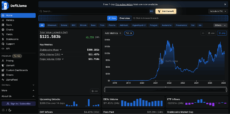
The DeFiLlama dashboard shows a Total Value Locked (TVL) of $121.583 billion. Source: DeFiLlama
Project-Specific Resources
Follow GitHub repositories to monitor how actively developers are shipping code. Join the project Discord or Telegram channels for direct community updates and developer discussions. Follow official project accounts and key developers on X for real-time announcements. Check project documentation regularly, frequent updates signal active development.
News Aggregation
The Block covers professional crypto journalism focused on AI sector developments. CoinDesk provides mainstream crypto news with AI coverage. Decrypt offers accessible reporting on AI crypto trends for general audiences.
Set up alerts for major announcements, price movements, and network upgrades. Portfolio tracking apps like CoinStats, Delta, or Blockfolio let you create custom price alerts and news notifications for specific tokens.
Risks & Challenges of AI Cryptocurrencies
The biggest risk in AI crypto is the gap between marketing and reality. Many projects slap “AI” onto their branding without meaningful AI integration. Before investing, ask: Is AI core to this protocol’s function, or is it just riding the AI narrative?
Red flags include vague whitepapers that use AI buzzwords without technical specifics, roadmaps where AI features are always “coming soon”, and teams without verifiable AI expertise. Legitimate projects have demonstrable AI functionality you can test or verify on-chain.
Volatility and Market Cycles
AI valuation excesses could trigger early volatility in crypto markets if the broader AI bubble deflates. AI crypto tokens often amplify both upward and downward market movements. When AI sentiment is bullish, these tokens can dramatically outperform. But Bitcoin might decline to the $60,000-$75,000 range in a correction scenario, and AI-specific tokens could see even sharper drops.
Position sizing matters. Don’t allocate more to AI crypto than you can afford to lose, especially in smaller-cap tokens with less liquidity. Consider dollar-cost averaging instead of trying to time entries.
Regulatory Uncertainty
Crypto regulations are changing and adapting, and AI crypto faces additional complexity since it spans both crypto and AI regulatory frameworks. Different jurisdictions treat tokens differently, some classify them as securities, others as utilities or commodities.
60% of business leaders rank cyber risk investment among their top three strategic priorities in 2026, driven by geopolitical volatility and AI-enhanced threats. Projects operating in multiple jurisdictions or handling sensitive data face stricter regulations.
Watch for updates from the SEC (US), MiCA regulation (EU), and other regional frameworks. Projects with clear legal structures, registered entities, and compliance programs generally carry less regulatory risk.
Technology Execution Risk
Building a decentralized AI infrastructure is technically challenging. Projects face risks, including:
- Competition from Web2. OpenAI, Google, and Anthropic have massive resources and don’t need blockchain. Decentralized alternatives must offer distinct advantages.
- Technical Complexity is another risk factor. Coordinating machine learning across distributed nodes, ensuring quality outputs, and preventing gaming of reward systems requires sophisticated engineering.
- AI workloads are computationally intensive. Projects need to prove they can handle scale without incurring costs or degrading performance.
Only 22% of organizations report full preparedness for AI-related threats, highlighting how even well-resourced entities struggle with AI security. Decentralized projects face additional challenges in securing distributed systems.
Market Liquidity Risks
Smaller AI tokens might have limited liquidity, especially on decentralized exchanges. This creates challenges: wide bid-ask spreads that eat into returns, difficulty entering or exiting large positions without moving the market, and vulnerability to price manipulation by large holders.
Always check 24-hour trading volume before buying. If volume is low relative to market cap, you might face problems selling when needed.
Competition and Token Value Capture
Even successful AI projects might not translate to token value if the token isn’t essential to the network. Ask whether the token is actually needed for the protocol to function, if there are deflationary mechanisms (burning, staking lockups), and whether network growth directly benefits token holders.
Some projects have brilliant technology but poor tokenomics, where tokens capture little value from network usage.
Conclusion: AI Crypto in 2026
The best AI crypto projects can solve real problems. Focus on GPU networks with actual usage, data marketplaces with engaged users, and agent platforms powering real economic activity. Look for working products, adoption metrics, and teams that ship code. Diversify by combining established projects like Chainlink with smaller high-risk positions. Don’t chase hype.
This is a high-risk, high-reward area of crypto. Analysts expect AI crypto market to grow in the future, but winners will be projects combining genuine innovation with sustainable economics. AI crypto could surge if decentralized infrastructure gains traction, or crash if projects fail to deliver. Invest wisely and do your own research.
FAQ
What is an AI cryptocurrency?
How do AI crypto tokens work?
Are AI crypto projects a good investment?
How do AI crypto coins differ from AI stocks or Web3 tokens?
How do I choose the best AI crypto project?
What risks come with investing in AI crypto?
References
- Artificial Intelligence (AI) Coins by Market Cap. CoinGecko.
- BMIC whitepaper
- Chainlink, Bittensor, Internet Computer, Near Protocol, and Render documentations, whitepapers.
- Crypto Regulations – MICA, SEC
Coinspeaker in Numbers
250K+
Monthly Users
80+
Articles & Guides
5000+
Research Hours
23
Authors
guides
Best AI Crypto in 2026: Top Artificial Intelligence Cryptocurrencies
February 1st, 2026
Vortex FX Launch Date
February 1st, 2026
Is VFX a Scam or Legit?
January 31st, 2026
If you have been following VFX token, you probably noticed the same question popping up everywhere: when does Vortex FX token actu...
The VFX token is tied directly to Vortex FX, a regulated forex broker that’s already executing trades and publishing live trading ...
Otar Topuria
Crypto Editor, 38 postsI’m a crypto writer and analyst at Coinspeaker with over three years of experience covering fintech and the rapidly evolving cryptocurrency landscape. My work focuses on market movements, investment trends, and the narratives driving them, helping readers what is happening in the markets and why. In addition to Coinspeaker, my insights and analyses have been featured in other leading crypto and fintech publications, where I’ve built a reputation as a thoughtful and reliable voice in the industry.
My mission is to demystify the crypto markets and help readers navigate the noise, highlighting the stories and trends that truly matter. Before specializing in crypto, I worked in the IT sector, writing technical content on software development, digital innovation, and emerging technologies. That made me something of an expert in breaking down complex systems and explaining them in a clear, accessible way, skills I now find very useful when it comes to unpacking the intricate world of blockchain and digital assets.
I hold a Master’s degree in Comparative Literature, which sharpened my ability to analyze patterns, draw connections across disciplines, and communicate nuanced ideas. I’m particularly passionate about early-stage project discovery and crypto trading, areas where innovation meets opportunity. I enjoy exploring how new protocols, tokens, and DeFi projects aim to disrupt traditional systems, while also evaluating their potential risks and rewards. By combining market analysis with forward-looking research, I strive to provide readers with content that is both informative and actionable.