
 Fact-Checked by:
 20 mins
 The best decentralized exchanges increasingly cover more than simple token swaps. They are places where traders can use on-chain o...
Bitcoin Futures Trading: Top 5 Best BTC Futures Exchanges
Discover the best Bitcoin futures exchanges for 2026. Find the right platform for you, whether you are a beginner in Bitcoin trading or seeking advanced trading tools.
In this guide, we’ll take a close look at the best Bitcoin futures trading platforms and help you decide which one is right for you.
Bitcoin futures trading offers an opportunity to place directional bets on Bitcoin and speculate on its future price. Futures trading allows for very flexible trading strategies and efficient use of capital with high leverage.
However, it is important to choose the right futures trading platform so that you get access to the best trading tools and lowest fees. Hence our guide to the top BTC futures exchanges for 2026.
Key Takeaways
- Bitcoin futures let traders speculate on BTC’s price with leverage and flexible strategies.
- Top exchanges offer varying fees, leverage limits, and contract types.
- Platforms like PrimeXBT, Kraken, and Coinbase provide advanced tools for experienced traders.
- U.S. traders have limited options, with Kraken standing out domestically.
The 5 Best Bitcoin Futures Platforms in 2026
Let’s dive straight into our list of the five best Bitcoin futures trading platforms to use today.
- PrimeXBT – The best BTC futures trading platform with 500x leverage
- Kraken – One of the few U.S. exchanges for Bitcoin futures trading
- Coinbase – Best for strong liquidity and regulation
- MEXC – Low-fee BTC futures trading platform
- Bitbase – Best Bitcoin futures exchange for comprehensive features
A Closer Look at the Best Bitcoin Futures Trading Platforms
Now let’s take a closer look at each of our top-ranked Bitcoin futures exchanges so you can decide which one to use.
1. PrimeXBT: Best BTC Futures Trading Platform With 500x Leverage
PrimeXBT launched in 2018, and offers leveraged trading in crypto futures and CFDs on other assets. Traders can use Bitcoin perpetual futures contracts with cross margin and isolated margin settings, as well as leverage up to 500x. Regular accounts pay a maker fee of 0.01% and a taker fee starting at 0.015%, and some pairs have zero fees during promotions.
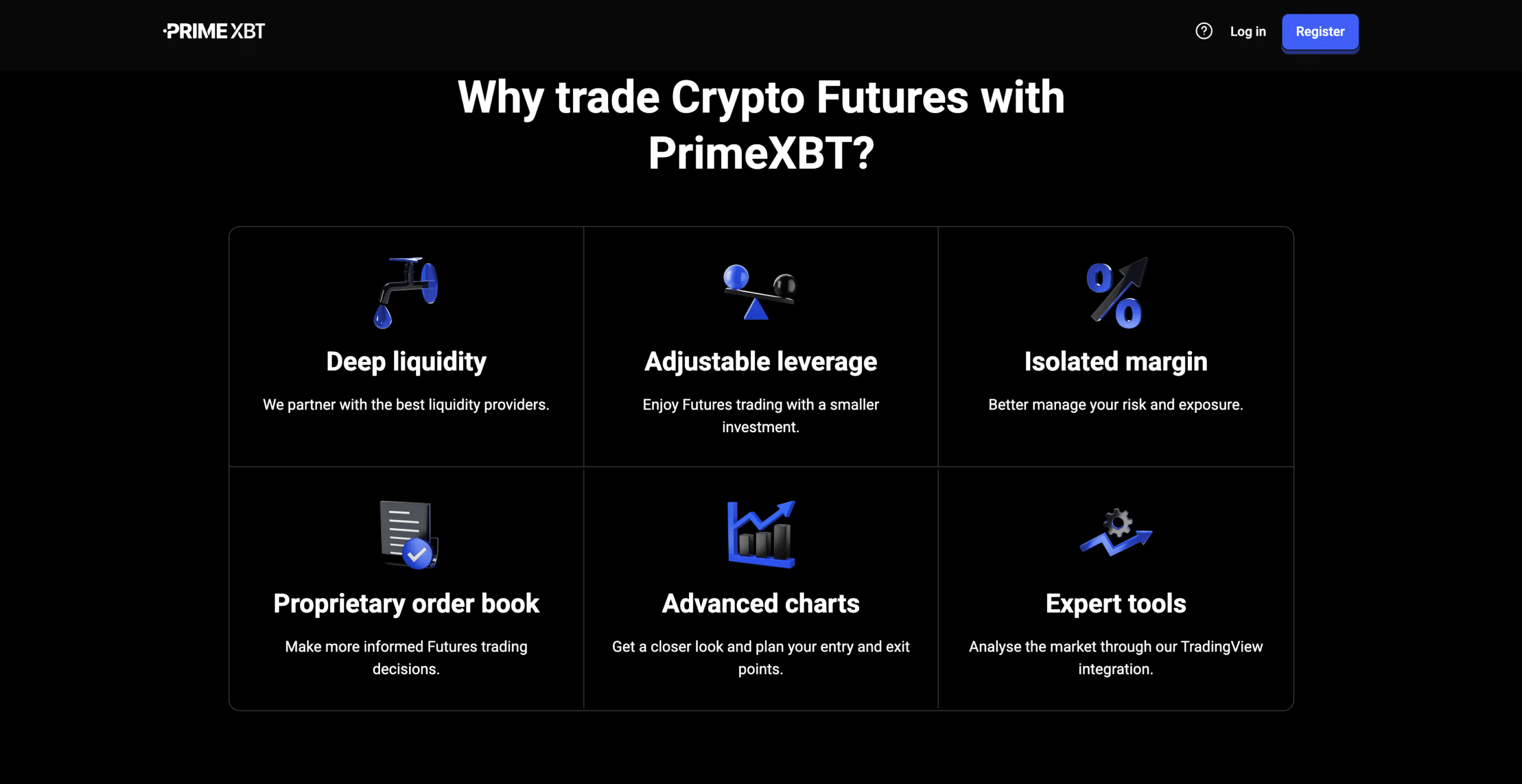
The PXTrader 2.0 platform powers PrimeXBT’s trading terminal and integrates charts from TradingView. Liquidity supplied by professional partners supports quick execution and limited slippage during sharp Bitcoin price movements, and funding payments on Bitcoin perpetual futures are made every eight hours. PrimeXBT’s combination of low fees and high leverage on Bitcoin futures gives active traders a cost-efficient way to take large positions.
On PrimeXBT, funds remain in cold storage secured by multisignature technology and hardware security modules that meet the FIPS 140-2 Level 3 standard. The platform itself operates through licensed entities in South Africa, El Salvador, and Saint Lucia, but the service is unavailable to residents of the United States, Canada, the United Kingdom, and the European Economic Area.
Pros
- Leverage up to 500x on Bitcoin futures
- Maker fee of 0.01%
- TradingView charts are built into the terminal
- Support for both isolated and cross margin
- Cold storage with multisignature keys
Cons
- Unavailable to traders in the U.S., EEA, UK, and Canada
2. Kraken: Best U.S. Exchange for Bitcoin Futures Trading
Kraken is one of the few U.S.-based crypto exchanges offering perpetual BTC futures trading to eligible American users, and it provides access to more than 300 perpetual futures contracts overall. Leverage on BTC perpetuals varies by contract and user location; it can reach 50x or even 100x for many users outside the U.S., but is more restricted for U.S. clients on regulated products. Kraken also has less liquidity than some of its globally dominant peers.
For U.S. traders looking for a domestically regulated platform to trade perpetual BTC futures, Kraken is one of the best options.

In addition to its own perpetual contracts, Kraken offers U.S. clients access to CME-listed Bitcoin and Micro Bitcoin futures contracts through its derivatives platform. These are cash-settled contracts that expire monthly. The standard Bitcoin futures contract has a minimum tick size of $25, while the Micro Bitcoin contract has a minimum tick size of $0.50.
Kraken charges futures trading fees of 0.02% for makers and 0.05% for takers, with no native token discount. Fees only decrease once a trader reaches at least $5 million in 30-day futures volume, which is generally out of reach for most retail traders. Kraken supports FIX API for programmatic trading and bots, but it does not offer built-in copy trading features for futures.
Pros
- 300+ perpetual futures contracts available to U.S. users
- Trade CME-listed BTC and Micro BTC futures
- User-friendly trading platform
- Competitive trading fees for U.S. users
- Offers 24/7 live chat support
Cons
- Fee discounts available only with $5M+ in monthly volume
- Lower leverage on BTC perpetuals than offshore platforms
3. Coinbase: Best Bitcoin Futures Exchange for Strong Liquidity and Regulation
Coinbase was founded in 2012, and operates one of the largest cryptocurrency exchanges with a strong focus on compliance and platform infrastructure. Its Bitcoin futures offering differs by jurisdiction due to varying regulations.
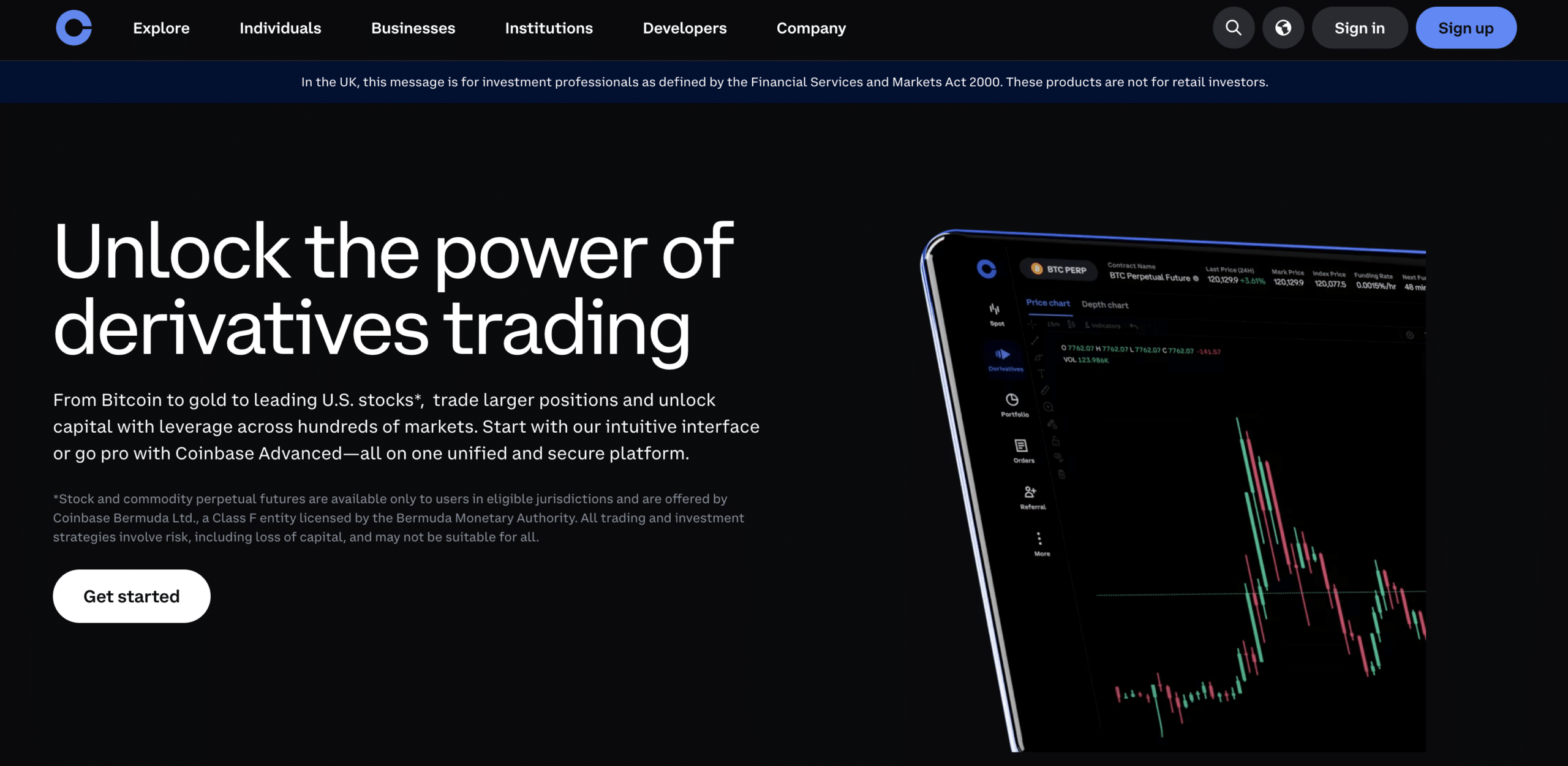
In the United States and eligible EEA countries, traders can access CFTC-regulated nano Bitcoin contracts and perpetual-style futures through Coinbase Derivatives. Each nano contract represents 0.01 BTC, lowering the capital required for leveraged positions. These perpetual-style contracts, introduced in 2025, have no monthly expirations and use funding rates to closely track spot Bitcoin prices. Trading runs nearly 24/7 with only a brief weekly maintenance window.
Outside the U.S., eligible traders in permitted jurisdictions can use Coinbase Advanced to trade standard Bitcoin perpetual futures. These offer higher leverage, often up to 50x, with continuous contracts settled in USDC and no artificial expiry dates. Both versions integrate with spot trading, allowing users to manage margin and positions in one interface while hedging or taking directional views on Bitcoin.
Liquidity remains solid across major contracts in all regions, supported by meaningful open interest and daily volume. The choice between versions depends on location: US traders gain stronger regulatory protections and smaller contract sizes, while international users typically receive greater leverage flexibility. Coinbase requires identity verification and eligibility checks everywhere.
Pros
- Nano contracts available in regulated US markets
- Perpetual futures offered in most eligible jurisdictions
- Integrated spot and futures trading platform
- Near-24/7 market access across offerings
- Solid liquidity in Bitcoin contracts globally
Cons
- Leverage and contract types vary by country
- Strict verification required for derivatives access
4. MEXC: Low-Fee BTC Futures Trading Platform
MEXC is one of the most popular crypto futures exchanges because it offers ultra-low fees. When trading BTC futures on this platform, you’ll pay 0% if you create liquidity and just 0.02% if you take liquidity. If you hold the exchange’s native MX crypto token, you’ll also qualify for a 20% trading fee reduction.
You can trade Bitcoin futures denominated in USDT, USDC, and BTC on MEXC, giving you a lot of flexibility to trade in the tokens you already own. Deposits in any of these tokens are free and withdrawals come with some of the lowest fees in the industry.
MEXC is also one of the top BTC futures exchanges for offering leverage. You can trade BTC/USDT perpetual futures contracts with up to 500x margin, compared to just 100x at most competing exchanges.
The MEXC futures trading platform includes powerful technical analysis tools, a demo trading environment, and a copy trading suite, giving you more ways to approach the Bitcoin futures market.
Pros
- Fees from 0%/0.02% for BTC futures trading
- Trade BTC/USDT perpetuals with up to 500x leverage
- Supports BTC-denominated futures contracts
- Strong selection of trading tools, including copy trading
- Welcome and referral bonuses available
Cons
- KYC required for futures trading (not for spot trading)
- Limited customer support availability
5. Bitbase: Best Bitcoin Futures Exchange for Comprehensive Features
Bitbase is a centralized crypto exchange offering Bitcoin futures trading alongside spot markets. Its futures service features leveraged perpetual and delivery contracts margined in USDT or USDC. Traders can take long or short positions on Bitcoin to pursue gains from price movements in either direction, or to hedge their existing holdings.

The exchange prioritizes security through a protection fund and multi-signature requirements for asset transfers, complemented by segregated online and offline storage. Bitbase lists over 624 trading pairs in total, giving users access to a wide range of spot and futures markets that include Bitcoin, Ethereum, and many other cryptocurrencies. Its mobile app supports efficient trading with rapid order processing and low latency, alongside straightforward deposit options via wallet addresses or third-party processors.
Bitbase combines derivatives capabilities with elements of traditional finance products, creating a versatile environment for portfolio management, and customer assistance is available around the clock. It also provides tools for risk management within a user-friendly framework.
Pros
- Leveraged perpetual and delivery Bitcoin futures available
- Multi-signature security and dedicated protection fund
- Fast order matching with low trading latency
- 624+ total trading pairs across spot and futures
- Round-the-clock customer support and easy deposits
Cons
- Newer platform (launched in 2023); liquidity levels may fluctuate
Top Bitcoin Futures Exchanges Compared
Here’s an overview of how our top-rated Bitcoin futures trading platforms stack up:
| Platform | No. of Futures Contracts | Maker/Taker Fees | Maximum Leverage | Supported Countries |
| PrimeXBT | 30+ | 0.01% / 0.015% | 500x | Global excluding U.S., Canada, UK, EEA, Iran, North Korea, Russia + sanctioned countries |
| Kraken | 350+ | 0.02% / 0.05% | 100x | Available in 190+ countries; futures restricted in UK (retail), Cuba, Iran, Iraq, North Korea, Libya, New Zealand, Russia |
| Coinbase | 300+ | 0% / 0.02% | 50x | International perpetuals available outside U.S., UK, EEA, Canada for many products; U.S. has separate regulated derivatives offering |
| MEXC | 1,000+ | 0% / 0.02% | 500x | Global excluding U.S., UK, Canada, Singapore, China, Hong Kong + sanctioned countries |
| Bitbase | 340+ | 0.02% / 0.06% | 150x | Global, except U.S., UK, Canada, Netherlands |
What Are Bitcoin Futures?
Bitcoin futures are standardized contracts traded on exchanges. They create an obligation for one party to buy Bitcoin and for the other party to sell it at a set price on a future date.
These contracts are mainly used to bet on whether Bitcoin’s price will go up or down. If you think the price will rise, you can buy a futures contract (go long). If Bitcoin’s price moves in your favor, you can close the position for a profit. If it moves against you, you lose money.
Most Bitcoin futures are cash-settled, meaning profits and losses are paid in USDT, USDC, or USD. Some futures contracts do involve actual BTC changing hands, but these are less common on most retail trading platforms.
How Does Crypto Futures Trading Work?
You don’t have to hold a futures contract until it expires. You can close your position at any time by doing the opposite trade (selling if you bought, or buying if you sold).
Bitcoin futures contracts have their own prices that change based on market expectations. This means you can profit by buying a contract and selling it at a higher price if Bitcoin moves up – without waiting for it to expire.
This flexibility allows for different trading strategies and helps traders manage risk. Many platforms also offer demo accounts and calculators so you can practice and see potential profits or losses before trading with real money.
How to Trade Bitcoin Futures
Now that you know the basics of Bitcoin futures, let’s walk through how to get started trading. We’ll use our top-rated platform, PrimeXBT, as an example.
Step 1: Create a PrimeXBT Account
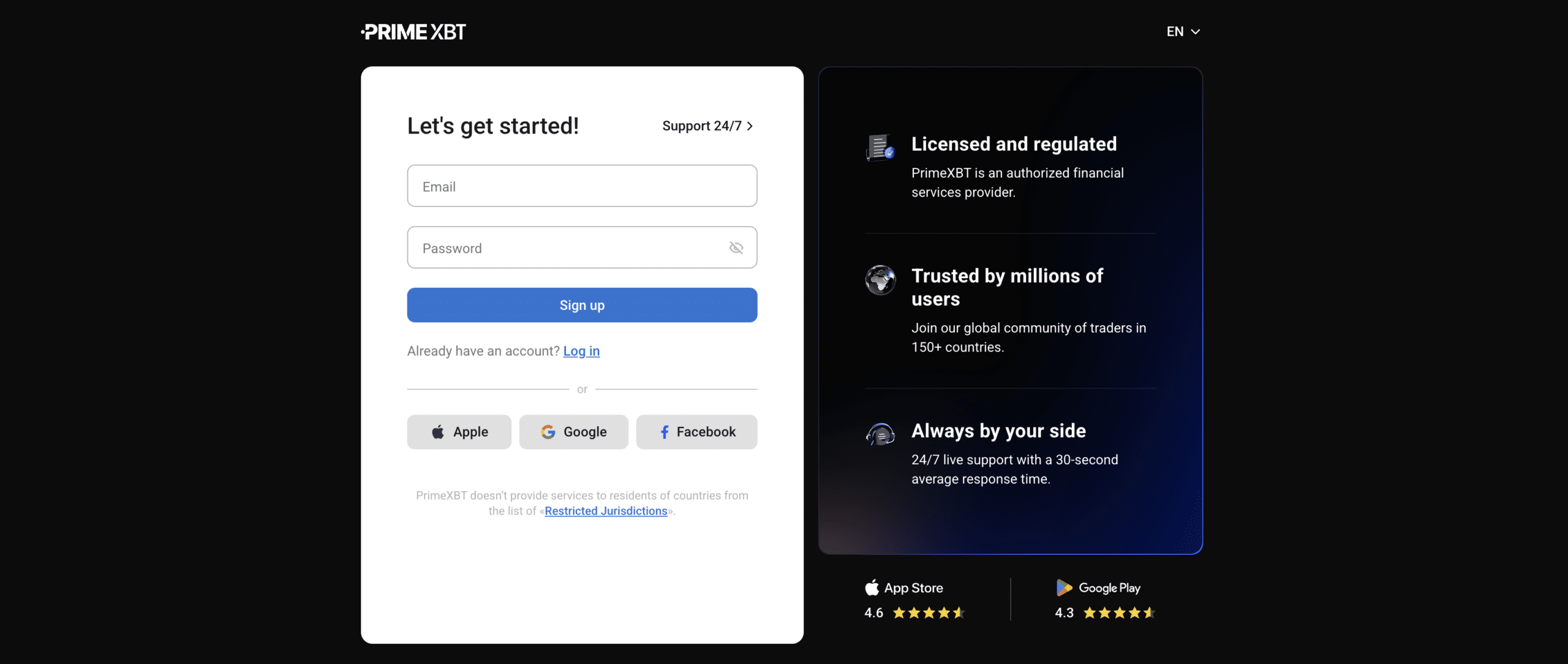
Visit PrimeXBT’s official website and click one of the prominent blue signup buttons that can be found throughout the homepage. On the account creation page, you can enter your email and create a password, or sign up instantly using your Apple, Google, or Facebook account. You’ll receive a verification email; confirm it to activate your account. The process takes under a minute and does not require KYC for cryptocurrency futures trading.
Step 2: Open Your PXTrader 2.0 Trading Account
After logging in, open your free PXTrader 2.0 account and choose your preferred account currency (e.g., USDT or BTC). This gives you instant access to over 30 crypto futures contracts, including Bitcoin perpetuals.
For practice, start with PrimeXBT’s free demo account loaded with $10,000 in virtual funds so you can test strategies in real market conditions with no risk.
Step 3: Deposit Funds
Go to the Deposits section in your dashboard. Send popular cryptocurrencies such as BTC, USDT, or others to your personal PrimeXBT deposit address. Deposits are processed quickly (often in under a minute) with zero or minimal fees.
When your funds arrive in your wallet, simply transfer them to your PXTrader 2.0 trading account, and you’ll be ready to trade with real capital.
Step 4: Navigate to the Bitcoin Futures Section
Launch PXTrader 2.0 (available on the web or via the PrimeXBT mobile app for iOS and Android). Go to the Crypto Futures section and select the Bitcoin (BTC/USDT) perpetual futures contract from the list.
Step 5: Place Your First Trade
In the trading interface, choose whether you want to go Long (expecting Bitcoin’s price to rise) or Short (expecting it to fall). Adjust your leverage, enter your desired position size, and optionally set Take-Profit and Stop-Loss levels to automatically manage risk. Select a Market or Limit order, and confirm to open your position. You can monitor your trade in real time with advanced charts, adjust or close it at any time, and track your profit and loss instantly.
Bitcoin Futures vs Bitcoin Options
Bitcoin futures are closely related to Bitcoin options, but they work differently. With futures, both sides are obligated to fulfil the contract (unless the position is closed early). With options, the buyer has the right, but not the obligation, to exercise the contract. This means options can expire worthless, limiting the buyer’s risk to the premium they paid.
Futures profits and losses depend solely on Bitcoin’s price movement. Options are more complex because their value is also affected by how close the contract is to its expiration date. Because of this, options can be used to bet on volatility, not just price direction.
Overall, Bitcoin options are significantly more complex than futures and are generally only suitable for experienced traders.
What You Need to Know Before Trading Bitcoin Futures
There are a few nuances to trading crypto futures that are important to understand before you start trading.
Perpetual vs Expiring Futures
The examples above refer to expiring futures, which have a set expiration date. However, many platforms also offer perpetual Bitcoin futures, which have no expiration date – so you can hold or close your position whenever you want.
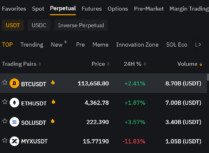
To keep the perpetual contract price close to Bitcoin’s spot price, exchanges use a funding rate mechanism. Every few hours (often every eight hours), longs and shorts exchange a small fee – so if the futures price is higher than spot, longs pay shorts. If it’s lower, shorts pay longs. These fees can impact the profitability of a perpetual futures position.
Settlement Currencies
Most Bitcoin futures are settled in USDT or USDC. Profits and losses are paid in these stablecoins, and no Bitcoin actually changes hands.
On the other hand, some contracts are BTC-denominated (and these are known as “inverse contracts”). With inverse contracts, Bitcoin is used for settlement, so actual BTC can change hands when the position is closed or settled.
Margin Types
There are two types of margins offered at most Bitcoin futures exchanges: cross margin and isolated margin.
Cross margin uses all of the positions across your exchange account to supply collateral for your trades. This reduces liquidation risk since profitable positions can serve as collateral for leveraged positions that lose money. However, you have less control over the risk associated with any single trade and your entire account balance is at risk if a trade goes very badly.
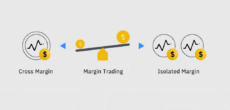
Isolated margin requires you to assign collateral to each individual trade. It requires more capital management and doesn’t enable you to use all of the funds within your exchange account to support new trades. However, your maximum risk for any single trade is clearly defined and it’s much easier to predict when a specific position could be at risk of liquidation.
In general, newer traders should stick to isolated margin for Bitcoin futures trading. Cross margin should be used very carefully as it puts your entire account balance at risk.
Risk Management Tools
Most major Bitcoin futures trading platforms offer risk management tools to help you minimize your losses and maximize your profits.
The most important of these tools are different order types that enable you to automatically close positions when they go against you. Stop loss orders automatically sell your BTC futures contract if the price of Bitcoin falls below a level you specify. This can enable you to lock in unrealized profits or limit the amount of money you can lose when a trade goes against you.
Take-profit orders automatically sell your BTC futures contract if the price of Bitcoin reaches a level you specify. This allows you to close your trade early to lock in profits.
Another important risk management tool is a demo account, which lets you practice Bitcoin futures trading in a simulated environment using virtual money. It’s a good idea to use a demo account to practice your futures trading strategy and ensure you can be consistently profitable before trading in a live account.
Some exchanges also offer a PnL simulator. This allows you to visualize the potential outcomes from a Bitcoin futures trade under different market scenarios. You can use these simulators to understand your risk if Bitcoin’s price were to reach a specific price level.
Benefits of Trading Bitcoin Futures
Trading Bitcoin futures can have a number of advantages over spot trading. Here are a few of the key reasons why Bitcoin futures trading has exploded in popularity.
Go Long or Short Bitcoin
A major benefit to trading Bitcoin futures is that you can make a directional bet in either direction. That’s a big plus for short sellers, who can face limited liquidity and high borrowing costs for trying to short BTC in spot markets (and many exchanges don’t support short selling at all).
So, if you think the price of Bitcoin is going to fall, you can use Bitcoin futures to try to profit from that movement.
Efficient Capital Allocation With Leverage
Bitcoin futures contracts can be traded with 100x leverage or more at many exchanges, enabling you to take relatively large positions with very small amounts of capital. This is important because it enables individual traders who don’t have hundreds of thousands of dollars to earn large profits from small price movements.
Since leveraged futures positions don’t require much capital, they also enable you to spread the capital you have across more positions. This is key for hedging and diversifying your portfolio, thus minimizing your risk to any one token.
Extremely High Liquidity
Bitcoin futures markets trade with incredibly deep liquidity. Bitcoin futures trades can be executed instantly 24/7 without worrying about slippage.
In addition, although liquidity in spot BTC isn’t an issue at most exchanges, deep liquidity in the futures market is a very important benefit for trading around other tokens that aren’t as popular as Bitcoin.
Low Trading Fees
Trading fees for Bitcoin futures contracts are very low for makers and takers, especially compared to trading fees for spot Bitcoin. For example, if an exchange charges 0.02% for makers in its Bitcoin futures market, but 0.1% for all spot Bitcoin trades, that’s a 5x higher fee for makers trading spot BTC.
These reduced fees can add up to significant savings and make more of your trades profitable.
Doesn’t Require Owning BTC
Many crypto traders prefer to own stablecoins like USDT and USDC rather than BTC, which is notoriously volatile in price. When trading spot Bitcoin, you have to own BTC in order to profit from price changes.
However, when trading Bitcoin futures, you never have to take ownership of actual Bitcoin. Most contracts are denominated in and settled in stablecoins like USDT or USDC, which helps protect your account from Bitcoin’s volatility.
Supports Hedging Strategies
Another reason to use Bitcoin futures contracts is to hedge against other positions in your portfolio. For example, if you have a large bullish trade open with spot BTC, you can open a short Bitcoin futures position to hedge. If the price of Bitcoin falls, profits from your futures position will help make up for lost value in your spot position. If the price of Bitcoin continues to go up, the profits from your spot position can more than offset any losses from your futures position.
Pros & Cons of Bitcoin Futures Trading
Here’s a full overview of the benefits and drawbacks of Bitcoin futures trading.
Pros
- Support long and short directional bets
- Highly leveraged positions possible
- Deep liquidity with little to no slippage
- Reduced trading fees compared to spot BTC trading
- Can hold positions in stablecoins like USDT or USDC
- Supports hedging strategies
Cons
- Directional bets have unlimited risk
- Leveraged trading magnifies losses and adds liquidation risk
- More complex than trading spot cryptocurrencies
Conclusion
Bitcoin futures contracts give traders more flexibility to trade around the price of Bitcoin. They let you take directional positions with high leverage and low trading fees. Futures trading has deep liquidity and many exchanges now offer perpetual Bitcoin futures with no expiration dates.
Based on our analysis, the best Bitcoin futures trading platform today is PrimeXBT. It offers up to 500x leverage on over 30 perpetual contracts, ultra-low fees from 0.01%, deep liquidity, advanced TradingView tools, and no mandatory KYC for many users.
References
- How Perpetual Futures Differs from Traditional Futures and Why It Matters for Crypto (The Digital Chamber)
- Using Futures to Hedge Against Market Downturns (Charles Schwab)
FAQ
What is the best Bitcoin futures exchange?
What are perpetual Bitcoin futures?
Are Bitcoin futures risky?
How much money do I need to trade Bitcoin futures?
Should I trade Bitcoin futures or options?
Coinspeaker in Numbers
250K+
Monthly Users
80+
Articles & Guides
5000+
Research Hours
23
Authors
guides
Best Decentralized Exchanges (DEXs) in September 2026
September 8th, 2026
How to Swap Crypto on Godex: A Step-by-Step Guide to No-KYC Crypto Swapping
June 12th, 2026
CoinDepo vs. WhiteBIT Earn Comparison: Yields, Features, Security and More
June 2nd, 2026
Most crypto swap platforms have an identity threshold at some point in the process, such as a KYC trigger buried in the terms, a c...
In the competitive world of crypto yield generation, CoinDepo and WhiteBIT Earn have built notable reputations as centralized plat...
Ibrahim Ajibade
, 373 postsI’m a research analyst with experience supporting Web3 startups and financial organizations through data-driven insights and strategic analysis. My goal is to help organizations make smarter decisions by bridging the gap between traditional finance and blockchain innovation.
With a background in Economics, I bring a solid understanding of market dynamics, financial systems, and the broader economic forces shaping the crypto industry. I’m currently pursuing a Master’s degree in Blockchain and Distributed Ledger Technologies at the University of Malta, where I’m expanding my expertise in decentralized systems, smart contracts, and real-world blockchain applications.
I’m especially interested in project evaluation, tokenomics, and ecosystem growth strategies, as these are areas where innovation can drive lasting impact. By combining my academic foundation with hands-on experience, I aim to provide meaningful insights that add value to both the financial and blockchain sectors.