
 Fact-Checked By:
 25 mins
 The best decentralized exchanges increasingly cover more than simple token swaps. They are places where traders can use on-chain o...
Top 6 Solana Futures Trading Platforms
Want to trade Solana futures but need some expert-led guidance? Read our beginner’s guide on how to trade SOL futures safely in 2026.
Traders buy and sell futures to profit from the rising and falling prices of Solana. As a derivative instrument, futures contracts offer low upfront requirements, allowing exchange traders to gain exposure to SOL price movements with a small fraction of the position value.
Based on our platform research, PrimeXBT is the best place to trade Solana futures. It lists a SOL/USDT perpetual alongside forex, commodities, and indices in one account, charges some of the lowest fees here, and pairs that with copy trading and native mobile apps.
Learn how to trade Solana futures in this extensive beginner’s guide. Discover safety best practices, including how to mitigate liquidation risk and select the right contract terms.
Key Takeaways
- Futures contracts offer exposure to Solana without requiring the purchase of actual SOL coins.
- Traders place buy and sell orders depending on whether they predict the SOL price to increase or decrease.
- SOL futures leverage varies widely by platform, ranging from around 50x on regulated venues to as high as 300x on offshore exchanges like MEXC.
- Exchanges liquidate losing positions when they decline below the maintenance margin, making futures riskier than traditional spot trading.
- To choose a suitable platform, traders must consider licensing, user-friendliness, margin requirements, and settlement terms.
Top 6 Solana Futures Trading Platforms
To trade Solana futures in a safe environment, consider the following platforms:
- PrimeXBT: Multi-Asset Platform to Trade SOL Perpetuals Alongside Forex, Commodities, and Indices
- Kraken: Security-First Exchange With SOL Perpetual and Dated Futures Contracts
- Coinbase: Regulated US SOL Futures Plus a USDC-Settled International Perpetual
- MEXC: Trade SOL Futures via USDT-M or Coin-M Perpetual Contracts
- Bitbase: High-Leverage SOLUSDT Perpetual With up to 125x
- Binance: World-Class Charting and Analysis Features With Deep Liquidity
Best Solana Futures Platforms Reviews
The top Solana futures platforms suit various trading profiles. Some stand out for their low commissions and margin requirements, while others offer advanced charting tools with ultra-fast execution speeds.
Read the following platform reviews to make an informed choice.
1. PrimeXBT: Overall Best Platform for Solana Futures Trading
PrimeXBT takes the top spot as a multi-asset platform where Solana futures sit alongside forex, commodities, indices, and CFDs in a single account. SOL trades as a USDT-margined perpetual (SOL/USDT), so your profit and loss settles in stablecoins rather than in SOL itself.
Where PrimeXBT earns its place here is cost. The SOL/USDT contract carries a 0.01% maker fee and a 0.045% taker fee at the standard tier, and the taker side drops as low as 0.015% once you reach the higher VIP levels. For anyone trading SOL actively, that gap adds up fast.
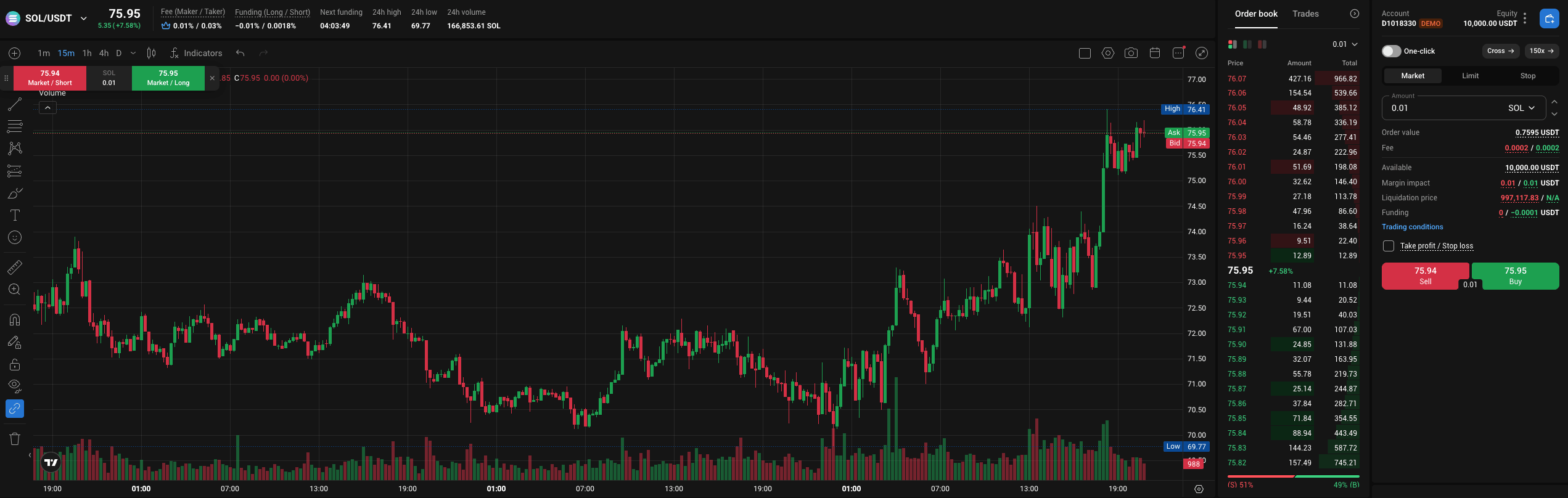
PrimeXBT lets you trade SOL/USDT perpetuals alongside forex and commodities from one account. Source: PrimeXBT
PrimeXBT also advertises leverage of up to 500x across its crypto futures, though it doesn’t publish a cap for the SOL pair specifically. Everything runs through PrimeXBT’s own trading terminal, with copy trading built in for anyone who’d rather follow experienced traders than place their own orders. There’s even native iOS and Android apps for trading on the move.
However, unlike the top no-KYC crypto exchanges, PrimeXBT can request identity verification at any point and may limit trading or withdrawals until you complete it. It’s also closed to traders in the US, so you’ll need to be based outside that market to open an account.
Pros
- Trade SOL/USDT perpetuals alongside forex, commodities, and indices from a single account
- Low fees on the SOL market: 0.01% maker and 0.045% taker, falling to 0.015% taker at the top VIP tiers
- USDT-margined contracts keep profit and loss in straightforward stablecoin terms
- Built-in copy trading for following more experienced SOL traders
- Native iOS and Android apps for managing positions away from the desk
- Integrated terminal brings charting, order entry, and multiple asset classes into one place
Cons
- Closed to traders based in the US
- No published max leverage for the SOL pair, so you only see the cap once you’re inside the order ticket
2. Kraken: Best for Security and Multiple SOL Contract Types
Kraken is one of the oldest and most security-focused names in crypto, and its futures arm gives SOL traders more contract choice than most. The live feed carries a SOL/USD perpetual plus dated contracts, so you can run an open-ended position or pick a fixed maturity depending on your preferences.
Everything is quoted and margined in USD. Outside the US, SOL perpetuals run through a multi-collateral futures wallet, with your collateral valued in dollars. Leverage on SOL reaches up to 50x for eligible traders, though the cap is lower in some regions (for example, Europe sits closer to 10x).
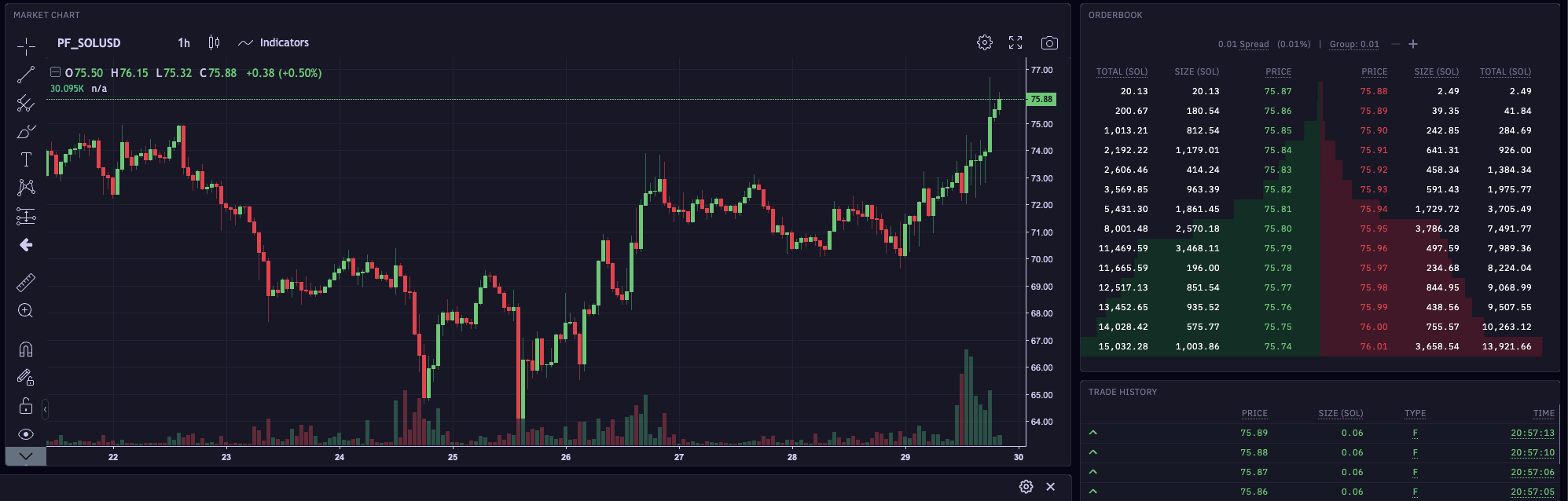
Kraken offers SOL/USD perpetual and dated futures, all margined in USD. Source: Kraken Futures
Fees are competitive: 0.02% maker and 0.05% taker at the entry tier, dropping sharply as your 30-day volume climbs. Execution is available on web, the mobile app, and Kraken Desktop.
US traders aren’t shut out, but the route differs. Rather than the offshore perpetuals, US clients access CME-listed Solana futures through Kraken’s regulated US derivatives arm, with USD-only collateral. KYC is required across the board.
Pros
- Multiple SOL contract types: a perpetual plus dated futures with set expiry dates
- Strong security and compliance track record from a long-established exchange
- Competitive fees starting at 0.02% maker / 0.05% taker, falling with volume
- US traders can access regulated CME-listed SOL futures through Kraken’s US derivatives arm
Cons
- Max SOL leverage varies by region and is well below the highest-leverage offshore venues
- Full KYC is required, so there’s no anonymous trading
3. Coinbase: Best for Regulated US Solana Futures
Coinbase is the most heavily regulated name on this list, offering many of the best cryptocurrencies to buy, and for SOL futures it runs two separate routes depending on where you live. In the US, Solana futures trade through Coinbase’s CFTC-regulated derivatives venue, which is a draw for traders who’d rather not go offshore.
There are three SOL contracts: a standard future (100 SOL), a nano future (5 SOL), and a no-expiry nano “perp-style” future that lets you hold without monthly rollovers. But the trade-off is leverage. Current margins on the SOL contracts work out to roughly 3-4x – well under the up-to-10x ceiling Coinbase cites for US perpetual futures generally.
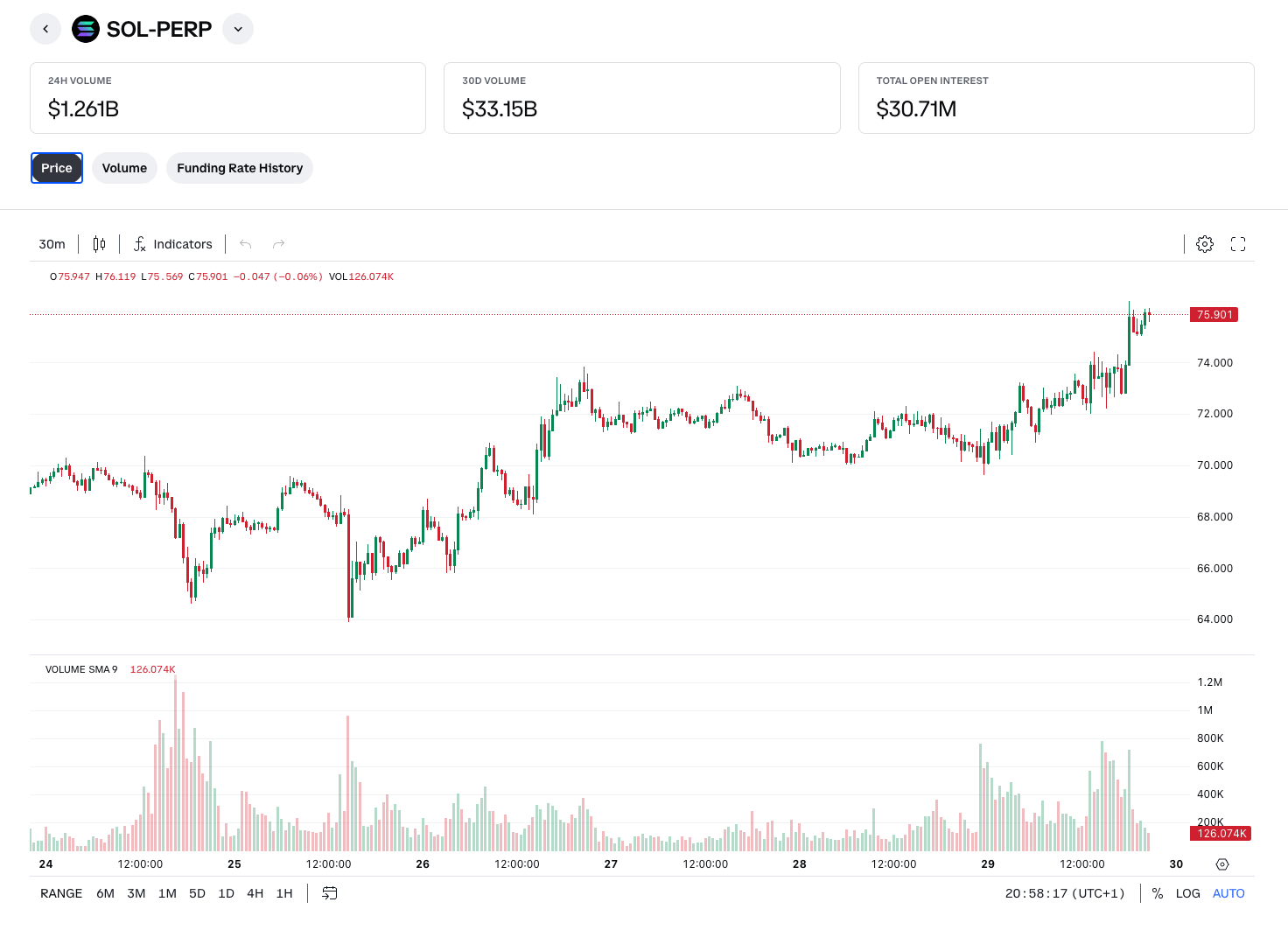
Coinbase offers CFTC-regulated SOL futures in the US and a USDC-settled SOL-PERP internationally. Source: Coinbase
US fees are charged per contract, per side, rather than as maker/taker: $0.10 a side on the nano contracts, $0.75 on the standard one. Outside the US, Coinbase International Exchange offers a SOL-PERP perpetual settled in USDC, with leverage up to 50x and a 0% maker/taker promotion running in eligible markets.
Either way, KYC is required, meaning you’ll onboard with a verified Coinbase account before trading. For a regulated, audited public company, that’s the expected trade-off.
Pros
- The most heavily regulated option here: US SOL futures run through a CFTC-regulated venue operated by a public company
- Three US SOL contracts – standard (100 SOL), nano (5 SOL), and a no-expiry nano perp-style future for smaller positions
- International SOL-PERP offers up to 50x leverage, USDC settlement, and a 0% maker/taker promo in eligible markets
- Low cost of entry: nano SOL futures run $0.10 per side, and the international SOL-PERP has a $10 minimum order
Cons
- US SOL leverage is very conservative, with current margins working out near 3-4x
- The high-leverage SOL-PERP is non-US only (UK retail excluded too), so access depends entirely on where you’re based
4. MEXC: Top-Rated SOL Futures Exchange With Linear and Inverse Settlement
Founded in 2018, MEXC is an offshore crypto exchange that offers thousands of spot and futures trading markets. Traders register without personal information, as MEXC collects only an email or mobile number. Exchange users retain their anonymity unless they cash out over 10 BTC within 24 hours.
MEXC offers two options when users set up a SOL futures position: linear or inverse contracts. Linear futures rely on Tether (USDT) for margin and contract settlement. Inexperienced derivative traders prefer this option, since profits and losses resemble conventional USD trading.
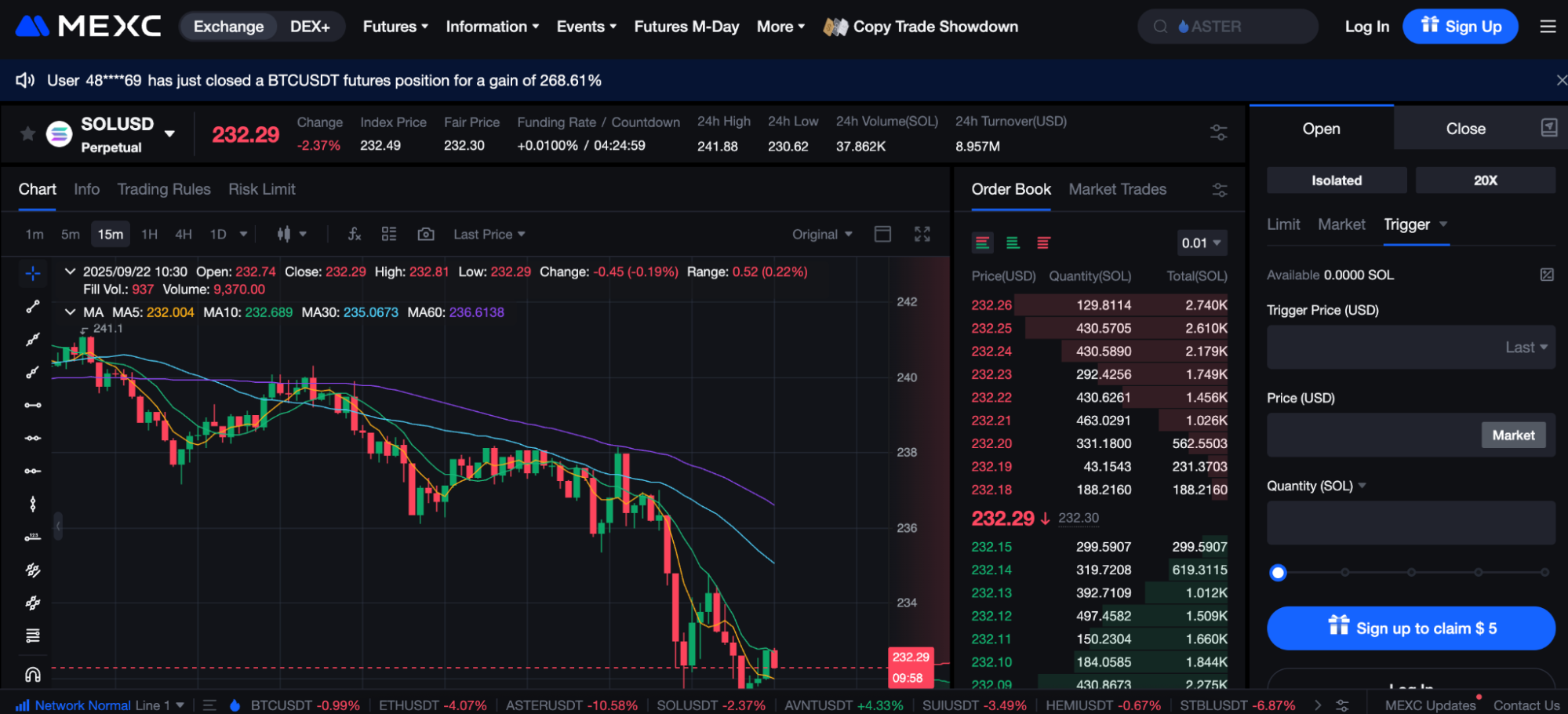
MEXC is a global exchange that offers Solana futures with USDT-M and Coin-M contracts. Source: MEXC
MEXC’s inverse contracts allow seasoned traders to post margin in SOL. When traders close their inverse positions, the exchange adjusts account balances in the same coin.
In terms of margin facilities, MEXC offers 300x leverage on SOL linear markets and 100x when traders use inverse contracts.
The provider supports a wide range of payment options, from debit/credit cards and SEPA transfers to hundreds of local methods via a peer-to-peer system.
Pros
- Popular spot and futures exchange with no-KYC accounts
- Trade Solana futures with leverage of up to 300x
- Choose between USDT-M or Coin-M contracts
- Place limit orders to secure 0.1% trading commissions
Cons
- The exchange provides no regulatory protections
- It reduces the leverage multiplier when position sizes exceed 580,275 USDT
5. Bitbase: Best for High-Leverage SOL Perpetuals
Bitbase is a newer derivatives platform that lists a SOLUSDT perpetual, margined and settled in USDT rather than in SOL. It’s the highest-leverage option in this lineup: up to 125x on SOL, though that ceiling only applies in the first risk bracket, up to 50,000 USDT of notional, and steps down as your position grows.
Fees on the SOL market are mid-table at 0.02% maker and 0.06% taker, with the minimum order set low at 5 USDT of notional. This means you can size in small while you get a feel for the platform.
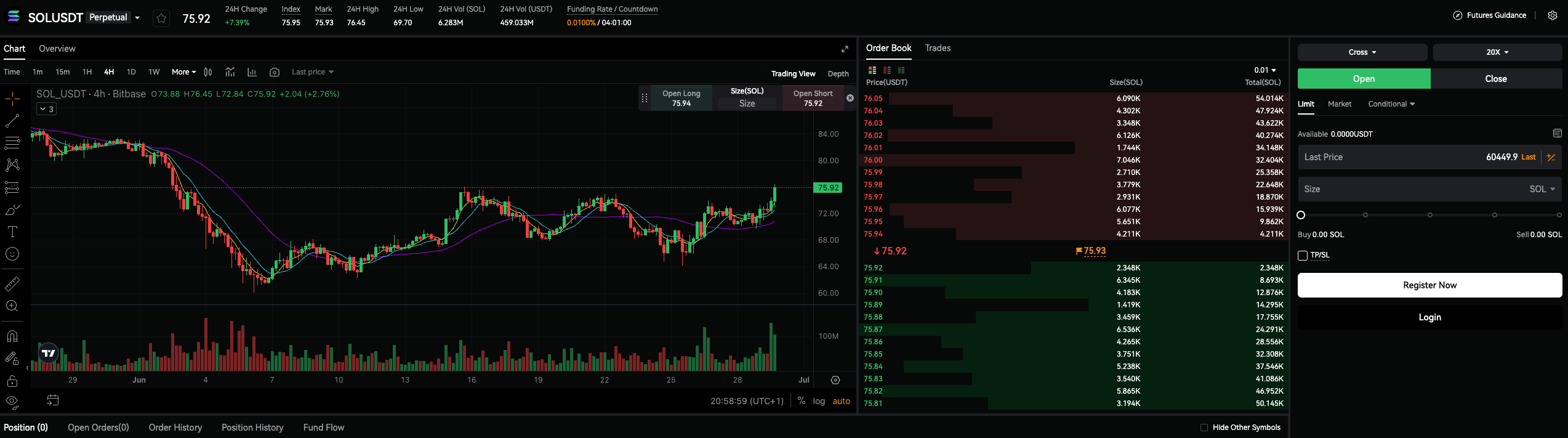
Bitbase lists a USDT-margined SOLUSDT perpetual with leverage up to 125x. Source: Bitbase
The thing to weigh is maturity. Bitbase only launched its current platform in March 2026, and the SOL contract was onboarded in February, so the track record is short. That’s worth knowing before you commit serious size, especially if you wish to trade the best meme coins at high leverage.
Identity verification is tiered, meaning you can deposit crypto with an unverified account, but verification unlocks fiat access and higher withdrawal limits.
Pros
- Highest SOL leverage in this lineup, up to 125x in the first risk bracket
- USDT-margined SOLUSDT perpetual with both isolated and cross margin modes
- Low barrier to entry, with a 5 USDT minimum order on the SOL market
- Competitive maker fees at 0.02%
Cons
- Very new and unproven: the platform launched in March 2026, with no verified proof of reserves
- High headline leverage applies only to smaller positions and scales down as size increases
6. Binance: Best Futures Trading Platform for Advanced Charting and Trading Features
Binance remains a popular choice with experienced derivative traders. Its world-class analysis tools include over 100 technical and economic indicators with full chart customization. It also supports trend drawing tools and advanced order types, and users access the platform through dedicated desktop and mobile software. Binance is also accessible on standard web browsers.
The exchange lists multiple Solana derivative markets, including delivery futures with quarterly and bi-quarterly contracts. Perpetual futures pairs contract USDT and USDC with significant liquidity.
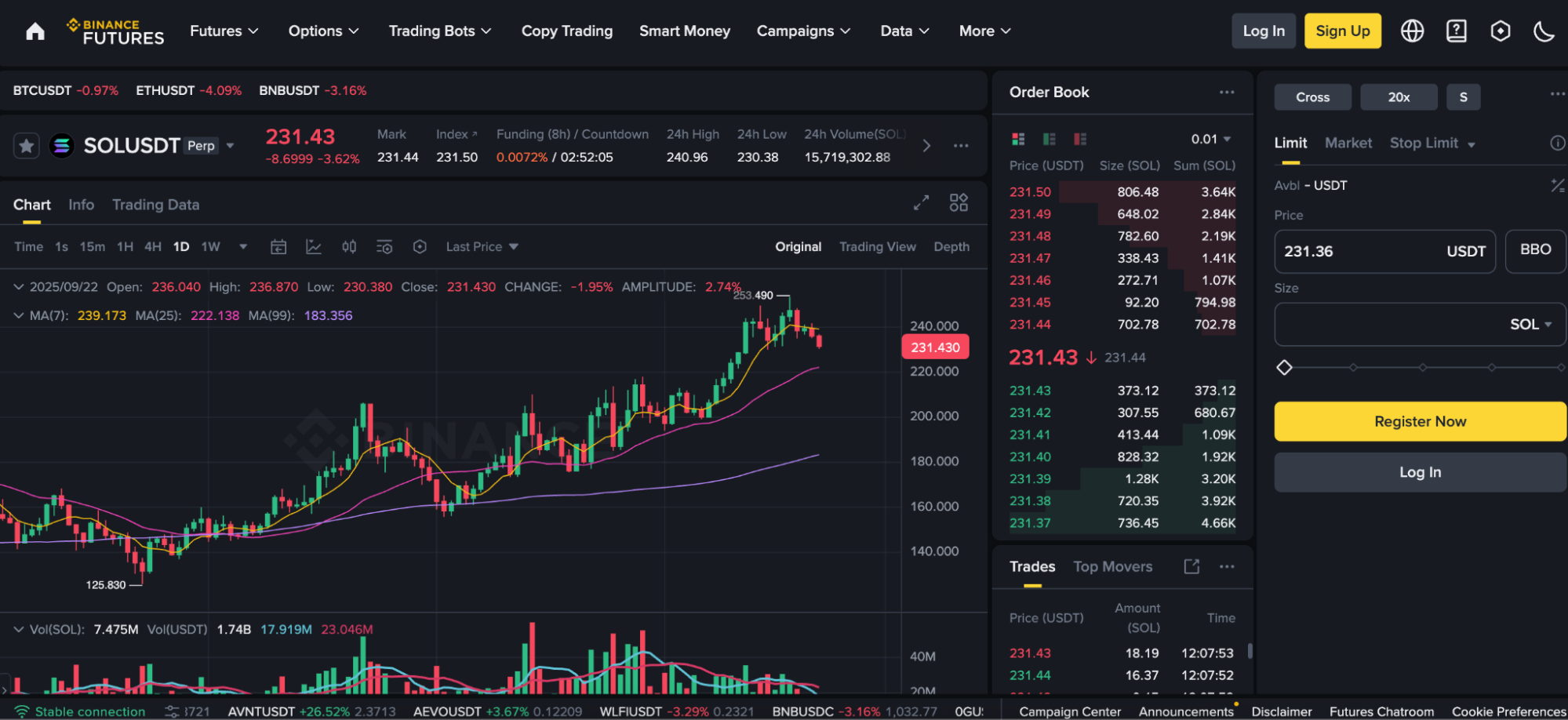
On Binance, users access perpetual and delivery SOL futures with a maximum leverage of 100x. Source: Binance
Leverage multipliers vary by the selected market. USDT-M perpetual contracts offer the highest limits at 100x. However, Coin-M delivery futures reduce those limits to just 20x. Similar to other online exchanges, Binance also increases margin requirements based on the notional trade value.
Trading fees also vary by key metrics, including whether traders hold BNB (BNB) and place limit or market orders. The platform caps futures commissions at 0.2% and 0.05% for makers and takers. While crypto deposits are fee-free, Binance charges variable commissions on fiat money payments.
Pros
- Top-rated trading tools with customizable charting screens
- The largest exchange for derivative liquidity and volume
- SOL futures contracts include perpetual and delivery markets
Cons
- Expiration contracts limit the SOL leverage to 20x
- Charges high debit/credit card fees in most regions
Solana Futures Exchanges Compared
Here are the top trading platforms compared by available Solana futures, leverage limits, settlement options, and other core factors:
| Supported SOL Futures | Settlement Options | Margin Options | Max SOL Leverage | Mobile App? | Max Futures Trading Fees | KYC? | |
| PrimeXBT | Perpetual | USDT | Isolated and cross | Not disclosed | Yes | 0.045% | Yes |
| Kraken | Perpetual and dated | USD | Multi-collateral | Up to 50x (region-dependent) | Yes | 0.05% | Yes |
| Coinbase | Perpetual and dated | USDC (intl), USD (US) | Isolated and cross | Up to 50x (intl); ~3-4x (US) | Yes | Per-contract (US); 0% promo (intl) | Yes |
| MEXC | Perpetual | USDT, USDC, SOL | Isolated and cross | 300x | Yes | 0.04% | No |
| Bitbase | Perpetual | USDT | Isolated and cross | Up to 125x (first risk tier) | Yes | 0.06% | Tiered |
| Binance | Perpetual and delivery | USDT, USDC, SOL | Isolated and cross | 100x | Yes | 0.05% | Yes |
What are Solana Futures?
Solana futures are financial derivatives traded between two or more counterparties. Market participants speculate long or short, based on whether they predict SOL prices will move higher or lower on a future date.
The most appealing aspect of trading futures is that derivative contracts require an initial margin rather than the full trade value. An exchange with a 2% margin requirement lets traders enter positions with just 2% of the position size. This framework unlocks unprecedented market exposure, since investors buy and sell SOL contracts with more than they could initially afford.
Solana futures come in various contract types, yet no derivative product provides real SOL ownership. Traders speculate on future prices only, and contracts typically settle in USDT. These contracts are called linear futures, or USDT-M at some platforms.
Some exchanges also offer Coin-M, or inverse, futures with SOL settlement, although these require a much deeper understanding of risk management.
How Does Trading Solana Futures Work?
Before buying and selling futures instruments, traders must select an appropriate contract type.
Exchange data confirms that perpetual futures remain the most popular option with SOL traders. These crypto-specific derivatives let holders speculate on Solana prices without expiration dates. While less common, some platforms also support delivery futures, typically with quarterly and bi-quarterly timeframes.
Traders choose between a buy or sell order when they enter the market. Their decision depends on whether they expect SOL to rise or fall.
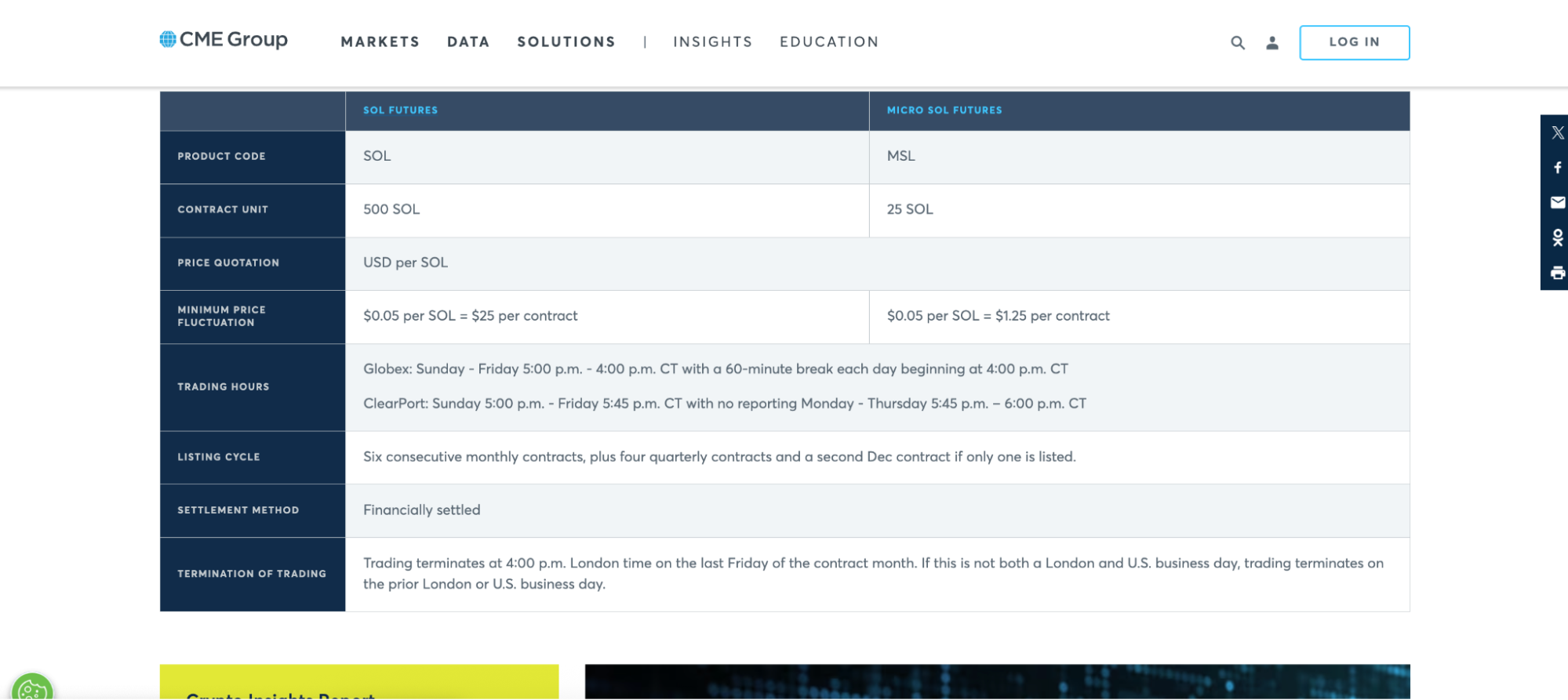
CME offers regulated Solana futures markets for institutional-grade investors. Source: CME
Futures platforms require an initial margin, which, unlike traditional spot exchanges, is always less than the total position size. Platform users also input a leverage multiplier that amplifies the initial margin.
For example, suppose you trade the SOL/USDT perpetual on PrimeXBT. You enter $50 as the initial margin and apply 20x leverage, so your market exposure rises to $1,000. A long position at 2% gains ordinarily yields a $1 profit on a $50 stake, yet with 20x leverage, those returns magnify to $20. The same multiplier works against you, so higher leverage means faster liquidation if the price moves the wrong way.
To protect users from excessive risk, the best crypto futures trading platforms have maintenance margin requirements. If the SOL futures trade declines below that figure, the platform liquidates it immediately. This outcome means the contract holder exits the market and loses only their initial margin.
What are CME Solana Futures?
Chicago Mercantile Exchange (CME) is a regulated derivative exchange that launched Solana futures in Q1 2025. The CME provides SOL exposure for institutional clients, which allows them to bypass crypto exchanges and avoid managing private wallets.
CME offers delivery futures with expiration dates, yet margin requirements are substantial. Standard contracts require approximately $50,000 upfront, so traditional exchanges remain the most viable option for retail clients.
How to Trade Solana Futures for Beginners
Solana futures operate in a speculative and volatile market, making them considerably riskier than traditional investing. If you’re trading derivatives for the first time, using a beginner-friendly platform is essential.
Follow these steps to trade the SOL/USDT perpetual on PrimeXBT, our top-rated platform for Solana futures.
Step 1: Register a Futures Account
Visit the PrimeXBT website or download the mobile app and click “Sign up”. Registration requires a valid email address, and each email can be linked to only one account.
PrimeXBT sends a confirmation email with a verification code. Enter that code to activate your account.
Identity verification isn’t mandatory to open an account, but completing it removes a 24-hour withdrawal limit, raises deposit limits, and unlocks bank-card deposits. Depending on your region, you may need to verify before you can deposit, so be ready to provide ID.
Step 2: Open PXTrader 2.0
After signing in, choose your platform. PrimeXBT runs PXTrader, PXTrader 2.0, and MetaTrader 5, and crypto perpetuals like SOL/USDT trade on PXTrader 2.0.
Open the “Trade” tab and select “Crypto Futures” (in the mobile app, go to Home and select “Crypto Futures”). The trade page shows a financial summary bar with your equity, balance, and free margin, plus a workspace split into Markets, Chart, Place Order, Summary, Order Book, and Trades.
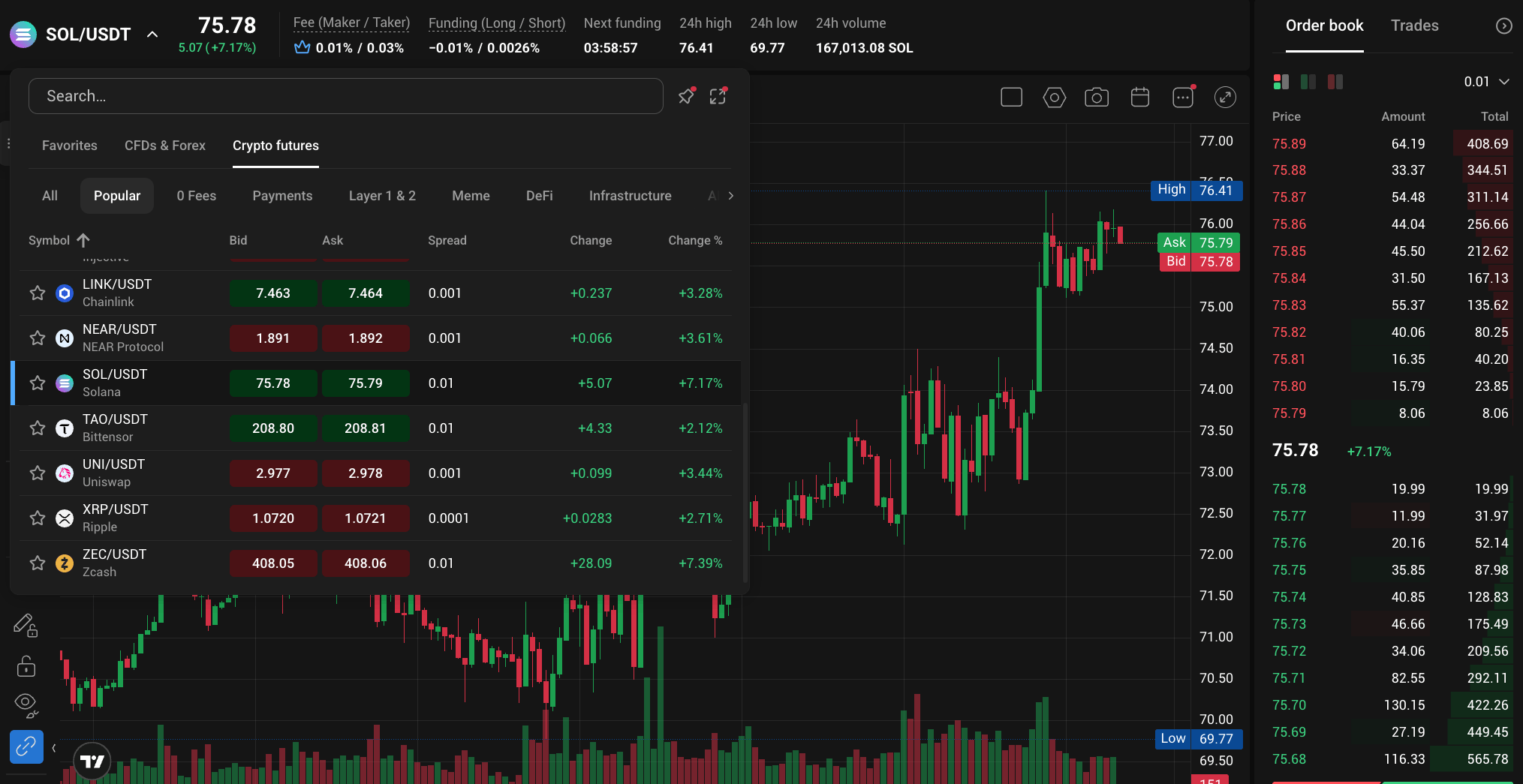
The PXTrader 2.0 Crypto Futures interface, showing the workspace and financial summary bar. Source: PrimeXBT
Step 3: Make a Deposit
PrimeXBT lets you fund the account with a direct crypto deposit, a fiat (money) deposit, or a card purchase through its third-party partner.
For crypto, open the Accounts page, click “Deposit”, choose your currency (USDT, USDC, BTC, ETH, and others), then pick a destination, your Wallet or the Crypto Futures trading account. Select the right network, copy the address, and send from your external wallet. Match the token network to the deposit network, or you risk losing the funds.
Fiat deposits require a verified account and run through options like AdvCash, Perfect Money, bank cards, and a few region-specific methods, with minimums starting around $5 to $30 depending on the method.
Step 4: Select the SOL/USDT Contract
If your funds landed in your main wallet, click the green “Fund” button in the Crypto Futures interface and move the amount you want into your trading account.
Use the “Markets” tab in the Contract Specifications section to switch instruments, and select the SOL/USDT perpetual. That section also displays 24-hour high and low, volume, maker and taker fees, and the current financing rate.
Step 5: Choose the Trade Parameters
On the right side of the trade room, find the Place Order panel. Pick your order type — PrimeXBT supports market, limit, and stop orders — then set the contract size.
Each order has a Margin Type field. Click the pencil icon to choose Isolated or Cross margin and set your leverage. With isolated margin, you can adjust leverage per trade using the slider; with cross margin, your whole account balance backs the position and leverage is fixed.
A note on leverage: PrimeXBT advertises a general 2x to 500x range across crypto futures, but it doesn’t publish a specific maximum for the SOL/USDT contract. Check the cap in the order ticket before sizing your position rather than assuming the top figure applies to SOL.
What is the Liquidation Price?
The liquidation price is the exact SOL/USDT price at which your position is force-closed because the loss has consumed your margin. The platform calculates it from your entry price, leverage, and whether you’re long or short.
Lower leverage leaves more distance between your entry and your liquidation price. As you raise leverage, that buffer shrinks fast, which is why high multipliers liquidate so easily on a small adverse move.
Step 6: Set Exit Orders and Place the Trade
Click “Buy/Long” if you expect SOL to rise or “Sell/Short” if you expect it to fall, then click “Place Order”. If one-click trading is off, you’ll get a confirmation window before the order goes live.
On PrimeXBT, you add a Stop-Loss and Take-Profit after the position is open: tap the open trade and set your SL and TP levels. The stop-loss closes the position automatically if the price moves against you, while the take-profit locks in gains at your target. Set these as soon as the trade is live, especially at higher leverage.
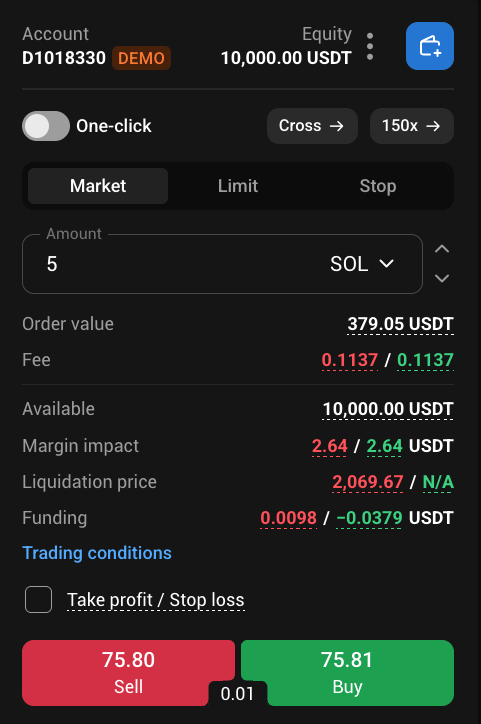
Setting up a SOL/USDT order and adding stop-loss and take-profit levels on PXTrader 2.0. Source: PrimeXBT
Why Trade Solana Futures? Potential Benefits
Traders buy and sell billions of dollars’ worth of SOL futures daily. Let’s explore why derivative contracts remain a popular way to gain exposure to Solana price movements.
Avoid Covering the Full Contract Value
Although futures platforms have varying minimum requirements, traders enter positions with a much smaller outlay compared with the overall trade size. Our research shows margin requirements start at 0.1%, so traders cover just $1 for every $1,000 in market exposure.
This structure benefits a wide range of trading profiles. Complete beginners, as well as those on a budget, risk small amounts while still having access to significant capital. It also helps investors become more capital efficient, since they can allocate the original deposit to a much wider range of positions.
Magnify SOL Profits With Leverage
While risk management is essential, leverage enables SOL futures traders to amplify their returns by substantial amounts. Leverage limits vary by exchange, yet our research confirms that market providers offer between 50x and 300x. As such, traders may magnify profitable positions by at least 50 times.
The leverage system particularly appeals to short-term traders who target small and risk-averse margins. Examples include the scalping and algorithmic strategies, which rely on leverage to boost marginal gains.
Trade SOL Price Movements in Both Directions
Futures track the SOL price without traders exchanging real SOL coins. Instead, traders exchange perpetual and delivery contracts. Their derivative nature unlocks market flexibility, since futures allow long and short trading.
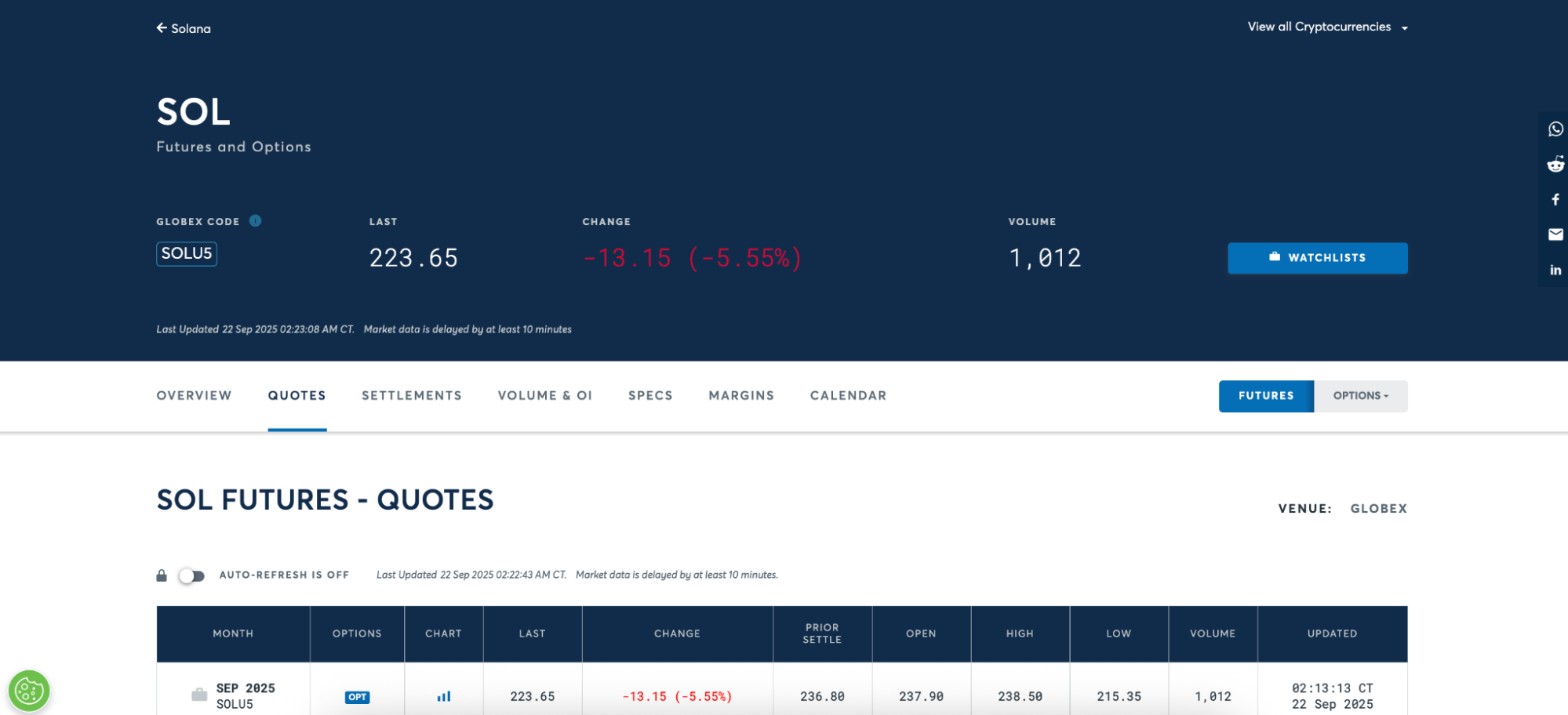
Similar to the retail-friendly exchanges, the CME lets market participants trade Solana long and short. Source: CME
During a bearish market, Solana may experience prolonged price declines. Long-term investors either hold strong or cash out. During these periods, futures traders place sell orders, and if SOL drops below the entry price, the position generates a profit.
Significant Trading Volume and Liquidity
We analyzed exchange data and found that Solana futures volumes exceed traditional spot exchanges. This dynamic is because of leverage, since traders typically magnify their positions by large multipliers.
Trading in a high-volume environment benefits traders, as they access deep liquidity, tighter spreads, and reduced slippage risks.
Futures Hedging Offsets Adverse Price Movements
Although most traders buy and sell SOL futures for pure profit speculation, investors also use them as a hedging tool. The strategy protects investors from near-term uncertainty, as they short-sell futures contracts to protect existing positions against unfavorable price movements.
Contract holders offload their futures contracts as market sentiment becomes clearer, and any profits or losses are offset against the original investment.
Risks & Limitations of Solana Futures Trading
Correctly predicting the SOL price via futures contracts can produce massive gains, yet like all derivative instruments, they also present drawbacks.
Consider these risks and challenges before trading Solana futures:
- No Asset Ownership: Non-custodial ownership is one of crypto’s biggest perks, since investors own and control their assets away from centralized intermediaries. Solana futures, as a derivative product, provide no ownership. Traders generally buy and sell contracts through centralized platforms, which creates counterparty risks. Investors who prefer buying real SOL coins must use a spot trading exchange or brokerage.
- Liquidation Leads to Financial Losses: The risk-reward of Solana futures trading depends on the selected leverage multiplier. As trading with high limits makes liquidation more likely, traders risk serious financial losses. Each liquidation event causes the trader to forfeit their initial margin, and potentially more if using cross margin mode.
- Perpetual Futures Incur Funding Rates: Depending on whether futures prices are higher or lower than the SOL spot price, either long or short traders pay funding fees. This cycle happens every eight hours to ensure market correlation. If you incur funding fees, platforms take them from your margin balance. Too many charges could force liquidation.
- Derivatives Suit Active Crypto Traders: Solana futures trading is time-intensive. Traders often predict short-term price movements through technical analysis, so a firm understanding of charting indicators is crucial. Missing a market signal could be costly, especially when you consider SOL’s volatile pricing swings. If you’re unable to dedicate sufficient time to market research, traditional investing could be a better fit.
Top Considerations for Solana Futures Trading
As a first-time Solana futures trader, consider these factors to avoid unnecessary risks:
- Ensure the Platform Offers Isolated Margin Mode: To limit the downside potential, ensure you trade futures with a platform that offers isolated margin. This mechanism ensures liquidated positions do not exceed the initial margin. In contrast, cross margin puts the entire account balance at risk.
- Always Set Stop-Loss Orders: Derivative traders avoid liquidation by setting stop-loss orders. They place the execution level above or below the liquidation price, depending on the trade prediction. When the stop-loss order triggers, contract holders exit the market automatically, preventing further losses.
- Understand the Expiration Terms: Most Solana futures resemble perpetual contracts that never expire. Traders may close their positions at any time. Delivery futures, however, have expiration dates. If you hold contracts at expiration, you must settle the trade at the respective SOL price.
- Avoid the Temptation of Excessive Leverage: Winning futures trades can generate unprecedented profits when traders apply high leverage multipliers, yet the strategy makes liquidation likely. The more risk-averse approach is to trade with manageable leverage ratios. Over time, traders build their account balance organically and mitigate drawdown risks.
- Diversify Into Other Futures Markets: Successful futures traders typically diversify their capital into multiple markets, rather than hone in on any single asset. Besides Solana, consider trading other derivative markets like ETH, BNB, and BTC. Avoid futures markets with low liquidity, though, since these pairs carry significant volatility risk.
Solana futures provide traders with several benefits that remain inaccessible on traditional exchanges. Derivative contracts support long and short trading, substantial leverage multipliers, and the ability to hedge against short-term uncertainty.
After reviewing the best Solana futures trading platforms for 2026, PrimeXBT is our top pick. It lists a SOL/USDT perpetual alongside forex, commodities, and indices, charges just 0.045% on the taker side, and adds copy trading plus native iOS and Android apps. Traders who prefer a regulated venue should look at Kraken or Coinbase instead.
FAQs
What are Solana futures?
What’s the difference between Solana futures and options?
What are the advantages of trading Solana futures?
Do Solana futures have more risk than regular Solana trading?
What’s the minimum amount needed to trade SOL futures?
How can I trade Solana futures as a beginner?
What is the best platform to trade Solana futures?
References
- CME Solana Futures Specifications (Chicago Mercantile Exchange)
- Understanding Derivatives (National Institute of Securities Markets)
- What are Perpetual Futures? (Coinbase)
Coinspeaker in Numbers
250K+
Monthly Users
80+
Articles & Guides
5000+
Research Hours
23
Authors
guides
Best Decentralized Exchanges (DEXs) in September 2026
September 8th, 2026
How to Swap Crypto on Godex: A Step-by-Step Guide to No-KYC Crypto Swapping
June 12th, 2026
CoinDepo vs. WhiteBIT Earn Comparison: Yields, Features, Security and More
June 2nd, 2026
Most crypto swap platforms have an identity threshold at some point in the process, such as a KYC trigger buried in the terms, a c...
In the competitive world of crypto yield generation, CoinDepo and WhiteBIT Earn have built notable reputations as centralized plat...
Ibrahim Ajibade
, 373 postsI’m a research analyst with experience supporting Web3 startups and financial organizations through data-driven insights and strategic analysis. My goal is to help organizations make smarter decisions by bridging the gap between traditional finance and blockchain innovation.
With a background in Economics, I bring a solid understanding of market dynamics, financial systems, and the broader economic forces shaping the crypto industry. I’m currently pursuing a Master’s degree in Blockchain and Distributed Ledger Technologies at the University of Malta, where I’m expanding my expertise in decentralized systems, smart contracts, and real-world blockchain applications.
I’m especially interested in project evaluation, tokenomics, and ecosystem growth strategies, as these are areas where innovation can drive lasting impact. By combining my academic foundation with hands-on experience, I aim to provide meaningful insights that add value to both the financial and blockchain sectors.