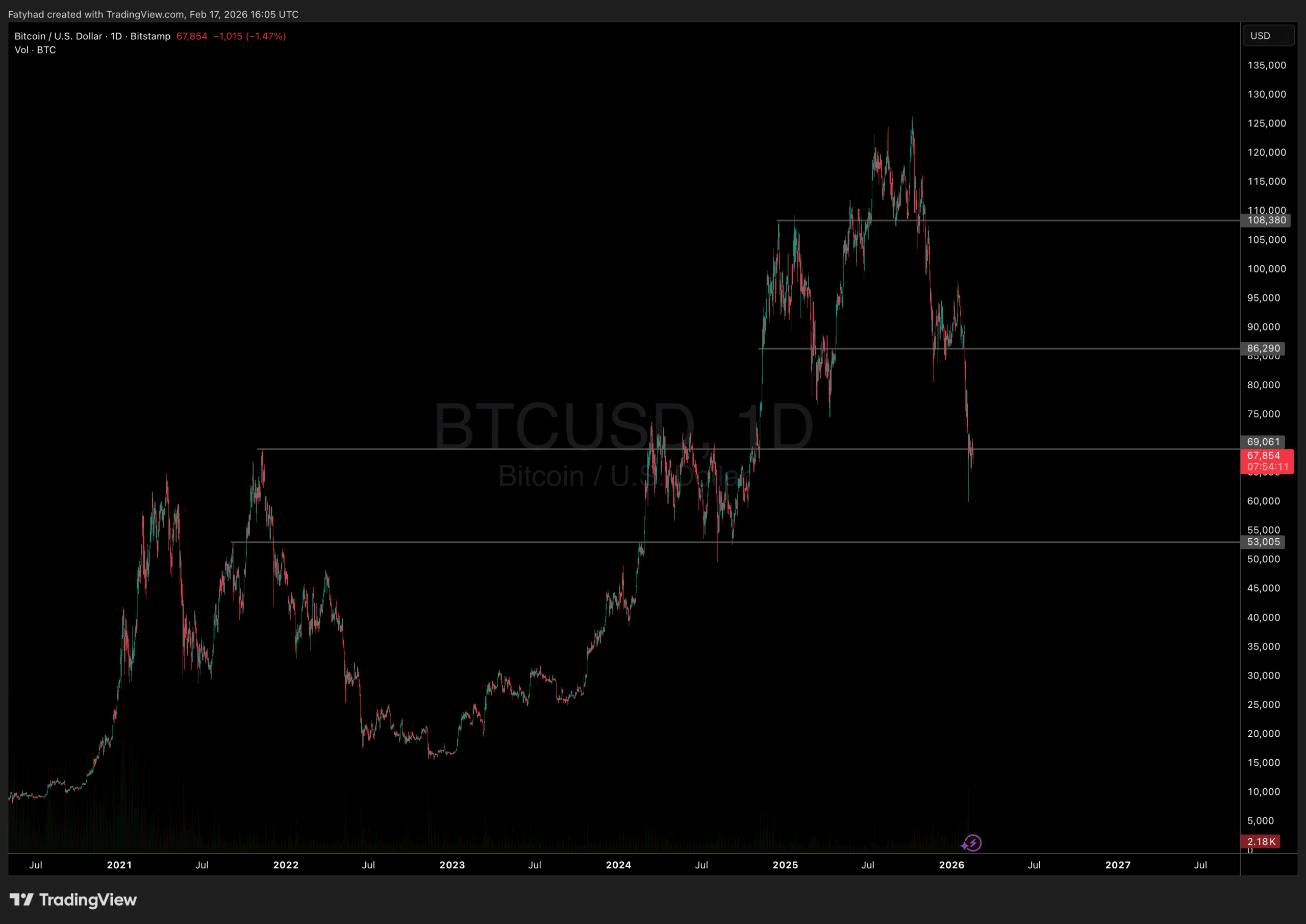
Harvard Management Company (HMC) has reduced its stake in BlackRock’s iShares Bitcoin Trust (IBIT) by roughly 21%, pointing to a strategic rebalancing within its crypto portfolio. The university’s endowment simultaneously allocated approximately $86.8 million to Ethereum ETFs, a move occurring alongside broad institutional outflows totaling over $1.1 billion across the sector. The Bitcoin price analysis suggests investors are closely watching institutional positioning for clues about the next market direction.
A Bigger Trend: Institutional Investors Cool on Bitcoin Exposure
The tactical adjustment by Harvard arrives as the market faces cooling demand from institution with some exceptions. Following Bitcoin’s rapid decline in late 2025, market data indicates that many institutional investors began reducing exposure to lock in profits. This trend has been reflected in recent fund flows, where crypto investment products recorded significant net outflows, totaling nearly $1.7 billion in recent weeks.
While Harvard reduction in Bitcoin ETF holdings might appear bearish, analysts suggest it reflects standard portfolio management rather than a complete market exit. Despite the heavy selling pressure and negative flow data in early 2026, the baseline demand for regulated crypto exposure remains intact, albeit at lower volumes than the peak frenzy seen the previous quarter.
Strategy (prev. #MicroStrategy) has bought 2,486 $BTC for $168.4M at an average price of $67,710 per #Bitcoin.
Harvard’s Strategy: Partial Rotation From Bitcoin To Ethereum
Harvard trimmed its IBIT position from 6.81 million shares in Q3 to 5.35 million shares by December 31. Even after this sale, the endowment’s remaining Bitcoin position is valued at approximately $265.8 million, maintaining its status as a major holder. However, the capital was not entirely removed from the ecosystem; HMC established a new position of 3.87 million shares in the iShares Ethereum ETF (ETHA), valued at roughly $86.8 million.
This strategy contrasts with the behavior of retail and smaller institutional cohorts, as recent data suggests that most Bitcoin ETF holders have maintained positions despite significant price volatility. Harvard’s move appears to be a calculated rotation rather than a panic sell, diversifying their bet into the second-largest cryptocurrency which had underperformed Bitcoin for much of the previous year.
The decision also tracks with broader industry movements where traditional finance giants are deepening their involvement with smart contract platforms. For instance, BlackRock itself has continued to expand its footprint, having recently acquired stakes in Ethereum-focused infrastructure, validating the asset class beyond just simple store-of-value propositions.
Such institutional adjustments point to relative-value considerations, where allocators anticipate potential mean reversion, with Ethereum gaining ground against Bitcoin in the near to medium term. This strategy maintains overall crypto allocation while addressing perceived risks tied specifically to Bitcoin’s performance.
Bitcoin’s limitations in speed and cost remain evident, creating room for Layer-2 solutions to expand its utility. But one hot new project, Bitcoin Hyper (HYPER) addresses these constraints through its Layer-2 architecture, which integrates the Solana Virtual Machine (SVM) to enable sub-second transactions, minimal fees, and full smart contract functionality. It bridges native Bitcoin securely via zero-knowledge proofs, preserving BTC’s security while adding programmability for DeFi, gaming, and other applications.
Smart money investors are clearly taking note, with a flurry of whales piling in to the rapidly accelerating HYPER presale, which has raised over $31.4 million, with the token priced at $0.0136757 for this stage (and rising soon!).
The project offers market-beating staking rewards of around 37% APY, which has drawn sustained participation. Audits from firms like Coinsult and SpyWolf support its technical foundation.
In a market where rotations favor assets with enhanced utility, Bitcoin Hyper positions itself to extend Bitcoin’s role beyond a store of value.
Disclaimer: Coinspeaker is committed to providing unbiased and transparent reporting. This article aims to deliver accurate and timely information but should not be taken as financial or investment advice. Since market conditions can change rapidly, we encourage you to verify information on your own and consult with a professional before making any decisions based on this content.
Daniel Frances is a technical writer and Web3 educator specializing in macroeconomics and DeFi mechanics. A crypto native since 2017, Daniel leverages his background in on-chain analytics to author evidence-based reports and deep-dive guides. He holds certifications from The Blockchain Council, and is dedicated to providing "information gain" that cuts through market hype to find real-world blockchain utility.