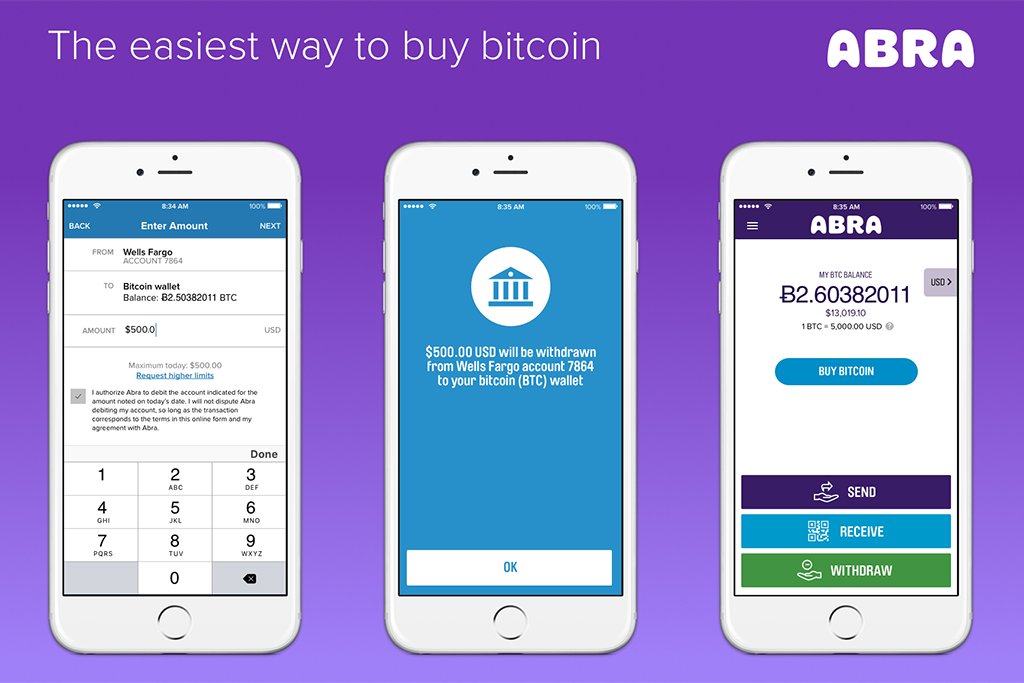
Crypto wallet and exchange startup Abra is working on widening the geography of its customers’ base. Offering support for Single Euro Payment Area (SEPA) bank accounts, Abra makes it possible for users from Europe to transfer Euros or other national currencies directly to Abra from European banks. Owing to this move, residents of European countries will have one more option to enter the constantly developing world of crypto investing.
Speaking about their new initiative Bill Barhydt, founder and CEO of Abra, stated:
“With users from over 70 countries globally, and a greater demand for the ability to invest in cryptocurrencies from any bank account, it is really important to give investors the opportunity to fund their Abra wallet directly from any bank account. This new feature is helping to change the way people invest, adding to a brighter future for the cryptocurrency market around the world.”
The main goal of Abra is to facilitate cryptocurrency investing for everyone. The project founded in 2014 represents an all-in-one global app that provides the functionality of a crypto exchange and a digital wallet in one place. The model chosen by Abra is 100% P2P as there is no necessity to involve a mediator at any stage of a transaction.
Users of Abra have a chance to work with 28 cryptocurrencies and 50 fiat currencies just on a single app. Thanks to the startup’s efforts more and more people are able to enjoy all the possibilities of the app.
Though previously, Abra offered funding of digital wallets only via bank and wire transfers in the United States and via American Express, Visa and MasterCard debit and credit cards from different corners of the world, now the situation has changed.
Currently, each person in Europe will be allowed to fund their Abra digital wallet via a bank account opened in one of the European banks. European bank transfers will be carried out in accordance with the SEPA guidelines. Under these guidelines, residents of some European countries will have a possibility to deposit not only Euros but also their national fiat currency.
The SEPA standards cover 28 members of the European Union and four members of the European Free Trade Association. It means that residents of these countries will get access to a range of Abra’s features and will be able to conduct cross-border payments through direct debit transactions.
When users transfer money to Abra, they get Bitcoin into their digital wallets where they can store their funds, or exchange them for any other coins, or convert them to their fiat currency, or send them back to their bank accounts.
Announcement of Abra’s support for SEPA is not the only one that has been recently made by the company. It has been also revealed that Abra is going to add support for three new coins: Cardano (ADA), Basic Attention Token (BAT) and Tron (TRX).
I’m a content writer and editor with extensive experience creating high-quality content across a range of industries. Currently, I serve as the Editor-in-Chief at Coinspeaker, where I lead content strategy, oversee editorial workflows, and ensure that every piece meets the highest standards. In this role, I collaborate closely with writers, researchers, and industry experts to deliver content that not only informs and educates but also sparks meaningful discussion around innovation.
Much of my work focuses on blockchain, cryptocurrencies, artificial intelligence, and software development, where I bring together editorial expertise, subject knowledge, and leadership experience to shape meaningful conversations about technology and its real-world impact. I’m particularly passionate about exploring how emerging technologies intersect with business, society, and everyday life. Whether I’m writing about decentralized finance, AI applications, or the latest in software development, my goal is always to make complex subjects accessible, relevant, and valuable to readers.
My academic background has played an important role in shaping my approach to content. I studied Intercultural Communications, PR, and Translation at Minsk State Linguistic University, and later pursued a Master’s degree in Economics and Management at the Belarusian State Economic University. The combination of linguistic, communication, and business training has given me the ability to translate complex technical and economic concepts into clear, engaging narratives for diverse audiences.
Over the years, my articles have been featured on a variety of platforms. In addition to contributing to company blogs—primarily for software development agencies—my work has appeared in well-regarded outlets such as SwissCognitive, HackerNoon, Tech Company News, and SmallBizClub, among others.