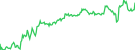
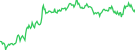
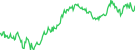
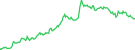
Monero price today
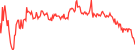
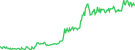
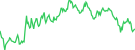
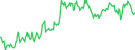
Today's live Monero price is $334 USD, with a 24-hour trading volume of $82 377 532 USD. We provide real-time updates for the XMR to USD price. Monero has decreased by 0% in the last 24 hours. Currently ranked 18 in the cryptocurrency market, Monero has a live market cap of $6 279 286 791 USD, with a circulating supply of
18 780 083XMR coins and the maximum supply not available.
Monero (XMR) is an open-source cryptocurrency created in April 2014 that focuses on fungibility and decentralization. Monero uses an obfuscated public ledger, meaning anybody can broadcast or send transactions, but no outside observer can tell the source, amount or destination. Monero uses a Proof of Work mechanism to issue new coins and incentivize miners to secure the network and validate transactions.
The privacy afforded by Monero has attracted illicit use by people interested in evading law enforcement during events such as the WannaCry Ransomware Attack, or on the dark web buying illegal substances. This has been acknowledged by Monero, and not entirely disavowed. Despite this, Monero is actively encouraged to those seeking financial privacy, since payments and account balances remain entirely hidden, which is not the standard for most cryptocurrencies.
The egalitarian mining process of Monero has made it an alternative choice for websites and applications looking for substitute sources of income. In 2018, Change.org led the way by implementing a Monero miner on their screensaver to raise funds for the Change.org Foundation. While some organizations use Monero miners to cover hosting costs as an alternative to paywalls or advertisements, malicious hackers have also used it via covertly embedding mining code into websites and apps seeking profit for themselves.
Click to see more
How much is 1 XMR?
Conversion Table
XMR/JPY
(Japanese Yen)
47 703 JPY
XMR/CHF
(Swiss Franc)
273.4 CHF
XMR/CNY
(Chinese Yuan)
2 457 CNY
XMR/GBP
(British Pound Sterling)
252.3 GBP
XMR/INR
(Indian Rupee)
28 641 INR
XMR/KRW
(South Korean Won)
477 643 KRW
XMR/CAD
(Canadian Dollar)
466.2 CAD
XMR/NGN
(Nigerian Naira)
536 677 NGN
XMR/BRL
(Brazilian Real)
1 968 BRL
XMR/SGD
(Singapore Dollar)
440.0 SGD