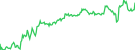
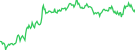
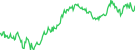
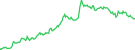
Uniswap price today
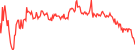
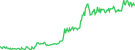
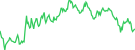
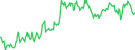
Today's live Uniswap price is $3.50 USD, with a 24-hour trading volume of $89 716 413 USD. We provide real-time updates for the UNI to USD price. Uniswap has decreased by 0% in the last 24 hours. Currently ranked 39 in the cryptocurrency market, Uniswap has a live market cap of $2 187 597 910 USD, with a circulating supply of
625 367 562UNI coins and 1000000000.00 maximum supply.
Since its inception, the Uniswap Protocol (”Uniswap”) has served as trustless and highly decentralized financial infrastructure. Having proven product-market fit for highly decentralized financial infrastructure with a platform that has thrived independently, Uniswap is now particularly well-positioned for community-led growth, development, and self-sustainability. The introduction of UNI (ERC-20) serves this purpose, enabling shared community ownership and a vibrant, diverse, and dedicated governance system, which will actively guide the protocol towards the future.
Click to see more
How much is 1 UNI?
Conversion Table
UNI/USD
(US Dollar)
3.50 USD
UNI/EUR
(Euro)
3.09 EUR
UNI/JPY
(Japanese Yen)
499.4 JPY
UNI/CHF
(Swiss Franc)
2.86 CHF
UNI/CNY
(Chinese Yuan)
25.72 CNY
UNI/GBP
(British Pound Sterling)
2.64 GBP
UNI/INR
(Indian Rupee)
299.8 INR
UNI/KRW
(South Korean Won)
5 000 KRW
UNI/CAD
(Canadian Dollar)
4.88 CAD
UNI/NGN
(Nigerian Naira)
5 618 NGN
UNI/BRL
(Brazilian Real)
20.60 BRL
UNI/SGD
(Singapore Dollar)
4.61 SGD