Despite Growth on Other Blockchains, DeFi Is Still Ethereum’s Forte
Ethereum has a major DeFi lead in several key metrics, including the overall number of DeFi apps, number of DeFi users, number of DeFi developers, and total value transacted through DeFi apps.
As the race for decentralized finance (DeFi) supremacy heats up, Ethereum is still leaps and bounds ahead of the pack, and it doesn’t look like that’s about to change any time soon. In the last few months, a wide variety of other blockchains have seen DeFi development activity skyrocket, with platforms like TRON, Cardano, EOS, Algorand, KAVA, and several others seeing a surge in the number of DeFi-related apps launched.
But as of yet, none have managed to come close to Ethereum’s success – despite many claiming to offer advantages over the platform, such as lower fees, better scalability, or better development tools.
Here we take a look at an often-overlooked reason why this may be.
DeFi Is About Community
Photo: Pixabay
Although several next-generation blockchains have appeared in recent years, many of which offer impressive scalability, speed, interoperability, and more. None have managed to overtake Ethereum as a hub for decentralized finance.
This is because DeFi is as much about new, exciting technologies and opportunities as it is about community. Though it is true that Ethereum sometimes suffers from high fees and delays during peak times, it also has by far the largest community in the cryptocurrency scene (barring Bitcoin).
Over the past six years, Ethereum has been gradually growing its community, including fervent developers, node operators, and general enthusiasts, giving it a solid foundation for the rapid uptake of new, innovative protocols and tools.
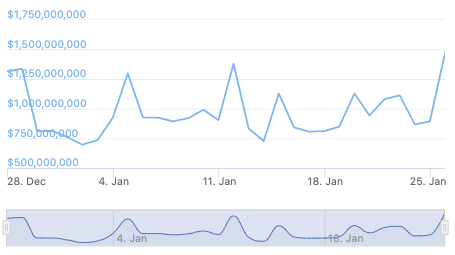
Because of this, Ethereum has a major DeFi lead in several key metrics, including the overall number of DeFi apps, number of DeFi users, number of DeFi developers, and total value transacted through DeFi apps. As a result, a single Ethereum DeFi app (Uniswap) has more transaction volume and total value locked (TVL) than all other DeFi apps on all other blockchains combined.
Uniswap trading volume exceeds that of all other DeFi apps (on other blockchains) combined. Photo: Coingecko
Uniswap trading volume exceeds that of all other DeFi apps (on other blockchains) combined.
This not only means DeFi apps on Ethereum have a drastically higher chance of success than those on competing blockchains, but they also have a better chance of receiving investment, generating community code contributions, and earning recognition – since there is always a legion of vocal, passionate community members to draw from.
If DeFi was a race, then Ethereum is inches from the finish line.
Leveraging the Community
Other projects that have already built a strong community likely have some understanding that this community is an essential part of their success. This is why many of them build on Ethereum.
Take NewsCrypto as an example. As a community-centric platform for analyzing crypto markets and improving trading performance, NewsCrypto has managed to develop a substantial community of its own.
Despite originally launching the NewsCrypto Coin (NWC) token on the Stellar blockchain, it recently launched it on the Ethereum blockchain as an ERC-20 token. This allowed it to list to token on Uniswap, opening the doors to DeFi to its hundreds of thousands of users – something that could not be done on Stellar.
With that said, Polkadot stands out as one of Ethereum’s biggest potential rivals. Though the platform is still arguably in its early days of development and only launched its mainnet recently (mid-2020), the number of upcoming DeFi launches on the platform number in the hundreds.
Not only this, but it also has a staggering community behind it, which may help it succeed where other platforms have failed.
But for now, it remains Ethereum vs everyone else.
Disclaimer: Coinspeaker is committed to providing unbiased and transparent reporting. This article aims to deliver accurate and timely information but should not be taken as financial or investment advice. Since market conditions can change rapidly, we encourage you to verify information on your own and consult with a professional before making any decisions based on this content.
I’m a content writer and editor with extensive experience creating high-quality content across a range of industries. Currently, I serve as the Editor-in-Chief at Coinspeaker, where I lead content strategy, oversee editorial workflows, and ensure that every piece meets the highest standards. In this role, I collaborate closely with writers, researchers, and industry experts to deliver content that not only informs and educates but also sparks meaningful discussion around innovation.
Much of my work focuses on blockchain, cryptocurrencies, artificial intelligence, and software development, where I bring together editorial expertise, subject knowledge, and leadership experience to shape meaningful conversations about technology and its real-world impact. I’m particularly passionate about exploring how emerging technologies intersect with business, society, and everyday life. Whether I’m writing about decentralized finance, AI applications, or the latest in software development, my goal is always to make complex subjects accessible, relevant, and valuable to readers.
My academic background has played an important role in shaping my approach to content. I studied Intercultural Communications, PR, and Translation at Minsk State Linguistic University, and later pursued a Master’s degree in Economics and Management at the Belarusian State Economic University. The combination of linguistic, communication, and business training has given me the ability to translate complex technical and economic concepts into clear, engaging narratives for diverse audiences.
Over the years, my articles have been featured on a variety of platforms. In addition to contributing to company blogs—primarily for software development agencies—my work has appeared in well-regarded outlets such as SwissCognitive, HackerNoon, Tech Company News, and SmallBizClub, among others.