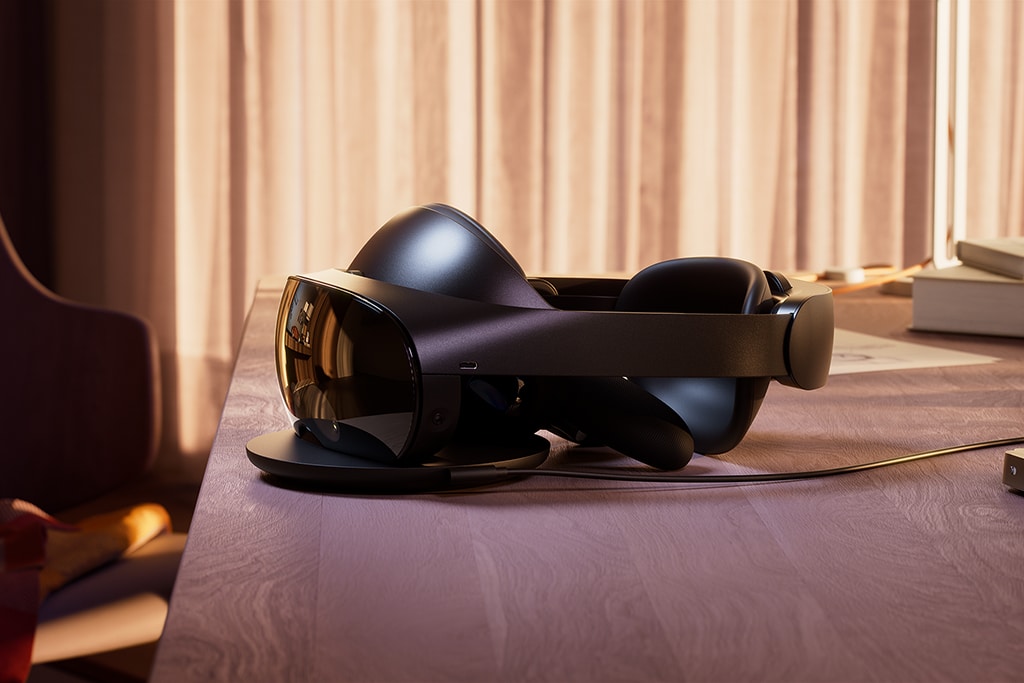
Meta (NASDAQ: META) chairman and CEO Mark Zuckerberg has debuted the company’s new virtual reality headset, the Meta Quest Pro. The company’s newest headset will start shipping on the 25th of October, retailing at $1,500 a piece. Surprisingly, the company’s shares fell in midday trading by nearly 4.5% to $127.85 after the announcement. The plunge in share price vaguely suggests that investors are not very excited about the new device.
The Meta Quest Pro is $1,100 more than the previous Quest 2, presumably because it comes equipped with new technology. For instance, Meta Quest Pro includes an advanced Qualcomm mobile Snapdragon computer chip designed for advanced graphics processing. During a demo held at Meta’s research division in Redmond, Washington, Zuckerberg described the new headset as the “highest-end VR device – for enthusiasts, the prosumer, the sort of people who are trying to get work done.”
Features of the Meta Quest Pro
The Meta Quest Pro’s chip is the XR2-Plus processor from Qualcomm with 12GB of memory, instead of the XR2 with 6GB in the Quest 2. The new headset also has 256GB of storage space instead of the previously designed 128GB and 256GB versions. It is also heavier at 722 grams compared to the Quest 2’s 503-gram weight.
The new headset is a significant improvement over Quest 2, with much better specs than its predecessor. For instance, the screen offers 1800 x 1920 pixels for each eye, with a refresh rate of 90Hz. Meta specifies that the display tech used for the Quest Pro provides more contrast than that of the Quest 2 by at least 75%.
Users can also enjoy impressive eye tracking on the Quest Pro. The device requires users to calibrate the tracking by tilting the headset and adjusting the focus. The inward-facing cameras also let the headset detect each user’s facial expressions, making them transferrable to an avatar. Although it might miss small micro expressions like lip biting and tongue movement, the device captures grinning, blinking, as well as eyebrow and nose movement.
However, these features may come at a steep price, somewhat paid for by the battery. According to The Verge, reports have it that the headset can only last between one and two hours on one charge. In addition, the device takes up to two hours to charge. By comparison, the Quest 2 can last up to three hours on a single charge.
Microsoft and Quest VR
At Meta’s Connect Conference debuting the headset, Microsoft CEO Satya Nadella spoke about a partnership between both tech giants. Nadella says that the intention is for the Quest VR devices to support several Microsoft work collaboration apps. For instance, Quest will support the Microsoft 365 software and the Team’s chat app. In addition to these, there is also planned support for the Xbox cloud gaming service with games available on Quest. Nadella said:
“You will be able to play 2D games with your Xbox controller projected on a massive screen on Quest. It’s early days, but we’re excited for what’s to come.”
Disclaimer: Coinspeaker is committed to providing unbiased and transparent reporting. This article aims to deliver accurate and timely information but should not be taken as financial or investment advice. Since market conditions can change rapidly, we encourage you to verify information on your own and consult with a professional before making any decisions based on this content.
I’m a content writer and editor with extensive experience creating high-quality content across a range of industries. Currently, I serve as the Editor-in-Chief at Coinspeaker, where I lead content strategy, oversee editorial workflows, and ensure that every piece meets the highest standards. In this role, I collaborate closely with writers, researchers, and industry experts to deliver content that not only informs and educates but also sparks meaningful discussion around innovation.
Much of my work focuses on blockchain, cryptocurrencies, artificial intelligence, and software development, where I bring together editorial expertise, subject knowledge, and leadership experience to shape meaningful conversations about technology and its real-world impact. I’m particularly passionate about exploring how emerging technologies intersect with business, society, and everyday life. Whether I’m writing about decentralized finance, AI applications, or the latest in software development, my goal is always to make complex subjects accessible, relevant, and valuable to readers.
My academic background has played an important role in shaping my approach to content. I studied Intercultural Communications, PR, and Translation at Minsk State Linguistic University, and later pursued a Master’s degree in Economics and Management at the Belarusian State Economic University. The combination of linguistic, communication, and business training has given me the ability to translate complex technical and economic concepts into clear, engaging narratives for diverse audiences.
Over the years, my articles have been featured on a variety of platforms. In addition to contributing to company blogs—primarily for software development agencies—my work has appeared in well-regarded outlets such as SwissCognitive, HackerNoon, Tech Company News, and SmallBizClub, among others.