BTC USD Nearing Buy Zone: Best Opportunity in 3 Years?
Bitcoin trades at $67,738 as its realized price gap compresses to 21% — historically close to cycle bottom territory, but on-chain capitulation signals haven’t fired yet. Here’s what the data actually shows.
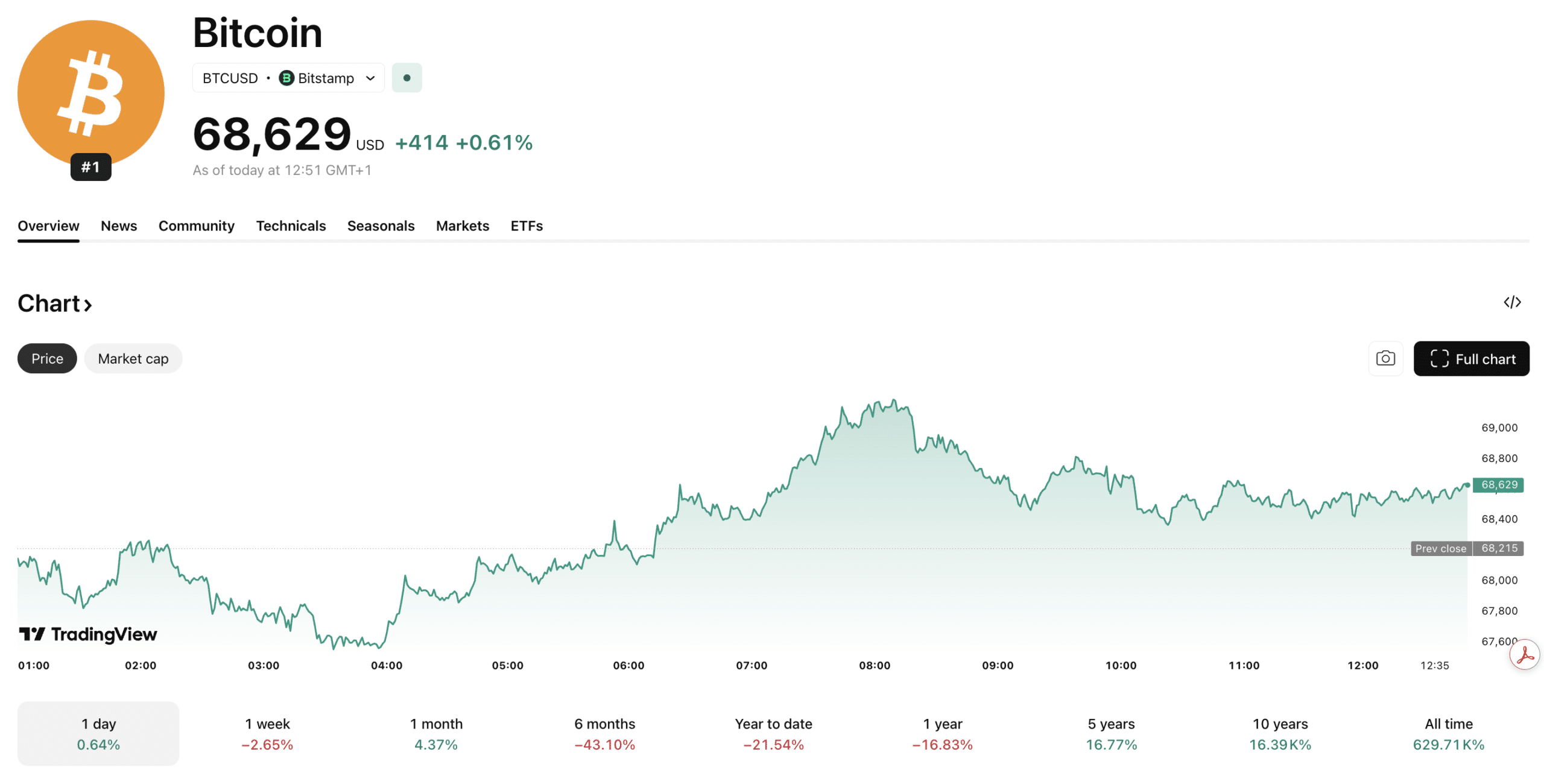
BTC USD is trading at approximately $68,200, down roughly +2.2% in the past 24 hours, as a key on-chain metric quietly signals something analysts haven’t flagged since the 2022 cycle bottom. The question isn’t whether a buy zone exists; it’s whether the market has actually reached it yet.
According to CryptoQuant data, Bitcoin’s realized price, the aggregate cost basis of all coins weighted by their last on-chain movement, currently sits at $54,286, while spot trades near $68,774. That places Bitcoin approximately 21% above its realized price, a gap that has compressed sharply from a roughly 120% premium recorded when BTC traded above $119,000 in late 2024.
CryptoQuant analysts flagged the setup as an emerging “accumulation zone” comparable to 2022, though the framing draws scrutiny: the actual 2022 bottom was defined by spot trading below realized price, not 21% above it. The capitulation signal, in other words, has not fired.
That nuance, compression without confirmation, frames the technical picture heading into April. Macro catalysts remain live, and the on-chain backdrop is shifting faster than most cycle timelines would predict.
Can Bitcoin Price Reclaim $70,000 Before a Deeper Correction Sets In?
Bitcoin’s 24-hour range of $67,500 to $68,700 reflects consolidation rather than conviction. Volume over the past 24 hours ranged between $41.6Bn and $57.7Bn, elevated but not the kind of surge associated with decisive breakouts. The 50-day moving average sits at approximately $67,388, serving as near-term support, while $70,000 marks the next meaningful resistance level.
Technical indicators present an unusual consensus. Investing.com’s aggregated signals show 12 of 12 moving averages are in buy territory, with RSI at 64.7 and STOCH at 99.1, the latter flashing overbought on shorter timeframes.
$BTC got rejected from the $69,000-$70,000 resistance zone.
Earlier this acted as a support for Bitcoin and has now flipped into resistance. pic.twitter.com/48xYG8NKwn
Three scenarios are plausible from current levels. The bull case: spot holds $67,000, reclaims $68,500, and pushes toward $70,000 amid improving geopolitical sentiment following President Trump’s comments that Middle East tensions would resolve shortly.
The base case shows consolidation between $65,950 and $68,500 persists through the week as the market awaits a clearer macro trigger. The bear case, and the one the on-chain data does not rule out, involves a flush toward the $54,000 realized price level, which would represent a further 20% decline and, historically, the kind of genuine capitulation that precedes durable cycle lows. BTC’s correlation with macro risk assets suggests that the scenario remains contingent on external shocks rather than crypto-native dynamics.
For investors watching BTC USD consolidate at prior highs, the arithmetic of large-cap upside looks increasingly constrained at current valuations. Even a clean break to $70,000 represents a move of roughly +3% from here. That’s a meaningful difference from the asymmetry available earlier in the cycle, and it’s precisely the gap that early-stage infrastructure projects attempt to fill.
LiquidChain ($LIQUID) is a Layer 3 infrastructure project positioning itself as a cross-chain liquidity layer, fusing Bitcoin, Ethereum, and Solana liquidity into a single execution environment. The architecture centers on a Unified Liquidity Layer and Deploy-Once design: developers build once and access all three ecosystems simultaneously, with Verifiable Settlement providing on-chain auditability.
The presale is currently priced at $0.01445 per $LIQUID, with $636,000 raised to date. L3 infrastructure is a nascent and technically complex category; execution risk and adoption uncertainty are real. That said, the cross-chain fragmentation problem the project targets is well-documented as a structural bottleneck for the broader market.
Disclaimer: Coinspeaker is committed to providing unbiased and transparent reporting. This article aims to deliver accurate and timely information but should not be taken as financial or investment advice. Since market conditions can change rapidly, we encourage you to verify information on your own and consult with a professional before making any decisions based on this content.
Daniel Frances is a technical writer and Web3 educator specializing in macroeconomics and DeFi mechanics. A crypto native since 2017, Daniel leverages his background in on-chain analytics to author evidence-based reports and deep-dive guides. He holds certifications from The Blockchain Council, and is dedicated to providing "information gain" that cuts through market hype to find real-world blockchain utility.