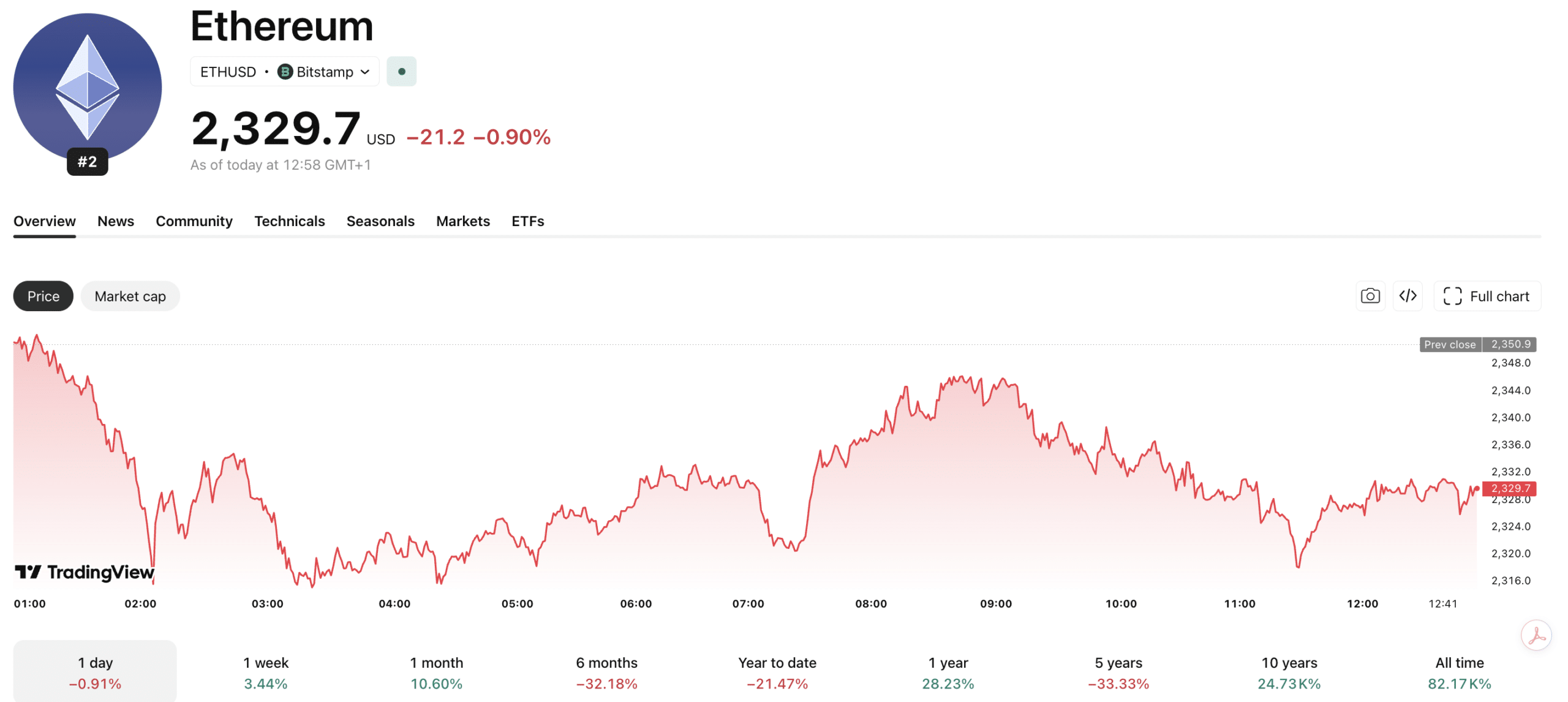
ETH USD has been unable to clear $2,400 for three consecutive months, logging a year-to-date loss of -21% against an -11% decline in total crypto market cap, underperformance that places Ethereum news squarely in focus for institutional holders reassessing the asset’s trajectory.
The stall has coincided with ETH’s 90-day price correlation with top-cap altcoins reaching 0.85 in early May 2025, per data tracked by CryptoRank, the highest reading since November 2024’s bear-market lows.
The ETH price analysis here is structurally more complex than a simple resistance failure. When ETH’s correlation with assets like SOL and LINK compresses this tightly, it signals that the market is not differentiating on fundamentals; it is pricing altcoins as a monolithic risk basket.
The question that framing raises is whether the correlation peak represents a temporary ceiling imposed by macro conditions, or a structural condition embedded in how capital is currently rotating through the digital asset complex.
Ethereum News: Can ETH Break $2,400 or Will it Breakdown Once More?
The mechanism operates as follows: when ETH’s correlation with the broader altcoin market rises, individual asset price discovery fails. Capital isn’t rotating from Bitcoin to Ethereum and then down to mid- and small-cap tokens; it stalls at significant market resistance. This pattern has persisted since mid-April 2025, with ETH consolidating between $2,200 and $2,470, recently peaking at $2,424 on May 6 before being rejected by the 100-hour moving average.
The on-chain data adds to this picture. Ethereum’s decentralized exchange volume has declined by about 53% over the last six months, while DApp revenue has fallen by roughly 49%. Solana and Hyperliquid now hold around 42% of the DApp revenue market share, a significant shift from two years ago.
Despite Ethereum’s total value locked being six times that of its nearest competitor, fee-generating activity is shifting to chains with lower fees and faster settlement.
The security environment in April further complicated matters, with crypto exploits costing around $630M, primarily from KelpDAO and Drift Protocol, implicating North Korea-linked entities. The KelpDAO exploit caused significant Aave TVL outflows and bad debt, eroding the trust needed for institutional liquidity in DeFi.
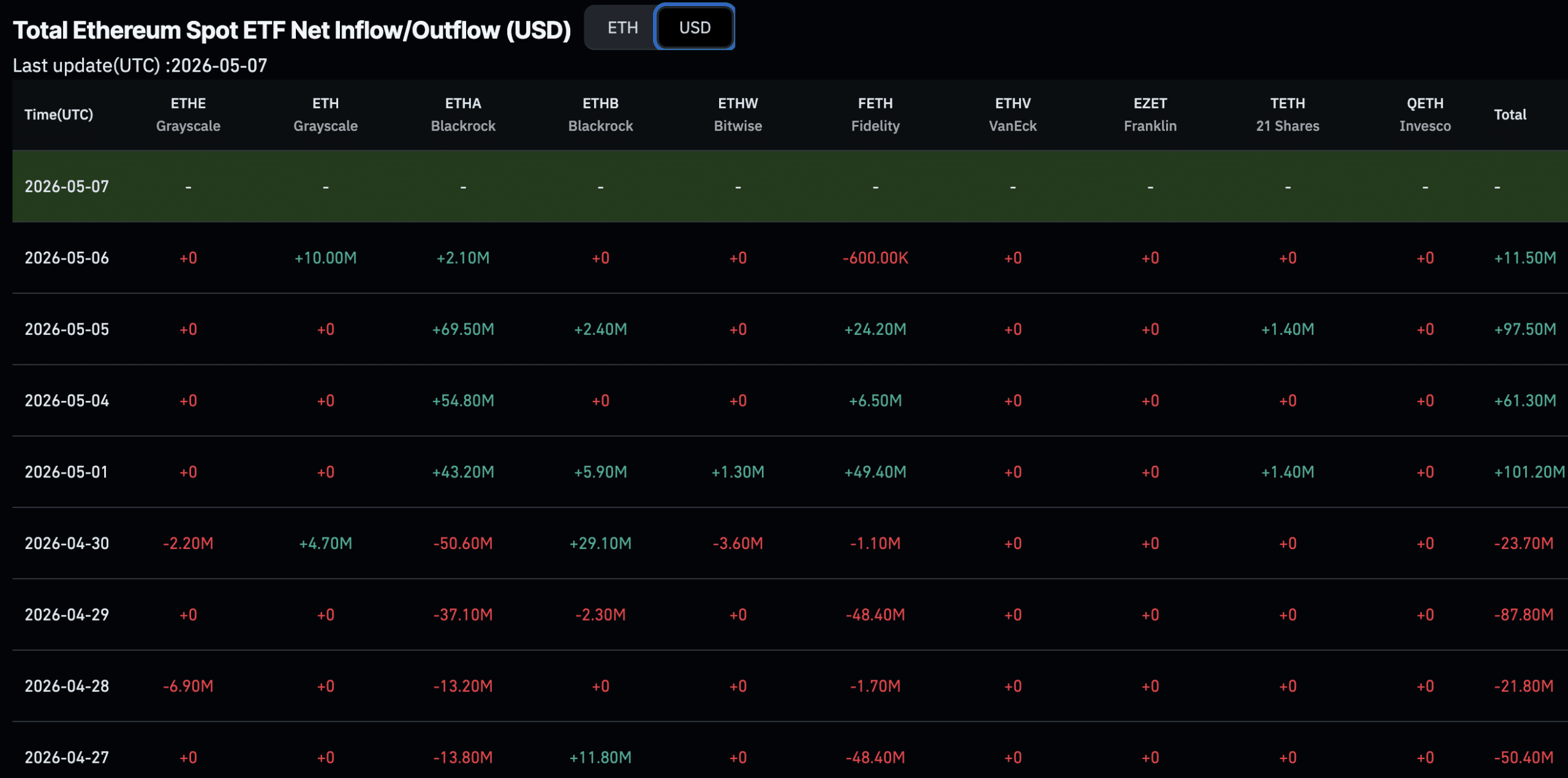
In other Ethereum news, and on a positive note, BlackRock’s iShares Ethereum Trust saw $142M in inflows on May 4, raising total ETF assets to $12.4Bn. BitMine added 101,745 ETH, worth approximately $238M, on May 5, bringing its total to 5.18M ETH (about 4.12% of circulating supply), with 73% staked. However, they face an unrealized loss of $1.4Bn on their position, reflecting the trend of Bitcoin outperforming while Ethereum and altcoins lag behind.
Bull case: ETH clears $2,420 on a daily close with expanding spot volume – a condition that hourly MACD and an RSI holding at 55 above neutral do not yet confirm, but do not rule out. A sustained breach opens the path toward $2,550, triggers short covering across the altcoin complex, and begins unwinding the correlation premium that is currently suppressing individual asset price discovery. The CLARITY Act, with a 60% chance of Senate passage on Polymarket, could serve as a regulatory catalyst accelerating institutional inflows into Ethereum-native DeFi infrastructure.
Base case: ETH continues to consolidate in the $2,200–$2,470 channel through the near term, with the $2,320 trendline serving as the key support level. Correlation with top-cap altcoins remains elevated, the Altcoin Season Index stays below rotation thresholds, and incremental institutional accumulation – evidenced by continued ETF inflows and BitMine’s staking revenue – absorbs selling pressure without generating a breakout. The Glamsterdam upgrade provides a sentiment catalyst but does not materially shift on-chain revenue metrics in the near term.
Bear case/invalidation: A failure to hold $2,200 support on a daily close invalidates the consolidation thesis and reopens the path toward the February low near $1,780. In this scenario, the crypto correlation that links ETH to the broader altcoin complex serves as the transmission mechanism for accelerated drawdowns across DeFi tokens and layer-1 ecosystem assets. BitMine’s $1.4Bn unrealized loss widens, and the corporate ETH treasury model – already under scrutiny – faces renewed pressure from institutional risk committees.
That is the actual gating variable: a confirmed daily close above $2,420 on sustained spot volume, with on-chain DApp revenue stabilizing rather than continuing its 49% descent. Until that resolves, elevated crypto correlation functions as a structural ceiling – not a temporary one – and altcoin season remains structurally deferred.
Disclaimer: Coinspeaker is committed to providing unbiased and transparent reporting. This article aims to deliver accurate and timely information but should not be taken as financial or investment advice. Since market conditions can change rapidly, we encourage you to verify information on your own and consult with a professional before making any decisions based on this content.
Daniel Frances is a technical writer and Web3 educator specializing in macroeconomics and DeFi mechanics. A crypto native since 2017, Daniel leverages his background in on-chain analytics to author evidence-based reports and deep-dive guides. He holds certifications from The Blockchain Council, and is dedicated to providing "information gain" that cuts through market hype to find real-world blockchain utility.