About
Michael J. Saylor is one of the most influential and polarizing figures in modern cryptocurrency history. He’s the co-founder, longtime CEO, and later Executive Chairman of MicroStrategy (rebranded as Strategy).
Saylor pioneered a corporate treasury strategy centered almost entirely on Bitcoin. This move reshaped how public companies think about digital assets, balance sheets, and long-term capital preservation.
Unlike crypto founders who build protocols or exchanges, Saylor’s influence comes from a different vector: institutional legitimacy. He converted a publicly traded U.S. software company into a de facto Bitcoin holding vehicle. Therefore, Saylor was among the first financial moguls to transform Bitcoin from a speculative asset into a corporate reserve instrument. By doing so, he created a blueprint that other companies would later follow.
MicroStrategy Before Bitcoin
Michael Saylor was born in 1965 and raised in a U.S. Air Force family. He spent much of his childhood on military bases abroad. He later attended the Massachusetts Institute of Technology (MIT), where he studied aeronautics and astronautics. While he initially aspired to become a pilot, medical disqualification redirected his career toward technology and entrepreneurship.
In 1989, Saylor co-founded MicroStrategy, an enterprise software company focused on business intelligence, analytics, and data-driven decision-making. During the 1990s and early 2000s, MicroStrategy grew into a recognizable name in enterprise software. Its stock price experienced extreme volatility, including a dramatic collapse during the dot-com bubble.
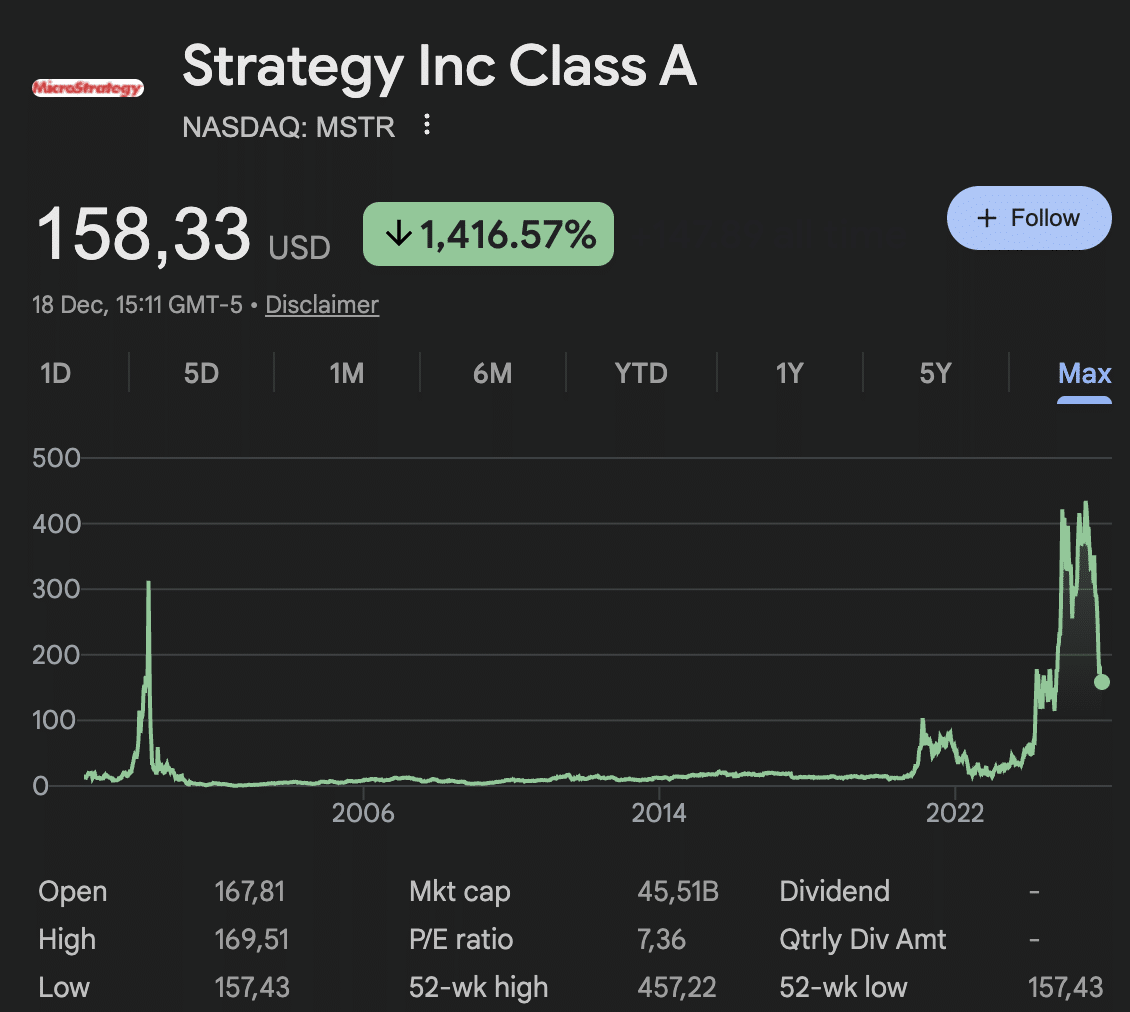
Historical performance of Microstrategy (MSTR) shares | Source: Google Finance
For decades, Saylor was known primarily as a technology executive and software evangelist, not a financial revolutionary. That changed dramatically in 2020.
Bitcoin as a Treasury Reserve Asset
In mid-2020, the market was shaken by aggressive monetary expansion, near-zero interest rates, and concerns about currency debasement. Saylor began publicly questioning the long-term viability of holding large cash reserves on corporate balance sheets.
His conclusion was radical at the time:
“Cash was a melting ice cube. Bitcoin was digital property.”
In August 2020, MicroStrategy announced its first Bitcoin purchase, converting a significant portion of its corporate treasury into BTC. This decision marked the beginning of what would become the largest corporate Bitcoin accumulation strategy in history.
Over the following years, MicroStrategy:
- Consistently purchased Bitcoin during both bull and bear markets.
- Used excess cash, debt issuance, convertible notes, and equity offerings to fund acquisitions.
- Publicly framed Bitcoin as a long-duration, non-sovereign, inflation-resistant asset.
By 2024–2025, MicroStrategy held hundreds of thousands of BTC, making it the largest publicly traded holder of Bitcoin in the world. As of 2025, it has far surpassed Tesla and any other corporate entity.

Top-10 institutional Bitcoin holders worldwide | Source: bitcointreasuries.net
This move fundamentally altered MicroStrategy’s identity. The company evolved from an enterprise software firm into a Bitcoin-centric financial vehicle. Its stock is increasingly trading as a leveraged proxy for Bitcoin price movements. However, whenever BTC price drops, as in December 2025, MSTR shares follow suit, leading to a crash.
Corporate Bitcoin Trend
Saylor’s strategy did not exist in isolation. His aggressive conviction helped legitimize Bitcoin within corporate finance discussions and inspired a wave of institutional curiosity.
Key impacts of the Saylor model:
- Introduced Bitcoin into boardroom-level treasury strategy
- Framed BTC as digital property, not currency or payment rail
- Encouraged CFOs and executives to reconsider idle cash management
- Helped normalize long-term Bitcoin holding over speculative trading
While relatively few companies matched MicroStrategy’s scale or risk tolerance, Saylor’s actions shifted the Overton window. Bitcoin was no longer just a hedge fund asset or retail speculation — it became a balance-sheet asset class.
MicroStrategy as a Bitcoin Proxy
As Bitcoin exposure grew, MicroStrategy’s stock behavior changed. Investors began treating it less as a software equity and more as a Bitcoin-linked instrument, often with amplified volatility due to leverage.
This dynamic created:
- Strong upside participation during Bitcoin bull cycles
- Severe drawdowns during market downturns
- A new class of investors using MSTR shares instead of direct BTC exposure
Saylor openly embraced this transformation, positioning MicroStrategy as a permanent Bitcoin accumulator, not a trader attempting to time markets.
Michael Saylor’s Personal Bitcoin Investments
In addition to corporate holdings, Saylor has confirmed significant personal Bitcoin ownership. While he has never disclosed an exact figure, public statements indicate he personally owns thousands of BTC, acquired independently of MicroStrategy.
Importantly:
- Saylor has stated he has never sold Bitcoin
- He frames Bitcoin ownership as a multi-decade commitment
- He rejects short-term trading, diversification away from BTC, or profit-taking narratives
His personal philosophy mirrors his corporate stance: Bitcoin is not an asset to trade, but a form of long-term digital capital preservation.
Public Advocacy, Predictions, and Market Narratives
Michael Saylor is not a quiet investor. He is one of Bitcoin’s most prolific and articulate public advocates, regularly appearing on podcasts, at conferences, on earnings calls, and on social media, especially on his X account.
Core themes in Saylor’s messaging:
- Bitcoin is a digital property, not a risk asset.
- Fiat currencies will continue to debase over time.
- Bitcoin’s fixed supply makes it superior to gold.
- Volatility is the price of long-term asymmetrical upside.
He is also known for bold price predictions, often framed over long time horizons rather than short-term cycles. While critics argue these projections fuel speculative enthusiasm, supporters see them as conviction-driven frameworks rooted in monetary theory.
Crucially, Saylor does not present himself as a trader. He consistently discourages leverage for individuals and emphasizes holding through volatility, even as MicroStrategy itself uses financial instruments at the corporate level.
Influence on Bitcoin Market Psychology
Saylor’s influence extends beyond price action. He has helped shape:
- The narrative of Bitcoin as corporate collateral.
- The idea of BTC as productive capital rather than idle wealth.
- Institutional confidence in holding BTC through regulatory uncertainty.
His messaging has become a reference point during market stress, with investors closely watching his statements during major drawdowns or rallies.
For many long-term Bitcoin holders, Saylor represents maximum conviction. He’s an archetype of belief in Bitcoin’s end-state rather than its short-term fluctuations.
Criticism and Risk Debate
Saylor’s strategy has not been without controversy. Critics point to:
Saylor’s response has been consistent. He believes Bitcoin’s volatility is temporary, while monetary debasement is permanent. This philosophical divide has made him one of the most debated figures in financial media. On one hand, he’s admired for his clarity and conviction and on the other hand, criticized for perceived recklessness.
Role in Broader Crypto Discourse
Unlike many crypto figures, Saylor focuses almost exclusively on Bitcoin, not altcoins. Moreover, he publicly dismisses most tokens as securities or speculative experiments. Saylor also avoids DeFi, NFTs, and short-term yield narratives.
This Bitcoin-maximalist stance has made him a defining voice in ideological debates within crypto, particularly between Bitcoin-centric and multi-chain communities.
Legacy and Long-Term Impact
Michael Saylor’s legacy is still unfolding, but its contours are already clear. He transformed a public company into a Bitcoin treasury vehicle and legitimized BTC as a corporate balance-sheet asset.
Whether MicroStrategy’s strategy is ultimately remembered as visionary or excessively risky will depend on Bitcoin’s long-term trajectory. But regardless of outcome, Saylor has already secured a place in crypto history as the executive who turned conviction into corporate policy.
Click to see more