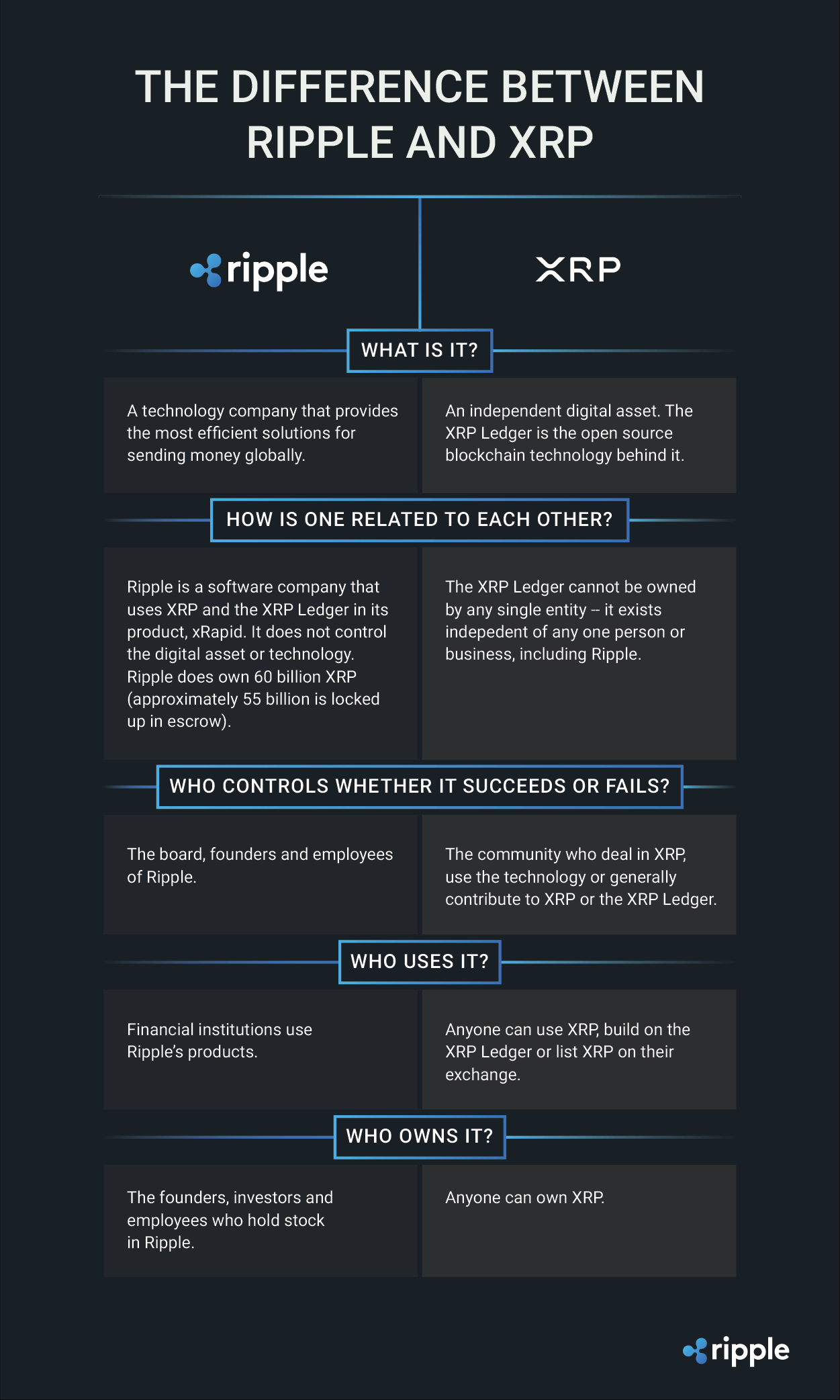
With a view to prevent further mistakes in usage of two notions, Ripple Labs Inc explained the difference between their brand and digital asset XRP.
Today more and more media outlets use such brands as Ripple and XRP interchangeably. Nevertheless, according to Ripple Labs Inc, it is absolutely incorrect. These are two different brands that shouldn’t be mixed. Ripple Labs Inc explained the difference between these two notions with a view to prevent further mistakes.
Ripple itself is a software company based in California. And the moment more than 200 employees work for it on a full-time basis. Through its platform it tries to make sending money globally easier and faster. For its product called xRapid it uses XRP (nevertheless, it doesn’t have any control over the digital asset) and the XRP Ledger that is the independent open source blockchain technology behind XRP.
The company’s blockchain network is already used by several financial institutions in different corners of the world. They are, for example, UAE-based RAKBANK, Mexican non-financial banking institution Cuallix and Spanish banking group Santander.
Ripple Labs Inc owns 60 billion XRP and over 55 billion XRP are locked up in escrow. XRP is central to all the products of Ripple. Nevertheless, some skeptics claim that such a situation means a high level of centralization, moreover, some other experts even say that the company tries to increase the value artificially with a view to fund their business.
As a result, currently, Ripple is involved in legal battles that are based on the assumption that XRP is a security and the company has sold XRP worth approximately $100 million in order to provide funding for itself. Nevertheless, its CEO Brad Garlinghouse insists that the digital coin is not a security.
But the U.S. Securities and Exchange Commission (SEC) still has some doubts according the status of XRP which has some impact on investors attitude towards this coin. Though the SEC has clearly specified that Bitcoin and Ethereum are not securities as they are decentralized, nothing has been said about the status of other cryptocurrencies including XRP.
Currently, XRP is ranked as the third largest cryptocurrency in the world with a market capitalization of $17.6 billion according to CoinMarketCap. At press time, it is traded for $0.449 having lost more than 6% over the last 24 hours.
And there are very different experts’ forecasts. While some of them believe that XRP will fall below $0.32 by the end of the year, some others are practically sure that it will reach the mark of $10 in December and will go up to $200-$300 in ten years.
The XRP digital currency is hosted on the XRP ledger that supports a decentralized exchange for transacting other assets and decentralized payments. As a result, all transactions that include usage of XRP rely on this ledger. XRP is also positioned as a settlement asset that can be used for conducting cross-border payments in partnership with the payment platform called RippleNet.
I’m a content writer and editor with extensive experience creating high-quality content across a range of industries. Currently, I serve as the Editor-in-Chief at Coinspeaker, where I lead content strategy, oversee editorial workflows, and ensure that every piece meets the highest standards. In this role, I collaborate closely with writers, researchers, and industry experts to deliver content that not only informs and educates but also sparks meaningful discussion around innovation.
Much of my work focuses on blockchain, cryptocurrencies, artificial intelligence, and software development, where I bring together editorial expertise, subject knowledge, and leadership experience to shape meaningful conversations about technology and its real-world impact. I’m particularly passionate about exploring how emerging technologies intersect with business, society, and everyday life. Whether I’m writing about decentralized finance, AI applications, or the latest in software development, my goal is always to make complex subjects accessible, relevant, and valuable to readers.
My academic background has played an important role in shaping my approach to content. I studied Intercultural Communications, PR, and Translation at Minsk State Linguistic University, and later pursued a Master’s degree in Economics and Management at the Belarusian State Economic University. The combination of linguistic, communication, and business training has given me the ability to translate complex technical and economic concepts into clear, engaging narratives for diverse audiences.
Over the years, my articles have been featured on a variety of platforms. In addition to contributing to company blogs—primarily for software development agencies—my work has appeared in well-regarded outlets such as SwissCognitive, HackerNoon, Tech Company News, and SmallBizClub, among others.