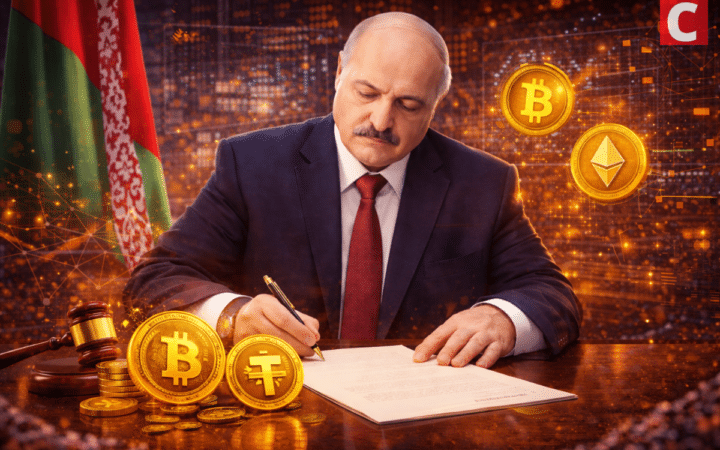
The Belarusian president has signed a new decree establishing a cryptobank framework.
Cryptobanks are now allowed to integrate token operations with traditional banking operations.
Last year, the Belarusian government restricted access to several major cryptocurrency exchanges.
Belarusian President Alexander Lukashenko has signed a decree that establishes a “cryptobank” framework in the country.
According to the leader, Decree No. 19, as it is called, allows the integration of token operations with traditional banking, payments, and other financial services.
A New Crypto Decree in Belarus
Decree No. 19, which was signed on January 16, is designed to cater to “cryptobanks” or joint-stock companies residing in the High-Tech Park (HTP), a state-run special economic zone in the country.
A statement from the Belarusian president’s office noted that by reason of the decree, these entities are now permitted to fuse token operations with traditional banking operations.
The latest allowance is still subject to dual supervision by HTP authorities and the National Bank of the Republic of Belarus.
The framework fosters “technological efficiency, speed, and convenience” for transactions involving tokens.
Whether this decree will be welcomed into the market is dependent on two specific conditions.
The first is that the entity must hold resident status within the HTP.
Secondly, it must have a place in the dedicated register of cryptobanks maintained by Belarus’ central bank.
Once operations kick off, cryptobanks are obliged to comply with Belarusian legislation governing non-bank credit and financial organizations.
In addition, they must implement all decisions issued by the HTP’s own supervisory board. It is worth noting that Lukashenko had first issued a directive in March, mandating the government to develop the national crypto-mining sector.
He proposed the installation of data centers in regions with surplus energy resources.
Belarus Restricts Crypto Exchanges
Belarus has demonstrated a high level of commitment towards the smooth running fofthe crypto sector under its jurisdiction.
However, in December 2025, the government abruptly restricted access to several major cryptocurrency exchanges, including Bybit, OKX, and even Bitget, which had secured a Bulgarian VASP license to expand its EU presence under MiCA.
This act was carried out under an order from the Ministry of Information and implemented by the state telecom authority BelGIE.
Consequently, any user attempting to visit the exchanges from Belarusian IP addresses will receive a notice from the government citing the country’s Mass Media Act.
Disclaimer: Coinspeaker is committed to providing unbiased and transparent reporting. This article aims to deliver accurate and timely information but should not be taken as financial or investment advice. Since market conditions can change rapidly, we encourage you to verify information on your own and consult with a professional before making any decisions based on this content.
Benjamin Godfrey is a blockchain enthusiast and journalist who relishes writing about the real life applications of blockchain technology and innovations to drive general acceptance and worldwide integration of the emerging technology. His desire to educate people about cryptocurrencies inspires his contributions to renowned blockchain media and sites.