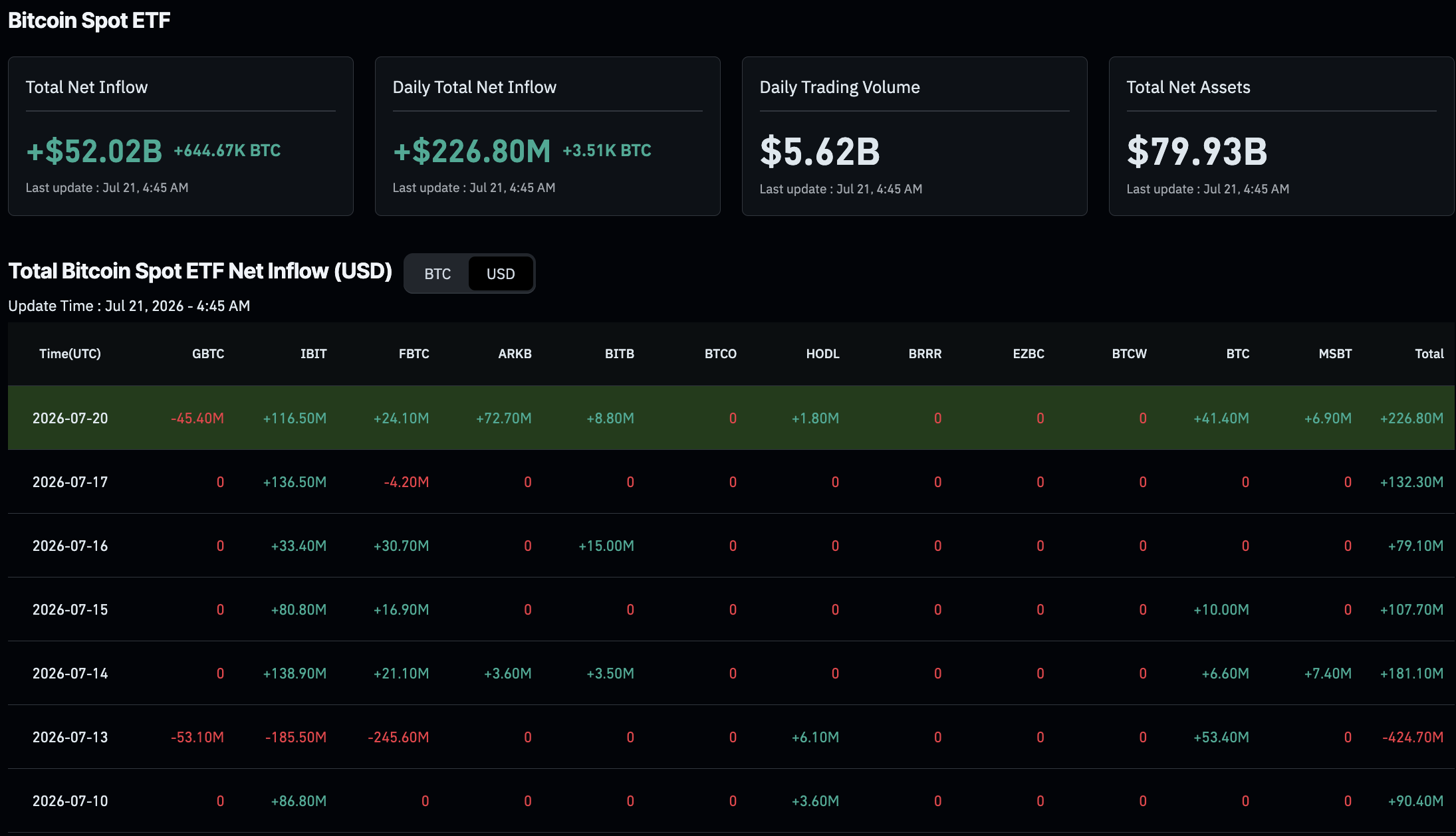
US spot Bitcoin ETFs recorded $206M in net inflows on July 21, per data tracked by CoinGlass, completing a six-consecutive-day run that totals more than $900M, the longest unbroken positive streak since May.
This inflow streak comes as the Bitcoin price reclaimed the $66,000 level (which it has since lost) and market sentiment entered neutral territory for the first time in nearly a month.
This is not simply a rebound in ETF flows. It is a structural re-engagement by institutional capital following one of the more damaging periods of outflows the Bitcoin ETF complex has endured since its January 2024 launch.
The analytical question is no longer whether June’s selling pressure has exhausted itself; it is whether the current inflow cadence is durable enough to shift the medium-term supply-demand balance.
Bitcoin ETF Flows: Mapping the Mechanism Behind the Streak
The mechanism functions as follows. A 10-day outflow streak that drained more than $2.7Bn from the spot Bitcoin ETF complex through late June ended abruptly on July 2, when a single session saw inflows of $221.7M.
That session was led by Fidelity FBTC and ARK ARKB, with BlackRock IBIT registering an anomalous net outflow of roughly $40 million before reversing course.
The recovery then accelerated. July 6 brought $265.7M, with IBIT alone contributing approximately $209M, a rotation in issuer leadership that repeated across subsequent sessions.
The streak paused briefly before resuming across July 14–17 with sessions of $181M and $108M, culminating in the July 20 print of $226.8M. The resulting two-week total lands at approximately $273M, the second consecutive positive week for the complex.
Across most sessions, BlackRock IBIT, Fidelity FBTC, and ARK ARKB led net contributions, with issuer leadership across sessions – with BlackRock’s IBIT, Fidelity’s FBTC, and ARK’s ARKB leading the charge in many sessions, suggesting that the demand is distributed across institutional mandates rather than concentrated in a single product.
Regulatory Catalysts and Whale Accumulation Reinforce the Macro Backdrop
Bitcoin Whales Buy Billions In BTC As Smaller Holders Exit
Bitcoin whales holding 1,000 to 10,000 $BTC accumulated 66,700 BTC over the past 60 days, their strongest accumulation since February, CryptoQuant says.
Two regulatory developments appear to have contributed to the shift in sentiment underpinning the inflow streak. In the US, the White House reached a deal on an ethics package that had been blocking the CLARITY Act, the bipartisan bill designed to delineate regulatory jurisdiction between the SEC and the CFTC.
Resolution of that ethics dispute increases the likelihood that the bill will advance in the Senate before the August recess, removing a source of structural regulatory uncertainty that had weighed on institutional positioning.
Separately, Russia’s State Duma passed a comprehensive crypto market law on July 21 that formally classifies digital assets as property, establishes a trading and custody framework under Bank of Russia oversight, and enables cross-border settlement while banning domestic crypto payments.
The law takes effect September 1, 2026, with certain provisions phased in later. Non-qualified retail investors face an annual purchase cap of 300,000 rubles (approximately $3,800); qualified investors are uncapped but subject to mandatory risk testing.
On-chain data from CryptoQuant adds a supply-side dimension to the picture. Wallets holding between 1,000 and 10,000 BTC accelerated accumulation at the fastest pace in months after Bitcoin price fell below $55,000 earlier in July. Total whale accumulation for the month exceeded 66,700 BTC, valued at approximately $4.415Bn.
CryptoQuant noted on X that the buying accelerated specifically after the sub-$55,000 print, a pattern consistent with large-holder behavior during prior accumulation phases.
Strategy also added $500M to cash reserves through a new convertible notes offering during the period while keeping its Bitcoin holdings unchanged, a move that signals balance-sheet preparation without immediate selling pressure on spot markets.
Disclaimer: Coinspeaker is committed to providing unbiased and transparent reporting. This article aims to deliver accurate and timely information but should not be taken as financial or investment advice. Since market conditions can change rapidly, we encourage you to verify information on your own and consult with a professional before making any decisions based on this content.
Daniel Frances is a technical writer and Web3 educator specializing in macroeconomics and DeFi mechanics. A crypto native since 2017, Daniel leverages his background in on-chain analytics to author evidence-based reports and deep-dive guides. He holds certifications from The Blockchain Council, and is dedicated to providing "information gain" that cuts through market hype to find real-world blockchain utility.