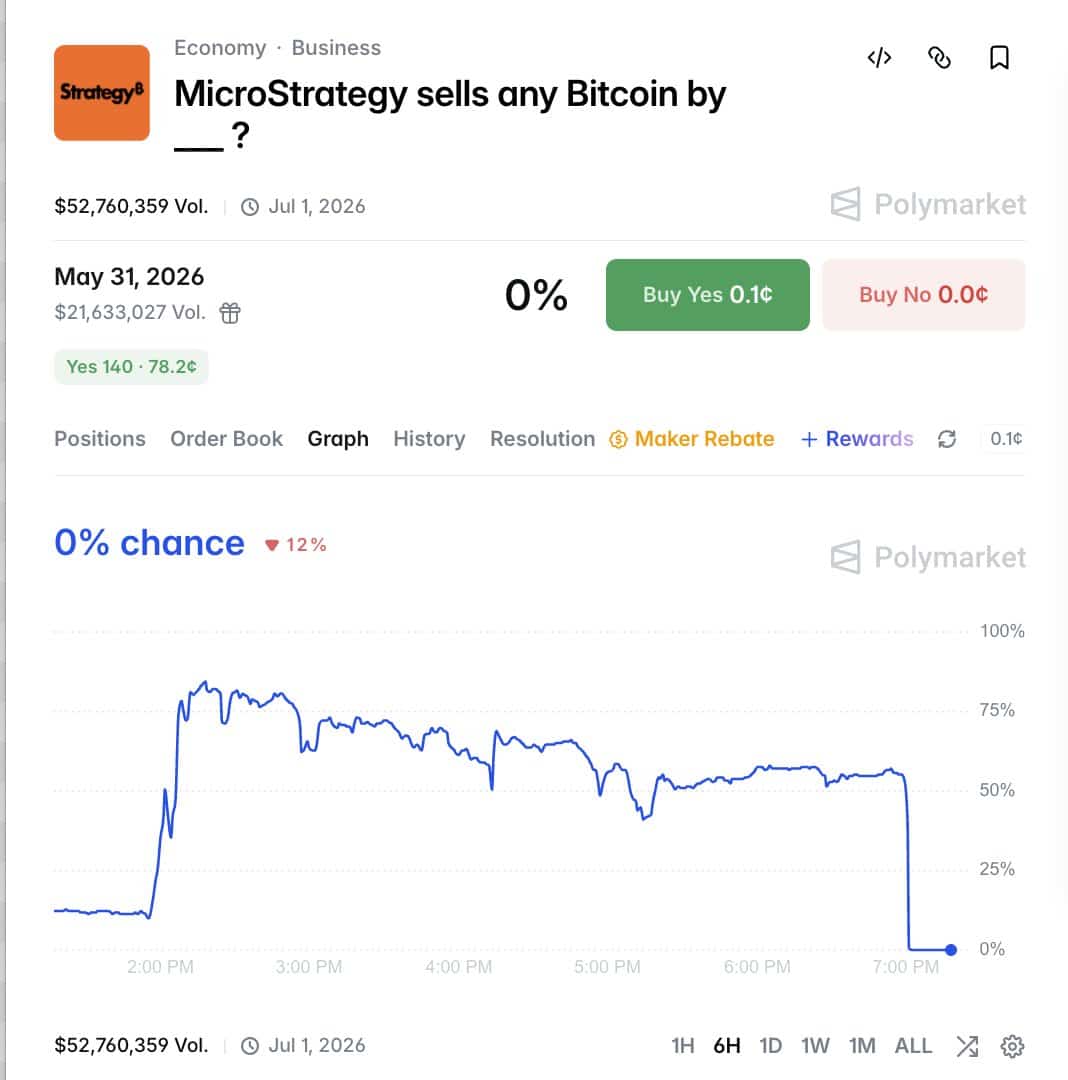
A Polymarket prediction market that attracted more than $80 million in trading volume has entered final dispute review after the platform proposed resolving it as “No,” despite Strategy having executed the underlying Bitcoin sale within the market’s specified timeframe.
The market asked whether Strategy would sell Bitcoin by May 31; the company sold 32 BTC worth approximately $2.5 million between May 26 and May 31, then disclosed the transaction in a regulatory filing on June 1.
Polymarket argued that because no confirmation existed before the deadline, the sale did not qualify for resolution purposes. The analytical question is no longer whether traders are unhappy with the outcome; it is whether the resolution criteria, as written and subsequently clarified, were sufficiently precise to justify the interpretation Polymarket applied to $80 million in participant capital.
Source: Polymarket
The dispute now falls to UMA tokenholders, the oracle system that powers Polymarket’s market settlement, who must issue a final ruling by 12:00 a.m. UTC on Wednesday or see the order book cleared.
This is at minimum the second time the market’s resolution has been formally challenged, making it one of Polymarket’s most repeatedly contested markets on record. For participants holding “Yes” shares, the stakes are concrete and immediate; for the platform and its governance infrastructure, the implications extend considerably further.
How the Polymarket Dispute Mechanism Actually Reached This Point
The mechanism functions as follows: Polymarket markets that use the UMA optimistic oracle submit a proposed resolution, which stands unless challenged by bonded disputers within a defined window.
When a challenge succeeds in escalating the question, UMA tokenholders vote on the correct interpretation. In this case, two proposed resolutions were disputed before the current final review, a sequence that is structurally unusual and that UMA’s governance design was not specifically optimized to handle at this frequency on a single market.
MicroStrategy sold Bitcoin, but the market resolved "No"
they sold BTC on May 26, but only reported it today
yes, they really did sell, but @Polymarket ruled that the confirmation came outside the market's timeframe
Polymarket’s position rests on a clarifying note added to the market page after the conflict emerged, language specifying that confirmations released outside the market’s timeframe would not count, and that no on-chain data, public filing, or credible reporting confirmed a Bitcoin sale before May 31 expired.
Several traders have characterized this addition as moving the goalposts after the majority of the $80 million in volume had already traded under different expectations. Strategy’s June 1 SEC filing, which disclosed the 32 BTC sale as tied to distributions on the company’s preferred stock program, was the first reported disposal of Bitcoin by the firm since December 2022, a fact that amplifies how much interpretive weight is now resting on a 24-hour disclosure gap.
Participants objecting to the “No” resolution have framed their argument around the distinction between event occurrence and public verifiability. One commenter on the market page wrote that Polymarket should “trade truth, not technicalities,” while others described the outcome as “unbelievable” and said it had eroded their confidence in the platform.
Despite the objections, market pricing as of the latest available data shows approximately 99.9% odds attached to the “No” outcome, a figure that reflects capital allocation under the current resolution trajectory, not necessarily the merits of the underlying dispute.
Disclaimer: Coinspeaker is committed to providing unbiased and transparent reporting. This article aims to deliver accurate and timely information but should not be taken as financial or investment advice. Since market conditions can change rapidly, we encourage you to verify information on your own and consult with a professional before making any decisions based on this content.
Daniel Frances is a technical writer and Web3 educator specializing in macroeconomics and DeFi mechanics. A crypto native since 2017, Daniel leverages his background in on-chain analytics to author evidence-based reports and deep-dive guides. He holds certifications from The Blockchain Council, and is dedicated to providing "information gain" that cuts through market hype to find real-world blockchain utility.