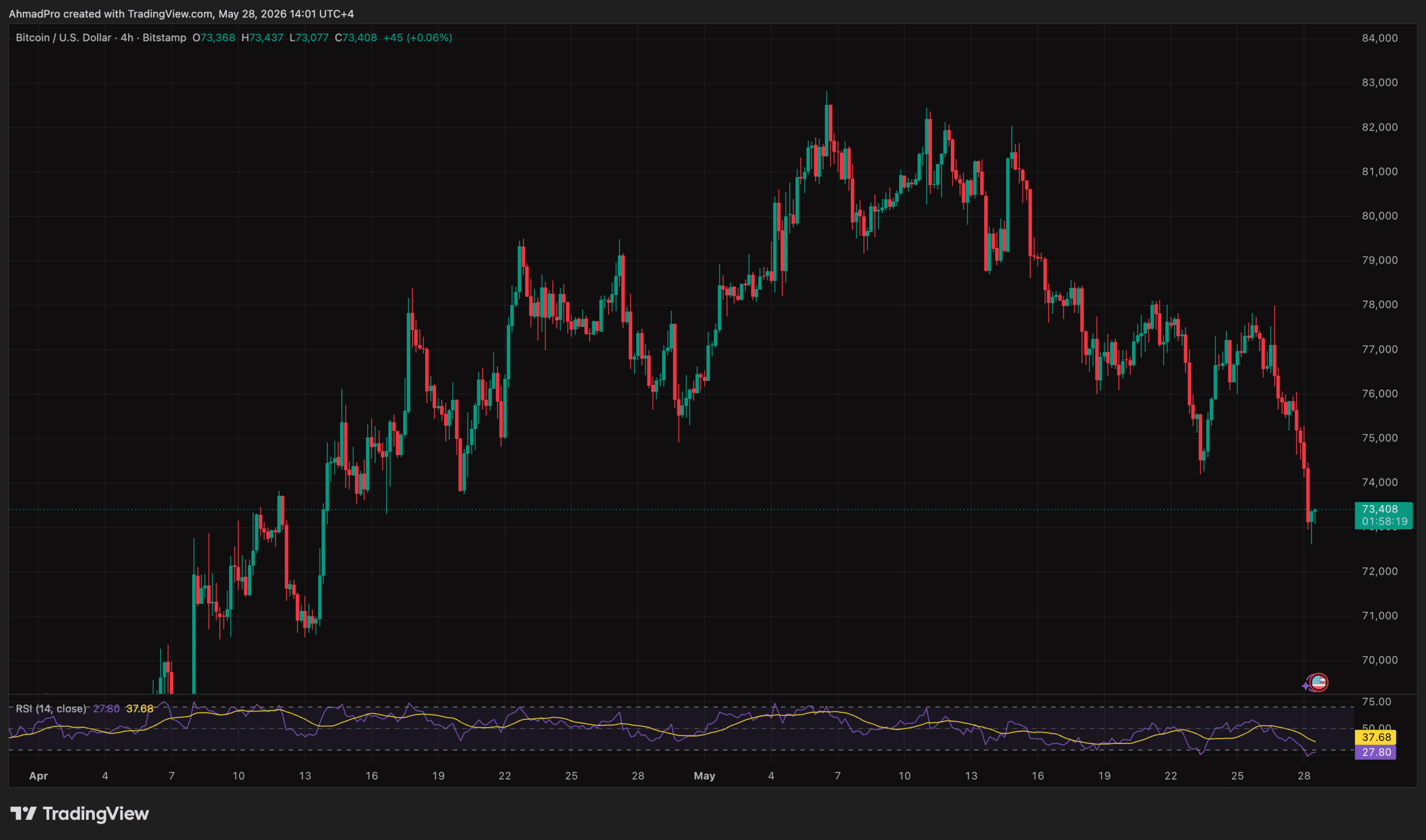
Bitcoin price fell to $72,978 in Asian hours today, down 3.4% over 24 hours as news on the US-Iran strike rattled the market.
The U.S. Central Command strike on an Iranian military site near the Strait of Hormuz has simultaneously triggered risk-off selling across equities, a bid into energy markets, and one of the largest single-session deleveraging events in crypto this year.
The analytical question is no longer whether Bitcoin fell on geopolitical news; it is whether the safe-haven narrative can survive an episode in which gold and Bitcoin moved in opposite directions during a live kinetic conflict involving U.S. military action.
BREAKING: Iran's IRGC releases a statement saying that it has retaliated to the US strike on an Iranian military position in the Strait of Hormuz by attacking a US airbase in Kuwait.
In their statement, the IRGC says "aggression will not go unanswered."
Oil prices are up nearly…
— The Kobeissi Letter (@KobeissiLetter) May 28, 2026
The transmission mechanism here was not subtle. U.S. strikes on Iran raised the geopolitical risk premium across global markets, driving capital into traditional hedges – gold, Treasuries, and to a lesser extent the U.S. dollar – while simultaneously triggering risk-off liquidation of high-beta assets.
Bitcoin, despite its store-of-value framing, absorbed the risk-off side of that trade rather than the safe-haven side.
Ether fell 4.2% to $1,976, losing the $2,000 handle and extending its seven-day loss to 7.7%. Solana dropped 3.5% to $80.57, XRP slid 3.6% to $1.28, and Dogecoin lost 3.2% to $0.0979.
The MSCI All Country World Index retreated 0.4% from a record high; a gauge of Asian shares fell 1.7%; S&P 500 and Nasdaq 100 futures both pointed lower. Oil climbed as the strikes complicated prospects for a Strait of Hormuz reopening, with Brent crude already elevated well above prior-cycle norms following the broader 2026 Strait of Hormuz crisis.
JUST IN: Over $250,000,000 liquidated from the crypto market in the past 15 minutes. pic.twitter.com/ioSzsz2mfq
The liquidation breakdown confirms this was a leverage wipeout driven by forced selling rather than deliberate short positioning. A 93% long-skew on a near-billion-dollar flush indicates that traders had been positioned for recovery, not hedged against escalation.
Macro commentators and derivatives desks have increasingly characterized Bitcoin in this conflict cycle as high-beta macro tech rather than digital gold, pointing to its tight intraday correlation with Nasdaq futures as the more accurate descriptor of its current institutional role. That framing was reinforced on Thursday.
ETF flows added institutional weight to the move. BlackRock’s iShares Bitcoin Trust recorded $527.84 million in net outflows on Wednesday – its second-largest single-day withdrawal since launching in January 2024, missing its all-time record by less than half a million dollars. The 11 U.S. spot bitcoin ETFs together shed $733.43 million that session, extending a multi-session streak that has pulled more than $2 billion from the products.
Bitcoin Price at $72,900–$73,000: What the Structure Is Actually Showing
The $72,000–$73,000 zone is now the most contested support band on the daily chart. Bitcoin had held above $74,000 through several weeks of Iran-related headlines before Thursday’s strikes broke that floor on elevated volume, suggesting the level absorbed meaningful demand before failing – a technically significant distinction from a low-liquidity wick.
Overhead resistance is clustered in the $74,500–$75,500 range, where prior support now functions as a ceiling. The 50-day simple moving average, which Bitcoin had been using as a recovery guide through May, is rolling over – a configuration that historically precedes either a test of deeper support or a failed reclaim attempt that fakes out short-term buyers. RSI on the daily timeframe has dropped toward the low-40s, approaching oversold territory without yet reaching levels that have historically preceded sharp reversals in this cycle.
A de-escalation signal, whether a ceasefire confirmation, a Strait of Hormuz shipping agreement, or a materially dovish Fed communication, allows Bitcoin to reclaim $74,500 within 72 hours and re-establish the prior range. Recovery target sits at $76,000 to $77,500 on a sustained close above that level.
If the geopolitical situation stays unresolved and ETF outflows continue at a reduced pace, Bitcoin grinds sideways between $72,000 and $74,500 over the next several sessions. No directional conviction develops in either direction, and $72,000 holds as the structural floor.
A daily close below $72,000, particularly if accompanied by continued ETF outflows and further Strait of Hormuz escalation, opens a measured move toward the $68,000 to $70,000 support cluster that derivatives analysts have flagged as the next meaningful demand zone.
Disclaimer: Coinspeaker is committed to providing unbiased and transparent reporting. This article aims to deliver accurate and timely information but should not be taken as financial or investment advice. Since market conditions can change rapidly, we encourage you to verify information on your own and consult with a professional before making any decisions based on this content.
Daniel Frances is a technical writer and Web3 educator specializing in macroeconomics and DeFi mechanics. A crypto native since 2017, Daniel leverages his background in on-chain analytics to author evidence-based reports and deep-dive guides. He holds certifications from The Blockchain Council, and is dedicated to providing "information gain" that cuts through market hype to find real-world blockchain utility.