Stripe, Paradigm Open Tempo Blockchain to Public as Stablecoin Demand Accelerates
Stripe and Paradigm opened Tempo’s public testnet, inviting companies to build stablecoin payment apps with fixed 0.1-cent fees and predictable settlement.
Tempo blockchain separates transaction lanes to prevent congestion and offers stable fees at one-tenth of a cent per transaction.
Major financial institutions including UBS, Deutsche Bank, and Cross River Bank are testing the payments-focused network's capabilities.
The platform accepts dollar-denominated stablecoins like USDT and USDC for transaction costs and targets microtransaction use cases.
Stripe and Paradigm opened Tempo’s public testnet on Tuesday, expanding the operational capacity of the payments-focused blockchain unveiled in September. A Bloomberg report on Tuesday detailed how the rollout invites any company to begin building stablecoin payment applications on the network.
The companies confirmed that Tempo’s newest group of partners includes UBS, Cross River Bank, and prediction-market operator Kalshi.
They join existing participants such as Deutsche Bank, Nubank, OpenAI, and Anthropic, which have been testing live workloads to validate the chain’s performance. Other partners mentioned include DoorDash, Shopify, Standard Chartered, Visa, Coupang, and Revolut, with more firms like Klarna, Brex, Coastal, Mastercard, Ramp, Payoneer, Persona, and Figure joining after the initial announcement.
Tempo’s testnet is live!
Any company can now build on a payments-first chain designed for instant settlement, predictable fees, and a stablecoin-native experience.
According to details, the Tempo blockchain applies a payments-first architecture that separates transaction lanes from the broader network to avoid congestion common on public blockchains. The design targets predictable settlement times and fee stability, aiming to prevent disruptions often triggered by spikes in speculative trading.
With a fixed fee of one-tenth of a cent per transaction, Tempo offers an alternative to traditional card rails that charge between one and three percent plus fixed costs.
This model also aligns with rising interest in microtransactions across fintech and AI firms, which increasingly prefer usage-based fees instead of monthly billing. Tempo also accepts any dollar-denominated stablecoin for transaction costs, including USDT and USDC, the two largest tokens in circulation.
Companies building on the Tempo blockchain can begin testing integrations today, according to project documentation.
"Working with Tempo allows Coastal to test and co-create the next generation of financial infrastructure. It’s not just about improving speed or efficiency — it’s about unlocking new capabilities for the broader ecosystem of fintech and embedded finance partners. Together, we’re… https://t.co/grxZmHHBKO
Coastal Bank President Brian Hamilton said his institution is testing how the network’s structure could unlock new capabilities across fintech and embedded-finance partners.
Matt Huang, managing partner at Paradigm, which leads the project’s development effort, told Bloomberg his team will focus on real-world use cases for stablecoins.
The move continues a year-long trend of US institutional participation in crypto, further accelerated by the GENIUS ACT regulatory framework signed into law by President Donald Trump in July 2025.
Pepe Node Presale Nears $2.5M Target as Institutional Demand
As Tempo blockchain launch accelerates crypto adoption in the US, early-stage projects like PEPENODE are receiving speculative demand.
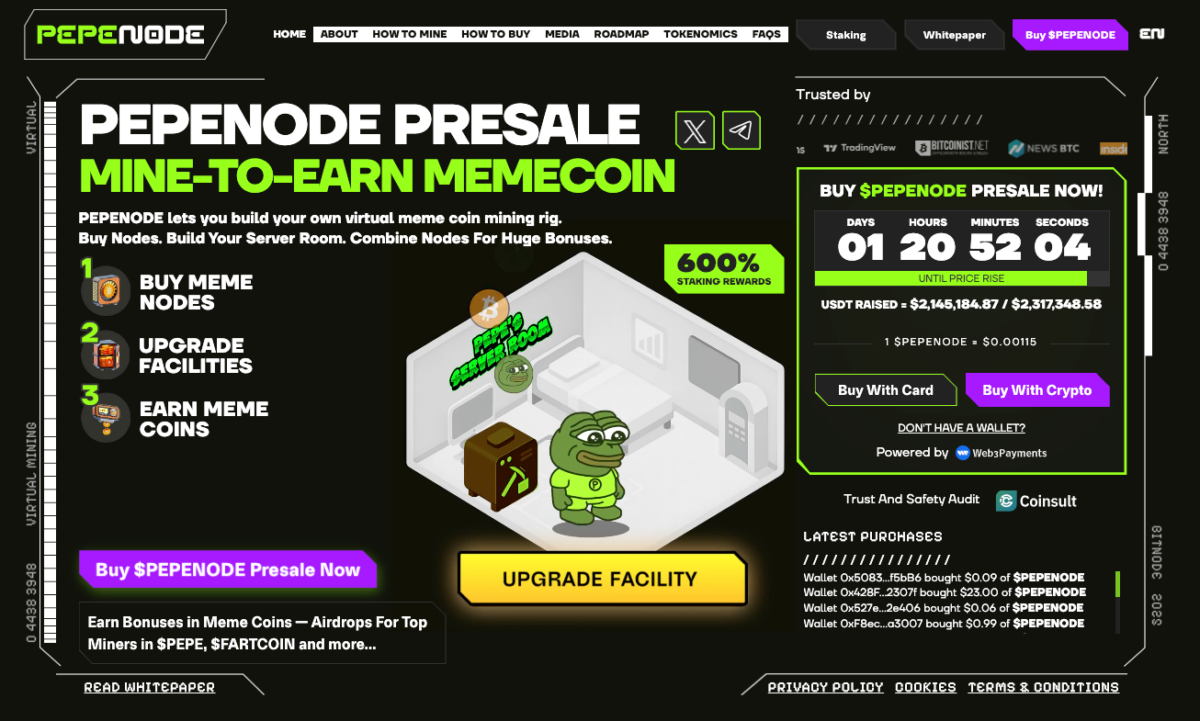
Pepe Node allows users to own virtual meme coin mining rigs, combine nodes for higher yields, and earn bonus rewards from network participation.
Pepe Node Presale
Currently priced at $0.0010, the Pepe Node presale has already raised over $2.3 million of its $2.5 million target. Investors can still join through the official Pepe Node website before the next price tier unlocks.
Disclaimer: Coinspeaker is committed to providing unbiased and transparent reporting. This article aims to deliver accurate and timely information but should not be taken as financial or investment advice. Since market conditions can change rapidly, we encourage you to verify information on your own and consult with a professional before making any decisions based on this content.
I’m a research analyst with experience supporting Web3 startups and financial organizations through data-driven insights and strategic analysis. My goal is to help organizations make smarter decisions by bridging the gap between traditional finance and blockchain innovation.
With a background in Economics, I bring a solid understanding of market dynamics, financial systems, and the broader economic forces shaping the crypto industry. I’m currently pursuing a Master’s degree in Blockchain and Distributed Ledger Technologies at the University of Malta, where I’m expanding my expertise in decentralized systems, smart contracts, and real-world blockchain applications.
I’m especially interested in project evaluation, tokenomics, and ecosystem growth strategies, as these are areas where innovation can drive lasting impact. By combining my academic foundation with hands-on experience, I aim to provide meaningful insights that add value to both the financial and blockchain sectors.