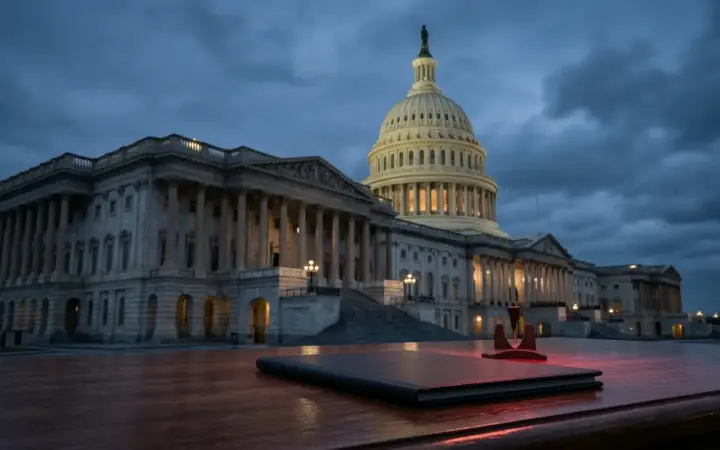
The Blockchain Association, a Washington-based crypto industry trade group is in the news as it convened an online town hall on Thursday to advocate for the Digital Asset Market Clarity Act, the Senate crypto bill commonly referred to as the Crypto Clarity Act, placing particular emphasis on the legislation’s illicit-finance provisions as the bill’s sponsors contend with fewer than eight weeks of Senate floor time before the chamber breaks for summer recess and the midterm elections cycle begins in earnest.
Senator Cynthia Lummis, Republican of Wyoming and chair of the Senate Banking Committee’s digital assets subcommittee, appeared at the event alongside Patrick Witt, the White House’s chief adviser on crypto, to press the case that the bill’s bad actor provision framework is both operationally rigorous and legislatively necessary, describing the current version, recently advanced by the Senate Banking Committee, as “the most highly negotiated bipartisan, or nonpartisan, sophisticated piece of a regulatory framework for digital assets that’s ever been presented to the public in this country.”
Missed today's Tele-Town Hall?
Watch the replay featuring remarks from @SenLummis, @GOPMajorityWhip, and @patrickjwitt, along with a discussion on the Clarity Act's law enforcement and national security provisions.
A special thank you to former FinCEN Acting Director @m_mosier_…
— Blockchain Association (@BlockchainAssn) June 4, 2026
This is not simply a lobbying event timed to a slow news cycle. It is an inflection point in a multi-year legislative effort in which the precise contours of a bad actor disqualification framework will determine which firms are permitted to operate inside a new federally licensed ecosystem, and which are structurally excluded from it, potentially permanently.
The stakes are sharpened by the arithmetic: the bill requires 60 affirmative votes to clear the Senate filibuster threshold, and Lummis herself has stated publicly that failure this session likely means no reconsideration until 2030.
Clarity Act News: The Bad Actor Provision Architecture, Disqualification Triggers, and the Unresolved Question of Remediation Pathways
It is an old news now that The Digital Asset Market Clarity Act (CLARITY Act) traces its immediate legislative ancestry to the Lummis-Gillibrand framework first introduced in 2022 and substantially revised through 2023, before the House passed its version of the bill on July 17, 2025, largely to resolve a longstanding jurisdictional contest between the Securities and Exchange Commission and the Commodity Futures Trading Commission over which agency holds primary authority over spot digital-asset intermediaries.
The Senate version, now advanced by the Senate Banking Committee under Chairman Tim Scott, retains the House bill’s core architecture, primary CFTC authority over “digital commodities,” SEC retention over digital asset securities, and a “mature blockchain” test that would allow certain networks to migrate into CFTC-only oversight once no single entity controls more than 20% of supply or governance, while adding negotiated language on illicit finance that has become the principal fault line between Democratic and Republican negotiators.
The mechanism functions as follows: the bill embeds bad actor screening requirements at multiple registration and exemption junctures, for exchanges, brokers, dealers, and token issuers, modeled directly on existing securities-law disqualification standards, including certain felony convictions, SEC or CFTC bars, and fraud judgments.
Commentators tracking the section-by-section summary produced by the Senate Banking Committee have noted that these hooks could effectively lock out firms carrying major prior enforcement settlements or injunctions from accessing specific exemption regimes, absent a legislatively defined remediation pathway.
Photo: Senator Lummis
Senator Lummis, in remarks at Thursday’s event, emphasized one specific provision: the bill “allows law enforcement to prosecute bad actors who publish code with the specific intent, and that’s the key, with the specific intent that their code be used to facilitate money laundering,” a formulation designed to protect open-source developers while still enabling prosecution of infrastructure deliberately constructed for illicit purposes.
The most commercially consequential question the current text leaves partially unresolved is whether prior enforcement settlements, the kind entered into by major exchanges like Binance, which reached a landmark $4.3 billion agreement with the U.S. Department of Justice in 2023, constitute a permanent disqualification from specific licensing regimes or merely a rebuttable presumption that can be overcome through demonstrated management overhaul, compliance monitor installation, and regulatory attestation.
Industry lobbyists have pushed aggressively for the latter construction, arguing that a hard permanent bar would reward offshore competitors and effectively foreclose the U.S. market for any firm that had the misfortune of operating during the pre-regulatory period now being legislated away.
The absence of FTX, whose collapse in 2022 provided the emotional and political impetus for accelerated crypto regulation, as an operational entity means the bill’s bad actor provisions now function less as a response to a specific ongoing threat and more as a structural screen against future analogs to that collapse.
Disclaimer: Coinspeaker is committed to providing unbiased and transparent reporting. This article aims to deliver accurate and timely information but should not be taken as financial or investment advice. Since market conditions can change rapidly, we encourage you to verify information on your own and consult with a professional before making any decisions based on this content.
Daniel Frances is a technical writer and Web3 educator specializing in macroeconomics and DeFi mechanics. A crypto native since 2017, Daniel leverages his background in on-chain analytics to author evidence-based reports and deep-dive guides. He holds certifications from The Blockchain Council, and is dedicated to providing "information gain" that cuts through market hype to find real-world blockchain utility.